


- Sustainable Procurement Cost Reduction and Savings Strategies - September 4, 2026
- Single-Source and Sole-Source Procurement Compared - September 4, 2026
- Procurement Benchmarks and Performance Standards - September 4, 2026
Category management manages a family of related spend as a continuing business portfolio rather than a series of isolated bids. It connects demand, stakeholder outcomes, supply-market conditions, sourcing, implementation, and benefits tracking.
How should category boundaries, demand profiles, and value hypotheses be defined before category planning?
In practical terms, category boundary sets the operating boundary, demand profile identifies what the organization is trying to protect or improve, and market insight provides the facts needed to test the opportunity. Value hypothesis should not be calculated or classified until the population, period, currency or unit, exclusions, and decision owner are explicit.
Decision boundary
- Category management: For category management in the definition, preserve the searched population, comparable requirement, response date, exclusions, alternatives, and supported decision. The retained search and response records make the category management assessment in this definition independently reviewable.
- How categories are formed: For how categories are formed in the definition, preserve the searched population, comparable requirement, response date, exclusions, alternatives, and supported decision. The retained search and response records make the how categories are formed assessment in this definition independently reviewable.
- The framework to spend visibility: Use the framework to spend visibility to define the boundary and decision consequence; retain the dated source and explain why the evidence is sufficient.
- Market intelligence: For market intelligence in the definition, preserve the searched population, comparable requirement, response date, exclusions, alternatives, and supported decision. The retained search and response records make the market intelligence assessment in this definition independently reviewable.
- Risk: In practice, assess risk in the definition with a plausible disruption scenario, exposure, mitigation, residual risk, trigger, and contingency owner. A color rating alone is not enough to authorize a definition decision involving risk.
Evidence and application
A practical application makes the boundary visible. An organization combines fragmented maintenance purchases into a category profile, segments recurring and urgent demand, maps suppliers and risks, sets a strategy, runs focused sourcing events, and reviews results quarterly. The decision file should distinguish observed facts from accepted assumptions, preserve rejected alternatives, and name the evidence that would reopen the decision about opportunity pipeline.
The main failure is a decision built on the wrong population or evidence, not a shortage of terminology. A category plan becomes shelfware when its opportunity pipeline lacks owners, dates, evidence, or implementation capacity. A reviewer should be able to trace category boundary to opportunity pipeline, identify the accountable owner, and see how the expected result will be verified after implementation.
Documentation can remain proportionate to category boundary. Low-value and reversible demand profile work may use a lighter record, whereas material, regulated, safety-critical, or continuity-sensitive work needs deeper validation. Either treatment of demand profile must be justified by evidence that fits the actual conditions of this decision.
How do the 5i, seven-step, and eight-step category management models align and diverge?
The operating sequence converts category boundary into review cadence through explicit handoffs. At each demand profile stage, the record needs an input, responsible role, acceptance test, and usable output; an activity list without those four items is uncontrolled.
Operating sequence
1 — Category boundary. For category boundary in the workflow, preserve the searched population, comparable requirement, response date, exclusions, alternatives, and supported decision. The retained search and response records make the category boundary assessment in this workflow independently reviewable.
2 — Demand profile. Use demand profile to connect the input to a named output and acceptance gate; retain the dated source and explain why the evidence is sufficient.
3 — Market insight. For market insight in the workflow, preserve the searched population, comparable requirement, response date, exclusions, alternatives, and supported decision. The retained search and response records make the market insight assessment in this workflow independently reviewable.
4 — Value hypothesis. Use value hypothesis to connect the input to a named output and acceptance gate; retain the dated source and explain why the evidence is sufficient.
5 — Opportunity pipeline. Use opportunity pipeline to connect the input to a named output and acceptance gate; retain the dated source and explain why the evidence is sufficient.
6 — Benefit owner. The workflow should assign benefit owner to one accountable owner, identify consulted and informed roles, and define what the receiving role must accept. Documented acceptance for benefit owner prevents an ownership gap in this workflow.
7 — Review cadence. Use review cadence to connect the input to a named output and acceptance gate; retain the dated source and explain why the evidence is sufficient.
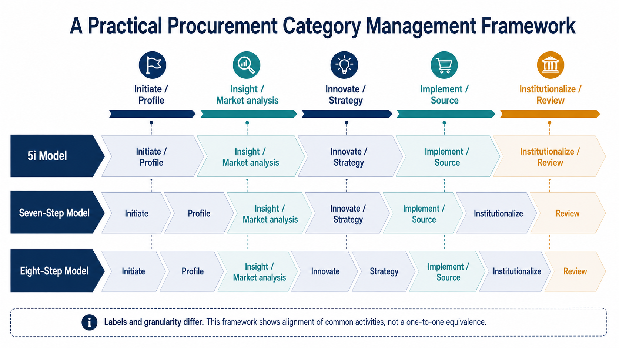
Figure: A Practical Procurement Category Management Framework — evidence, decisions, owners, and outputs across the operating flow.
Handoffs and exceptions
One practical sequence works as follows: An organization combines fragmented maintenance purchases into a category profile, segments recurring and urgent demand, maps suppliers and risks, sets a strategy, runs focused sourcing events, and reviews results quarterly. The sequence stops when evidence for demand profile is incomplete instead of passing ambiguity downstream. Rework tied to market insight is coded to its producing stage, separating capacity constraints from definition, approval, supplier-response, or data-quality defects.
Exceptions need their own route. Urgency around category boundary may compress timing, but it does not erase authority, requirement clarity, commercial comparison, receipt, or post-award evidence. The person accountable for benefit owner defines who can authorize a deviation, which minimum checks remain, and when work returns to the standard path.
Which evidence and deliverables should each category management stage produce?
A usable analytical layer makes market insight, value hypothesis, and opportunity pipeline comparable. Options for value hypothesis must share one population, period, unit, currency basis, inclusion rule, and scenario logic; otherwise even a precise score can support the wrong choice.
Measurement and comparison
- A practical process covering category profiling: For a practical process covering category profiling in the analysis, preserve the searched population, comparable requirement, response date, exclusions, alternatives, and supported decision. The retained search and response records make the practical process covering category profiling assessment independently reviewable.
- Stakeholder needs: The analysis should assign stakeholder needs to one accountable owner, identify consulted and informed roles, and define what the receiving role must accept. Documented acceptance for stakeholder needs prevents an ownership gap.
- Supply-market analysis: For supply-market analysis in the analysis, preserve the searched population, comparable requirement, response date, exclusions, alternatives, and supported decision. The retained search and response records make the supply-market analysis assessment independently reviewable.
- Strategy development: Use strategy development to make the evidence comparable across options; retain the dated source and explain why the evidence is sufficient.
- Sourcing: For sourcing in the analysis, preserve the searched population, comparable requirement, response date, exclusions, alternatives, and supported decision. The retained search and response records make the sourcing assessment independently reviewable.
Sensitivity testing should concentrate on variables capable of changing opportunity pipeline: volume, mix, timing, price, utilization, recovery, risk, or threshold assumptions as applicable. Showing a base case, downside case, and value hypothesis break point reveals whether this choice is robust or depends on one optimistic input.
Interpretation and control
The analytical owner should lock the source version, retain calculation logic, and document overrides. A second reviewer reconciles the output to category boundary and tests whether the criteria for opportunity pipeline were applied as approved. If a small assumption shift changes the result, the recommendation about value hypothesis is conditional rather than certain.
Which KPIs, governance forums, and benefits controls keep a category strategy executable?
Control design begins with the failure that matters: A category plan becomes shelfware when its opportunity pipeline lacks owners, dates, evidence, or implementation capacity. The response should combine prevention near category boundary with detection in workflow, transaction, supplier, invoice, or performance data, and name the owner of correction.
Preventive safeguards
- Category plans: For category plans in the control design, preserve the searched population, comparable requirement, response date, exclusions, alternatives, and supported decision. The retained search and response records make the category plans assessment in this control design independently reviewable.
- Opportunity pipelines: Use opportunity pipelines to pair prevention with an exception and escalation path; retain the dated source and explain why the evidence is sufficient.
- Supplier segmentation: For supplier segmentation in the control design, preserve the searched population, comparable requirement, response date, exclusions, alternatives, and supported decision. The retained search and response records make the supplier segmentation assessment in this control design independently reviewable.
- Risk registers: In practice, assess risk registers in the control design with a plausible disruption scenario, exposure, mitigation, residual risk, trigger, and contingency owner. A color rating alone is not enough to authorize a control design decision involving risk registers.
- Benefits tracking: The control design should set out benefits tracking with a documented baseline, unit, period, inclusions, formula, rounding rule, and sensitivity range. Finance should be able to reproduce the calculation for benefits tracking from the evidence retained for this control design.
Detection and correction
A material opportunity pipeline exception needs four records: observed condition, expected value, authorized disposition, and closure evidence. Trend opportunity pipeline exceptions by root cause instead of treating each as an isolated task. Repeated defects in opportunity pipeline or benefit owner indicate that process, master data, contract, training, or supplier action needs redesign.
Controls over benefit owner must remain proportionate to this decision. Too many benefit owner approvals can push users outside the process, while automatic approval can conceal bad master data. Monitor cycle time with compliance, sample approved and rejected cases, and test whether corrective actions changed review cadence rather than merely closing a ticket.
Decision element | Specific application | Evidence or calculation | Action if weak |
Category plans | Use category plans to determine whether value hypothesis can proceed | Source, date, unit, assumption, and owner for value hypothesis | Correct the input, narrow the scope, or route an exception for value hypothesis |
Opportunity pipelines | Use opportunity pipelines to determine whether opportunity pipeline can proceed | Source, date, unit, assumption, and owner for opportunity pipeline | Correct the input, narrow the scope, or route an exception for opportunity pipeline |
Supplier segmentation | Use supplier segmentation to determine whether benefit owner can proceed | Source, date, unit, assumption, and owner for benefit owner | Correct the input, narrow the scope, or route an exception for benefit owner |
Risk registers | Use risk registers to determine whether review cadence can proceed | Source, date, unit, assumption, and owner for review cadence | Correct the input, narrow the scope, or route an exception for review cadence |
Benefits tracking | Use benefits tracking to determine whether category boundary can proceed | Source, date, unit, assumption, and owner for category boundary | Correct the input, narrow the scope, or route an exception for category boundary |
How can Hubzone Depot's Spotbuy service support tail-spend and non-catalog needs within a category strategy?
For the use case, Hubzone Depot describes SpotBuy as a route for one-off and non-catalog requests: the buyer submits a need, sourcing specialists compare available channels, and the buyer receives an itemized quote with cost and lead-time information. In practice, this discrete sourcing support does not transfer the buyer's policy, competition, approval, contract, funding, receipt, or risk responsibilities tied to opportunity pipeline.
Service fit
- Defined scope: The request evaluated can be bounded using category boundary and a clear completion criterion.
- Comparable evidence: The buyer can compare returned information against market insight on the same unit and time basis.
- Decision authority: An internal owner remains accountable for opportunity pipeline and any exception or award related to this decision.
- Operational follow-through: Receiving, payment, credit, or performance evidence can confirm review cadence after action under the approved approach.
- Proportionate route: The effort matches value, urgency, complexity, regulatory exposure, and reversibility.
Intake and buyer control
An intake package should include a precise item or service requirement, quantity, specifications, acceptable substitutions, delivery location, need date, budget context, approval status, and quote-comparison fields. Resolve missing fields in the intake before comparing quotes or audit findings, because different assumptions about category boundary, service, timing, quantity, or eligibility can make similar-looking results non-comparable.
The next step is to review Hubzone Depot's SpotBuy page and request only the information needed to test the category boundary use case. The buyer documents the evaluation method in advance, retains its own approvals, and confirms implementation or credit evidence before reporting an outcome.
Conclusion: What should procurement teams remember when implementing category management?
The practical conclusion is to connect the original need to an implementable, testable decision. That requires the boundary for category boundary, the evidence behind market insight, the approval criteria for opportunity pipeline, and the owner who will verify review cadence.
Implementation priorities
- Define: In practice, state the population, period, inclusions, exclusions, and authority for category boundary.
- Verify: In practice, reconcile market insight to a dated source and distinguish facts from assumptions.
- Decide: Apply opportunity pipeline consistently and preserve the rejected alternative.
- Implement: Assign benefit owner and specify the required acceptance evidence.
- Review: Measure review cadence after implementation and reopen the decision when a material condition changes.
Choose the model whose language fits the organization, but require the same core evidence: profile, insight, strategy, execution plan, and performance review. The recommendation is strongest when the current requirement, policy or contract, source dates, assumptions, and implementation capacity are verifiable. A material change affecting category boundary, market availability, regulation, carrier rules, supplier capability, or data quality can change the conclusion.
Decision rule and sources
A final review of this decision should not rely on one score. The opportunity pipeline record should explain why the chosen path is acceptable, identify residual risk and its owner, and set the next review date or trigger. The resulting record turns review cadence into evidence for the next decision instead of forcing the organization to reconstruct its reasoning from email.