Accounting for annual software license prepaid expenses

Understanding Prepaid Software License Expenses in Accounting Understanding prepaid expenses

Alibaba Group has come a long way since its inception in 1999 by Jack Ma and his team of co-founders. Initially started as a platform to help small businesses in China, it has evolved into a diversified tech giant with a global presence. The journey from a simple B2B marketplace to a conglomerate that spans multiple industries is nothing short of extraordinary.

Transforming E-Commerce

Alibaba has made significant strides in the e-commerce sector through its various platforms:

  • Taobao: Often described as the “eBay of China,” Taobao allows individuals and small businesses to sell directly to consumers.
  • Tmall: Aimed at more established brands, Tmall offers a premium shopping experience for consumers seeking high-quality goods.
  • AliExpress: This platform enables Chinese merchants to sell products directly to international buyers, making global trade seamless.

These platforms have revolutionized how people shop online, both in China and globally, offering a variety of products ranging from everyday essentials to luxury items.

Beyond E-Commerce

Alibaba’s ambitions go beyond online retail. Key initiatives include:

  • Ant Group: Originally part of Alibaba, Ant Group has developed into a financial services powerhouse with Alipay, one of the world’s largest mobile payment platforms.
  • Alibaba Cloud: Dominating the cloud computing market in Asia, Alibaba Cloud provides scalable computing resources and storage solutions for enterprises of all sizes.

Alibaba Supply Chain

The extensive network of Alibaba offices worldwide facilitates international trade, ensuring smooth operations and connectivity between suppliers and buyers across different regions. These offices play a crucial role in Alibaba’s strategy to be a truly global player in various markets.

For businesses looking to optimize their expenses, implementing effective spend analysis techniques can provide valuable insights into cost-saving strategies.

Moreover, as the world continues to grapple with the COVID-19 pandemic, ensuring workplace safety has become a top priority. Hubzone Depot offers a wide range of safety supplies that can help businesses create a secure environment for their employees and customers.

The Alibaba Group continues to push boundaries, shaping the future of e-commerce and beyond with innovation at its core.

Understanding the Key Components of Alibaba Supply Chain

Comprehensive Definition of the Alibaba Supply Chain

The Alibaba Supply Chain is an intricate network designed to facilitate both digital and physical trade. It spans various stages, from product sourcing and inventory management to order fulfillment and last-mile delivery. This supply chain is not just a logistical marvel but also a technological powerhouse, leveraging cutting-edge data analytics to streamline operations.

Role of Logistics in Alibaba’s Ecosystem

Logistics operations are the backbone of the Alibaba ecosystem. They ensure that transactions within this vast network run smoothly and efficiently. Imagine you’re ordering a bulk supply of Personal Protective Equipment (PPE) from a verified supplier on Alibaba. The logistics arm ensures that these items are picked, packed, and shipped promptly, reducing lead times and enhancing customer satisfaction.

Data-Driven Technologies for Inventory Management

Data-driven technologies play a crucial role in efficient inventory management and order fulfillment on Alibaba’s platforms. Real-time tracking systems, predictive analytics, and AI-powered recommendations help businesses maintain optimal stock levels. For instance, by analyzing purchasing trends during major events like Copa America 2024, businesses can adjust their inventory to meet anticipated demand spikes.

The Dual Role of Alibaba: Empowering Businesses and Enriching Consumer Experiences

Alibaba plays a crucial role in empowering businesses and providing exceptional experiences for consumers. Its ecosystem brings advantages to both merchants and customers, creating a positive cycle of growth. Here’s how:

For Businesses

Alibaba offers a wide range of tools and services specifically designed to support marketing efforts, enhance brand visibility, and expand customer reach. This includes:

  • Marketing Tools: Tailored advertising solutions help businesses target specific audience segments effectively.
  • Enhanced Brand Visibility: Merchants can showcase their products in front of millions by utilizing platforms like Taobao and Tmall.
  • Customer Reach Expansion: Access to Alibaba’s vast network ensures that businesses can tap into new markets globally.

For Consumers

Shopping on Alibaba platforms is more than just convenient; it’s an immersive experience. Here’s what customers can look forward to:

  • Personalized Recommendations: Data-driven algorithms suggest products based on individual preferences, making shopping seamless and enjoyable.
  • Secure Payment Solutions: With options like Alipay, consumers are assured of safe and swift transactions.

This dual approach ensures that while merchants expand their business horizons, customers enjoy a rich, personalized shopping experience.

To further optimize procurement strategies and achieve enhanced spend visibility and cost savings through tail spend management, businesses can refer to this insightful guide on visibility and cost reduction in procurement strategies. Additionally, if you’re looking for a reliable tier 1 woman-owned data center, you might consider exploring this option.

Facilitating Global Trade Through Alibaba: A Boon for Exporters and Importers

Alibaba is a powerful tool for Chinese exporters, helping them expand into international markets through its extensive buyer network. This network links millions of businesses worldwide, creating endless opportunities for trade and collaboration.

Benefits for Exporters in China

Chinese exporters find Alibaba incredibly useful for several reasons:

  • Access to a Global Audience: Alibaba’s platforms such as AliExpress and Alibaba.com enable Chinese exporters to reach customers all over the world, breaking down geographical barriers.
  • Verified Buyer Network: The platform has a large group of verified buyers, ensuring safe transactions and reducing risks associated with international trade.

Opportunities for Companies Worldwide

Businesses around the world also benefit greatly from Alibaba’s system:

  • High-Quality Products: Companies can find a wide range of high-quality products from verified suppliers on Alibaba, ensuring reliability and consistency in their supply chain.
  • Cost-Effective Sourcing: Competitive pricing on Alibaba’s platform allows businesses to improve their procurement processes and lower costs.

For those interested in exploring how Group Purchasing Organizations (GPOs) can further maximize these benefits across different industries, check out the article on “Maximizing GPO Benefits Across Industries”. Additionally, learn more about certification standards that can enhance your business credentials by visiting Certification – Tier 1 HUBZone Certified Woman-Owned Office and Industrial Supplier.

Alibaba’s role in facilitating global trade is undeniable. It provides a strong platform that connects exporters from China to buyers all over the world, promoting growth and efficiency in international commerce.

Key Services Offered by The Alibaba Group to Drive Business Success

1. Online Marketing

Alibaba offers a robust suite of online marketing services designed to help businesses thrive in the digital marketplace. Leveraging these services can significantly enhance brand visibility, target specific audience segments more effectively, and optimize conversion rates.

Targeting Specific Audience Segments

One of the standout features of Alibaba’s online marketing is its advanced targeting capabilities. By utilizing data analytics and machine learning algorithms, businesses can identify and reach their ideal customer profiles. This precision targeting ensures that marketing efforts are not only broad but also deep, effectively speaking to the needs and preferences of potential customers.

Example: A small business selling eco-friendly products can use Alibaba’s marketing tools to target environmentally-conscious consumers across different regions. This targeted approach maximizes the impact of their marketing budget by focusing on those most likely to convert.

Optimizing Conversion Rates

Conversion rate optimization (CRO) is crucial for driving business success, and Alibaba’s platforms offer various tools to aid in this area. From A/B testing of ad creatives to personalized recommendations based on user behavior, Alibaba provides comprehensive support to ensure higher conversion rates.

Example: An online clothing retailer can employ A/B testing on Alibaba’s platform to determine which product images or promotional messages resonate best with their audience. This iterative process helps in fine-tuning marketing strategies for better results.

Practical Applications

  • Sponsored Product Ads: These allow businesses to promote their products directly within search results on Alibaba’s e-commerce sites.
  • Display Advertising: Brands can place visually appealing ads across Alibaba’s extensive network, capturing the attention of millions of users.
  • Search Engine Marketing (SEM): Companies can bid on keywords related to their products or services, ensuring they appear at the top of search results.

Alibaba’s online marketing services create a self-sustaining ecosystem where businesses can continuously adapt and refine their strategies based on real-time data feedback.

2. Cloud Computing

Alibaba Cloud plays a pivotal role in providing scalable computing resources and storage solutions for enterprises of all sizes. Businesses can leverage these services for everything from data storage to complex computational tasks, ensuring operational efficiency and agility.

3. Digital Media and Entertainment

Alibaba’s digital media and entertainment platforms, such as Youku and UC Browser, offer unique advertising avenues. These platforms not only entertain but also provide brands with innovative ways to connect with audiences through engaging content and interactive ads.

4. Logistics Operation

A cornerstone of the Alibaba Supply Chain is its comprehensive logistics operation. From warehousing solutions to last-mile delivery, Alibaba ensures that products are moved efficiently from suppliers to customers globally.

2. Cloud Computing

Alibaba Cloud, often known as Aliyun, plays an essential role in providing scalable computing resources and storage solutions for enterprises of all sizes. Businesses rely heavily on robust technology infrastructure to support their operations, and Alibaba Cloud offers a range of services that cater to these needs.

Key Features of Alibaba Cloud:

  • Scalability: Whether you’re a startup or a multinational corporation, Alibaba Cloud scales with your business. Need more storage during peak seasons? Alibaba Cloud adjusts seamlessly.
  • Security: Advanced security measures ensure your data remains protected. From encryption to regular security updates, Alibaba Cloud prioritizes safeguarding your information.
  • Global Reach: With data centers strategically located worldwide, businesses can host their services closer to their customer base, reducing latency and improving user experience.

Example: Imagine running an e-commerce site that experiences high traffic during holiday sales. With Alibaba Cloud’s auto-scaling feature, your site can handle the surge without crashing, ensuring customers have a smooth shopping experience.

While the benefits of cloud computing are evident with Alibaba Cloud, it’s crucial to understand the broader landscape and explore other options as well. Hyperscale cloud providers offer unique advantages that may align better with specific business strategies.

To make informed decisions about cloud investment and avoid common workplace purchasing errors, tapping into industry expertise is key. Hubzone Depot provides valuable insights on various topics including workplace purchasing errors, helping businesses optimize their cloud investments.

Alibaba Cloud is not just about storage and computing; it encompasses a suite of tools designed to support diverse business needs. By providing reliable and scalable technology infrastructure, Alibaba Cloud empowers organizations to innovate and grow without worrying about the backend complexities.

To delve deeper into cloud computing, it’s worth exploring the benefits, disadvantages, and types available in the market. This comprehensive understanding will enable businesses to craft a robust cloud strategy that aligns with their specific requirements.

3. Digital Media and Entertainment

Alibaba’s digital media and entertainment platforms offer unique advertising avenues that cater to various business needs. Platforms like Youku and UC Browser provide diverse opportunities for companies looking to enhance their marketing strategies.

Youku: The “YouTube of China”

Youku, often dubbed the “YouTube of China,” is a powerhouse in online video content. Businesses can tap into its vast user base for targeted advertising, leveraging both pre-roll ads and sponsored content. This helps brands reach a highly engaged audience, enhancing visibility and driving conversions.

UC Browser: Beyond Browsing

UC Browser goes beyond traditional web browsing by integrating advanced advertising capabilities. With features such as personalized news feeds and interactive ad formats, businesses can deliver more engaging marketing campaigns. This platform ensures that ads are seamlessly integrated into the user experience, making them less intrusive yet highly effective.

These platforms exemplify how Alibaba’s digital media ecosystem supports businesses in crafting impactful marketing campaigns, blending entertainment with strategic advertising. By leveraging these tools, brands can connect with audiences in innovative ways, driving growth and achieving their marketing objectives.

For those navigating procurement challenges or aiming for sustainable growth, exploring diverse marketing opportunities through Alibaba’s digital media channels can be a game-changer.

Expanding your reach through Alibaba’s digital media platforms not only enhances brand visibility but also aligns with modern consumer behaviors, ensuring your message resonates effectively.

4. Logistics Operation

Alibaba’s logistics solutions are crucial for smooth transactions and efficient supply chain management. These comprehensive services include:

  • Warehousing: Alibaba has advanced warehouses strategically located to reduce transit times and improve inventory management. This allows businesses to store goods safely while ensuring quick access for order fulfillment.
  • Shipping: By partnering with top global carriers, Alibaba offers reliable shipping options that meet various business requirements. Whether it’s small packages or large shipments, businesses can enjoy competitive prices and timely deliveries.
  • Customs Clearance: Alibaba’s customs clearance services make it easier to navigate the complexities of international trade. They ensure compliance with relevant regulations, minimizing delays and avoiding potential penalties.

Using these logistics services enables businesses to concentrate on growth strategies without being burdened by the complexities of supply chain operations. Whether you’re a small business or a large company, Alibaba’s logistics capabilities provide scalability and adaptability to fulfill different needs.

To further boost your business success, it’s essential to understand the significance of Supplier Relationship Management (SRM). Implementing effective SRM strategies can unlock tremendous potential and propel your business towards greater achievements.

Learn more about SRM and its importance here.

For deeper insights into optimizing your operations, you can also explore a related article on unlocking SRM benefits:

Unlocking SRM Benefits: Enhance Business Success

Case Studies: Real-World Examples of Businesses Thriving with Alibaba Supply Chain

Exploring real-world examples can provide valuable insights into how businesses leverage the Alibaba Supply Chain to gain a competitive edge. Let’s dive into a few success stories:

1. Tech Gadgets Inc.

Industry: Consumer Electronics

Challenge: Expanding international market reach without compromising on inventory management and shipping efficiency.

Solution: By integrating Alibaba’s logistics solutions, Tech Gadgets Inc. streamlined their supply chain operations, ensuring timely deliveries and reducing warehousing costs. The use of data-driven technologies from Alibaba allowed them to manage inventory with precision, catering to global demand seamlessly.

2. Green Apparel Co.

Industry: Sustainable Fashion

Challenge: Sourcing eco-friendly materials at competitive prices while maintaining ethical standards.

Solution: Utilizing Alibaba’s extensive network of verified suppliers, Green Apparel Co. sourced high-quality, sustainable fabrics from around the world. This not only helped them maintain their brand’s integrity but also optimized production costs and timelines.

3. Smart Home Solutions Ltd.

Industry: Home Automation

Challenge: Navigating customs regulations and ensuring product compliance for multiple countries.

Solution: Leveraging Alibaba’s comprehensive logistics services, including customs clearance support, Smart Home Solutions Ltd. managed to simplify their cross-border trade processes. This enabled them to focus on innovation and customer satisfaction, knowing that logistics were efficiently handled.

These case studies highlight the transformative impact of the Alibaba Supply Chain across different industries, illustrating its potential to drive business success.

For further reading on optimizing supply chains and procurement strategies, you might find these articles on GPO and MRO insightful.

By learning from these examples, businesses can better understand how to harness the power of Alibaba’s ecosystem to achieve their goals and navigate the complexities of global trade effectively.

Hubzone Depot: Empowering Small Businesses Through Alibaba Supply Chain Solutions

Hubzone Depot, a certified HUBZone small business, has successfully used Alibaba’s supply chain expertise to fulfill customer orders quickly and efficiently. By combining Alibaba’s strong logistics and procurement capabilities, Hubzone Depot ensures on-time delivery and excellent service for its clients.

Working Together with Suppliers

One of the key ways that Hubzone Depot operates is by collaborating with vendors through Group Purchasing Organizations (GPOs). This approach allows them to:

  • Achieve Cost Savings: By pooling resources and purchasing power, Hubzone Depot can negotiate better prices and terms from suppliers.
  • Increase Bargaining Power: The collective strength of GPOs enhances their negotiating leverage, leading to more favorable deals.

Leveraging the Alibaba Supply Chain

Hubzone Depot takes advantage of the Alibaba Supply Chain, which gives them access to a wide network of suppliers and advanced data-driven technologies for efficient inventory management. This combination not only makes their operations smoother but also helps them stay competitive in the market.

“By working closely with our suppliers through GPOs and utilizing Alibaba’s powerful supply chain tools, we’ve been able to offer top-notch products at competitive prices.” – John Davis, CEO of Hubzone Depot

For more insights on their strategic approaches, check out the Tail Spend Management Archives on their website. These archives provide valuable information on reducing costs through effective procurement strategies.

Additionally, you can explore how Hubzone Depot further reduces costs through their Tier One Woman-Owned Office MRO Supplier services. These services, offered by a Tier 1 HUBZone Certified Woman-Owned Office and Industrial Supplier, not only provide unbeatable pricing but also come with dedicated customer support.

By using Alibaba’s supply chain capabilities and implementing innovative strategies like the ones mentioned above, Hubzone Depot shows how small businesses can succeed in a competitive market while staying cost-effective and efficient.

Embrace the Power of Alibaba Supply Chain for Business Growth

Tapping into the Alibaba supply chain offers numerous advantages for businesses of all sizes. Companies like Hubzone Depot, a certified HUBZone small business, have seen firsthand the transformative benefits of leveraging Alibaba’s extensive network. Let’s break down some key benefits:

1. Access to a Vast Supplier Network

Alibaba connects businesses with millions of suppliers worldwide, offering a diverse range of products and materials. This extensive network ensures that companies can find exactly what they need, often at competitive prices.

2. Streamlined Procurement Processes

The platform simplifies procurement by providing tools that facilitate easy ordering, payment, and tracking. Businesses can manage their supply chain more efficiently, reducing lead times and operational costs.

3. Data-Driven Decision Making

Alibaba employs advanced data analytics to help businesses make informed decisions about inventory management and order fulfillment. This results in optimized stock levels and minimized wastage.

4. Competitive Edge in the Digital Era

Staying competitive today means embracing innovative solutions. The Alibaba Group leads in offering state-of-the-art digital tools and services that help businesses stay ahead of the curve.

Hubzone Depot exemplifies how integrating with Alibaba’s supply chain can yield significant efficiencies and cost savings. For instance, their approach to collaborating with vendors through Group Purchasing Organizations (GPOs) not only enhances bargaining power but also ensures they source high-quality products reliably.

For those looking to explore similar benefits, understanding how digital innovation drives these processes is crucial. Embracing platforms that provide robust supply chain solutions can be a game-changer for your business growth.

To illustrate this further, consider how efficient procurement strategies on platforms like Alibaba can provide access to breakroom supplies, streamlining your operations while ensuring cost-effectiveness.

Contact Hubzone Depot for Your Supply Chain Needs

Making it easy to do business

Connecting with Hubzone Depot is a breeze. Whether you’re a small business or a large enterprise, we are here to simplify your supply chain management. Just reach out, and we’ll handle the rest.

Who We Are

Hubzone Depot LLC is a certified HUBZone small business and Women’s Business Enterprise (WBE). Founded by Jessica S. Presco, our mission is to be your Tier 1 supplier for office and industrial needs, delivering best-in-class service and integrity.

What We Do

We specialize in providing high-quality supplies and services to public sector clients using public funds. Our collaboration with vendors through Group Purchasing Organizations (GPO) ensures you get the best deals without long-term contracts or purchase minimums.

Resources

  • Transparent Reporting: Our four-stage method guarantees value and time savings.
  • Ongoing Account Management: Benchmarking against purchasing trends ensures optimal performance.
  • Exclusive Discounts: Save millions with our personalized support and bulk buying power.

Let’s Connect

Ready to streamline your supply chain? Contact Hubzone Depot today to leverage the Alibaba Supply Chain and take your business operations to the next level.

Contact us at (609) 333-2200 or visit us at Hubzone Depot.

FAQs (Frequently Asked Questions)

What is the Alibaba Supply Chain?

The Alibaba Supply Chain encompasses both digital and physical aspects of trade facilitation, enabling businesses to connect and transact seamlessly on a global scale.

How has Alibaba transformed the e-commerce landscape?

Alibaba has revolutionized e-commerce in China and globally through platforms such as Taobao, Tmall, and AliExpress, creating new opportunities for businesses and consumers alike.

What are the key initiatives beyond e-commerce by Alibaba?

Alibaba has extended its reach into financial services through Ant Group’s ecosystem and established dominance in cloud computing with Alibaba Cloud, showcasing its diversified tech capabilities.

How does Alibaba benefit both merchants/sellers and individual customers?

Alibaba’s ecosystem supports merchants with marketing tools and services while providing consumers with a seamless shopping experience, creating a mutually beneficial cycle of growth.

How does Alibaba facilitate global trade?

Alibaba serves as a gateway for Chinese exporters to access international markets while offering companies worldwide the opportunity to source high-quality products from verified suppliers on its platforms.

What are the key services offered by The Alibaba Group?

The key services include online marketing, cloud computing, digital media, entertainment, and logistics operation, catering to different aspects of companies’ growth strategies.

Alibaba Supply Chain Explained

Alibaba Group has come a long way since its inception

Introduction

E-procurement is the digital transformation of procurement processes, streamlining purchasing activities through online platforms. In today’s fast-paced business environment, e-procurement enhances efficiency, reduces costs, and improves supplier relationships.

In the steel industry, effective supply chain management is crucial due to:

  • High competition
  • Fluctuating prices
  • Global sourcing challenges

Tata Steel stands out as a leading player, committed to leveraging innovative technologies to enhance their operations. Their proactive approach to adopting e-procurement solutions sets them apart in optimizing their supply chain management. By embracing these strategies, Tata Steel is not just keeping pace with industry trends but also revolutionizing how procurement is conducted within their organization.

One of the critical areas where Tata Steel can further improve its procurement process is in tail spend management. This involves managing the small, low-value purchases that often go unnoticed but collectively represent a significant portion of overall spend. By implementing effective tail spend management strategies, Tata Steel can unlock substantial savings and improve operational efficiency.

Moreover, as part of their e-procurement strategy, Tata Steel could also explore effective sourcing strategies for hiring top talent. These strategies can help the company attract and retain skilled professionals who are essential for driving innovation and maintaining competitiveness in the steel industry.

Additionally, while focusing on procurement for operational needs, it’s equally important for Tata Steel to consider maximizing federal grant funding for nonprofits if they engage in any corporate social responsibility initiatives. Understanding how to effectively source and utilize these funds can lead to significant benefits for both the company and the communities it serves.

Lastly, improving employee satisfaction should also be a priority. A simple yet effective way to boost employee morale is by ensuring that they have access to adequate break room supplies. This is a small but impactful aspect of procurement that can lead to improved employee productivity and satisfaction.

The E-Procurement Revolution: A Game Changer for Tata Steel

E-procurement has dramatically transformed traditional procurement practices, reshaping how companies like Tata Steel manage their supply chains. This digital transformation marks a shift from manual processes to automated systems that streamline procurement activities.

Key Benefits of E-Procurement for Tata Steel

Tata Steel’s experience with e-procurement illustrates several compelling benefits:

  • Improved Efficiency: Automated workflows reduce time-consuming tasks. This allows procurement teams to focus on strategic decision-making rather than administrative duties.
  • Cost Savings: By leveraging e-procurement platforms, Tata Steel can negotiate better pricing with suppliers through bulk purchasing and competitive bidding. Cost transparency also helps identify savings opportunities.
  • Enhanced Supplier Collaboration: E-procurement fosters stronger relationships with suppliers by providing real-time communication channels. This collaboration leads to a better understanding and alignment on project goals, which is a key aspect of effective supplier relationship management.
  • Increased Visibility: With centralized data management, Tata Steel gains insights into spending patterns and supplier performance. Enhanced visibility facilitates informed decision-making.

Real Examples of Procurement Innovation

Tata Steel’s implementation of e-procurement strategies showcases how proactive technology adoption revolutionizes supply chain operations:

  • Supplier Portals: By using dedicated supplier portals, Tata Steel engages with vendors more efficiently, enabling quicker order placements and status updates.
  • Automated Approval Processes: Streamlined approval workflows minimize delays in procurement cycles, ensuring timely access to essential materials.

This evolution in procurement practices signifies a broader trend within the steel industry toward embracing technology. As companies adopt innovative solutions, they position themselves to remain competitive in a rapidly changing marketplace. The integration of digital tools not only enhances operational effectiveness but also sets the stage for ongoing advancements in supply chain management.

However, it’s important to note that such transitions are not without challenges. Companies must be prepared to build resilience for tough times and navigate through potential setbacks. Additionally, as we move towards the future of procurement, it’s crucial to debunk myths surrounding Group Purchasing Organizations (GPOs) and understand their role in maximizing efficiency.

Moreover, as part of the e-procurement journey, companies like Tata Steel must also focus on maximizing supplier performance to ensure quality and reliability in their supply chain processes.

Unleashing the Power of Technology: Key Components of E-Procurement Systems

E-procurement systems are transforming the way organizations manage purchasing activities. At the heart of these systems are essential components that drive efficiency and innovation. Key elements include:

1. Automated Procurement Processes

Automation streamlines procurement tasks, reducing manual errors and speeding up operations. This efficiency allows teams to focus on strategic initiatives rather than repetitive administrative work.

2. Digital Tools for Sourcing and Negotiation

Modern e-procurement platforms leverage advanced digital tools to enhance sourcing strategies and negotiation tactics. These tools facilitate real-time communication with suppliers, enabling better decision-making and quicker responses to market changes.

Tata Steel exemplifies how technology can revolutionize procurement practices. They have adopted several cutting-edge technologies, including:

1. Supplier Relationship Management (SRM) Software

This tool fosters stronger collaboration with suppliers through shared insights and performance tracking. It enhances transparency and builds trust in supplier partnerships.

2. E-Sourcing Tools

Tata Steel utilizes these platforms to conduct online auctions and tenders, ensuring competitive pricing while reducing time spent on vendor selection.

3. Data Analytics

By analyzing procurement data, Tata Steel gains valuable insights into spending patterns, supplier performance, and market trends. This data-driven approach enables proactive procurement strategies.

These technological advancements not only optimize procurement processes but also position Tata Steel as a leader in supply chain innovation within the steel industry.

In the broader context of e-procurement, it’s important to understand the distinction between strategic sourcing and category management, as both play crucial roles in enhancing procurement effectiveness. The journey of Frank Corris, a master in procurement, illustrates how continuous learning and strategic thinking can drive success in this field.

Moreover, businesses often face challenges when working with limited resources. However, by embracing constraints and optimizing processes, it’s possible to thrive even in such situations. Understanding the difference between purchasing groups and group purchasing organizations can also provide valuable insights for organizations looking to streamline their purchasing processes.

Finally, staying updated with the latest trends is vital for maintaining a competitive edge. For instance, being aware of the top trends in supplier innovation can help businesses adapt their strategies effectively.

A Seamless Transition: Tata Steel’s Journey Towards Centralized E-Procurement Portal

Implementing a centralized e-procurement portal is no small feat. Tata Steel embraced this challenge with a well-structured approach, which can be outlined in key steps:

1. Needs Assessment

  • Identifying gaps in the existing procurement processes.
  • Engaging stakeholders to understand their requirements.

2. System Selection

  • Evaluating various e-procurement platforms.
  • Choosing a solution that aligns with organizational goals and user needs.

3. Pilot Testing

  • Launching a pilot phase to test the system’s functionality.
  • Gathering feedback from initial users to make necessary adjustments.

4. Full-Scale Implementation

  • Rolling out the portal across all departments.
  • Ensuring compatibility with existing systems to facilitate smooth integration.

5. Training and Support

  • Providing comprehensive training sessions for employees.
  • Establishing support channels for ongoing assistance.

Throughout this journey, Tata Steel faced several implementation challenges:

  • Resistance from employees accustomed to traditional methods.
  • Technical issues during the initial roll-out phase.
  • Ensuring supplier compliance with the new system.

To address these hurdles, Tata Steel recognized the importance of effective change management strategies. Key elements included:

  • Communication: Keeping all stakeholders informed about changes and benefits of the new system.
  • Engagement: Involving team members in the transition process, making them feel part of the change.
  • Feedback Loops: Creating mechanisms for ongoing feedback helped refine processes and build trust among users.

These strategies played an essential role in fostering a culture of adaptability and acceptance within Tata Steel. By prioritizing change management, they transformed potential roadblocks into stepping stones towards success in their e-procurement journey.

Moreover, this transition has also paved the way for optimizing supplier management, a crucial aspect for business success. The lessons learned through this experience contribute significantly to enhancing procurement practices within Tata Steel’s supply chain management framework.

One important aspect of this journey was ensuring contract compliance with best practices for procurement, which is vital for maintaining supplier relationships and achieving contract compliance.

Additionally, understanding indirect spend is crucial as it often constitutes a significant portion of a company’s overall spending. This knowledge about indirect spend has been instrumental in refining Tata Steel’s procurement strategy.

For any inquiries or further information regarding this transformative journey, feel free to contact us.

Driving Supply Chain Excellence through E-Procurement: Lessons Learned from Tata Steel

Tata Steel has harnessed the power of e-procurement to elevate its supply chain management. This strategic shift has transformed how they interact with suppliers, leading to optimized relationships and enhanced visibility across the supply chain.

Key Strategies in Supplier Relationship Management:

1. Collaborative Platforms

By utilizing e-procurement systems, Tata Steel fosters collaboration with suppliers. These platforms allow real-time communication, ensuring that both parties are aligned on expectations, timelines, and deliverables. This importance of transparent supplier communication cannot be overstated as it builds trust and drives business growth.

2. Performance Metrics

Tata Steel tracks supplier performance through comprehensive analytics. This data-driven approach allows for timely feedback and adjustments, driving continuous improvement in supplier relationships.

Real-Time Data Sharing for Visibility:

1. Proactive Decision-Making

Real-time data sharing is crucial in today’s fast-paced market. Tata Steel employs advanced analytics to monitor inventory levels, demand forecasts, and supplier capabilities. This information empowers teams to make informed decisions swiftly.

2. Visibility Across the Supply Chain

With e-procurement tools in place, all stakeholders can access pertinent data at any time. This transparency not only enhances trust but also enables quicker response times to potential disruptions.

By leveraging these strategies, Tata Steel has positioned itself as a leader in supply chain excellence. The integration of e-procurement practices facilitates a seamless flow of information and collaboration, ultimately driving efficiency and effectiveness throughout their operations. Moreover, adopting concepts such as frugal living can further optimize cost savings in their daily operations.

Mitigating Risks and Ensuring Compliance: The Role of E-Procurement in Tata Steel’s Procurement Strategy

Tata Steel places a strong emphasis on regulatory adherence in procurement processes. Their e-procurement solutions play a crucial role in ensuring compliance with both internal policies and external regulations.

Key aspects include:

  • Automated Compliance Checks: E-procurement systems automatically verify that all procurement activities align with established guidelines. This minimizes the risk of non-compliance.
  • Audit Trails: Detailed records of all transactions are maintained, facilitating transparency and accountability. This feature is essential during audits and reviews.
  • Supplier Assessment Tools: By leveraging technology, Tata Steel can assess suppliers against regulatory standards. This ensures that only compliant vendors are engaged.
  • Training and Awareness Initiatives: The company invests in educating its procurement team about compliance requirements, enhancing their ability to navigate complex regulations effectively.

By integrating these elements into their e-procurement strategy, Tata Steel strengthens its commitment to ethical sourcing while mitigating potential risks associated with procurement activities.

To further enhance their procurement strategy, Tata Steel could consider exploring the best procurement software and outsourcing companies which can revolutionize their procurement processes.

Moreover, for organizations operating with limited resources, such as a one-person procurement function, strategic solutions can optimize cost efficiency and supplier management.

It’s also vital for businesses to avoid certain procurement terms that may obscure the value of their procurement processes. Lastly, embracing procurement optimization strategies can lead to significant improvements in overall efficiency and effectiveness.

Towards a Sustainable Future: The Green Initiatives Supported by E-Procurement at Tata Steel

Tata Steel is committed to sustainability, and e-procurement plays a vital role in achieving these goals. By embracing resource optimization through digital procurement, Tata Steel minimizes waste and enhances efficiency across the procurement lifecycle.

Key aspects include:

  • Reduced Paper Usage: Transitioning to digital platforms cuts down on paper consumption, promoting eco-friendly practices.
  • Supplier Collaboration: Engaging with suppliers who prioritize sustainable materials ensures responsible sourcing and lower environmental impact.
  • Data-Driven Decisions: Real-time analytics support informed choices that align with sustainability objectives.

By embedding these practices within their e-procurement strategy, Tata Steel not only meets regulatory requirements but also demonstrates leadership in corporate responsibility. This commitment contributes positively to the steel industry while setting a benchmark for others to follow.

The Road Ahead: Future Trends Shaping E-Procurement in the Steel Industry

The world of e-procurement in the steel industry is about to change significantly. New technologies, such as advanced procurement software solutions, are set to redefine how companies like Tata Steel operate. Here are some key trends to watch:

1. Impact of Industry 4.0

The integration of smart technologies is changing procurement practices. With real-time data analytics, decision-making becomes more efficient, enabling quicker responses to market demands.

2. Role of Artificial Intelligence (AI)

AI is streamlining procurement processes by automating repetitive tasks and analyzing large amounts of data. This includes using predictive analytics to forecast demand and optimize inventory management.

3. Importance of Blockchain Technology

Blockchain technology is enhancing transparency and trust within supply chains. By providing an unchangeable record of transactions, it reduces fraud and ensures compliance with regulations.

4. Rise of Digital Collaboration Tools

These tools are improving communication between suppliers and buyers, leading to better supplier relationships and greater innovation in product offerings.

E-Procurement in Tata Steel exemplifies how embracing these trends can lead to improved operational efficiency and a competitive edge in the market. As the steel industry continues to evolve, staying ahead of these technological advancements will be crucial for success.

Three professionals engaged in a digital procurement meeting, featuring a Caucasian woman, an Asian man, and a Hispanic woman. They are seated arou...

E-Procurement in Tata Steel: Revolutionizing Supply Chain Management

Discover how Tata Steel revolutionizes supply chain management through e-procurement,

What is a vendor sourcing strategy, and why does it matter?

Vendor sourcing definition

A vendor sourcing strategy is a deliberate, structured approach to identifying, evaluating, and selecting external suppliers that support an organization’s procurement goals. It shifts purchasing decisions from reactive and transactional to informed, planned, and value-driven. Rather than sourcing whatever is needed on the spot — and whoever answers the phone first — a strategy establishes a consistent framework for how supplier decisions get made.

The Chartered Institute of Procurement & Supply (CIPS) defines sourcing strategy as capturing decisions that inform and direct all sourcing activity, aligned to organizational goals and market positioning (https://www.cips.org/intelligence-hub/sourcing/strategy). That framing matters. A vendor sourcing strategy isn’t just a procurement template — it’s a deliberate plan for how an organization creates leverage and reduces risk across its entire supplier base.

Business goals that sourcing strategy supports

Vendor sourcing serves several interconnected goals that go well beyond getting a competitive quote:

  • Cost control: Consolidating suppliers and understanding market pricing reduces the risk of overpaying — especially on recurring or high-volume purchases.
  • Resilience: Organizations with a documented sourcing strategy are less exposed when a supplier fails, delivery slips, or a category becomes unpredictable.
  • Compliance and diversity: A structured approach ensures suppliers meet internal standards, certifications, and — for government contractors — supplier diversity requirements.
  • Governance: Consistent criteria reduce the risk of ad hoc supplier choices that create contract gaps, pricing inconsistencies, or accountability blind spots.

Common triggers that turn sourcing reactive into strategic

Most organizations start thinking seriously about a vendor sourcing strategy after a specific pain point surfaces. These triggers include sustained cost increases with no corrective mechanism, repeated delivery failures from a single supplier, pressure to meet diversity spend targets, or an expansion into new categories where internal expertise is limited.

Tail spend is a particularly common trigger. When purchasing volume is spread across hundreds of low-dollar transactions with no formal sourcing process, the administrative cost and compliance risk accumulate quickly. Hubzone Depot’s Spotbuy Program is designed precisely for this scenario — offering a structured sourcing model that handles one-off and hard-to-procure items without requiring procurement teams to build separate supplier relationships for every request.

How does vendor sourcing differ from procurement in day-to-day operations?

Sourcing vs procurement matrix

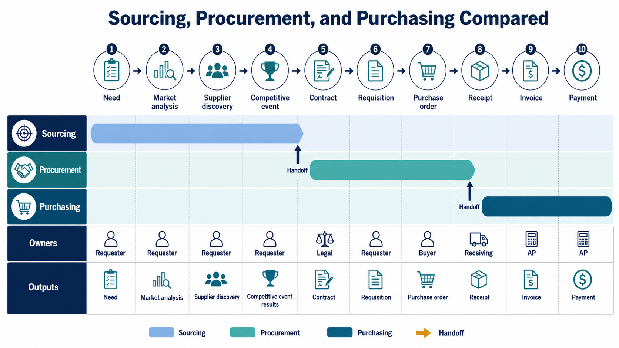
“Sourcing” and “procurement” are often used interchangeably, but they describe different levels of activity. Understanding the difference affects who owns which decisions, what tools are needed, and where responsibility sits.

DimensionVendor SourcingProcurement
FocusSupplier selection and strategyTransaction execution
Time horizonMedium to long termShort to near term
Key activitiesMarket research, RFQ/RFP, supplier evaluationPO creation, invoicing, delivery management
OwnershipCategory managers, procurement leadsBuyers, AP teams, business units
DeliverablePreferred supplier list, contracts, sourcing decisionsFulfilled purchase orders, processed invoices
TriggerCategory need, strategic reviewDemand from internal stakeholders

Sourcing operates upstream. Procurement executes what sourcing has set up. But that distinction breaks down in practice — especially in leaner teams where the same person owns both functions simultaneously.

When they overlap

In mid-sized organizations, sourcing and procurement are often handled by the same team or the same individual. This creates a workload challenge: when procurement activity peaks — month-end, budget season, urgent buys — sourcing planning gets delayed. The result is that sourcing drifts from strategic to reactive, and supplier choices get made based on availability, not value.

A clear ownership model helps. At minimum, sourcing decisions above a certain spend threshold should require documented justification, market comparison, and an approved supplier or RFQ process. Below that threshold, operational procurement can move faster without formal sourcing steps.

Where handoffs fail

The most common failure point is the handoff between sourcing decisions and ongoing procurement management. A sourcing process may identify the right supplier and negotiate competitive terms — but if that decision isn’t converted into a contract, a preferred supplier entry, or buyer-facing guidance, the next person to place an order will start from scratch. Spend data becomes fragmented. Negotiated rates go unused. The sourcing investment doesn’t compound into lasting value.

What makes effective vendor sourcing strategies different from ad hoc buying?

Planning discipline

Ad hoc buying is what happens when demand appears and someone responds to it without a prior framework. It’s fast in the short term and expensive over time. Effective vendor sourcing strategies introduce planning discipline before the buying decision — not after.

This means knowing which categories consume the most spend, which suppliers dominate each category, and what market conditions affect pricing. It also means segmenting supplier relationships: not every vendor warrants the same level of attention, but every vendor decision should be traceable to a deliberate choice.

The CIPS sourcing strategy framework recommends aligning sourcing decisions to organizational market position and using tools like the Kraljic Matrix to determine which supplier relationships should be strategic partnerships versus arm’s-length transactions (https://www.cips.org/intelligence-hub/sourcing/strategy). This segmentation logic is what separates a true strategy from a list of preferred suppliers.

Evaluation criteria and supplier benchmarks

Effective sourcing strategies don’t just identify a supplier — they compare multiple options against consistent criteria. This typically includes:

  • Price and total cost: Unit cost is one factor, but freight, lead times, minimum order quantities, and payment terms all affect the true cost of a supplier relationship.
  • Market intelligence: Understanding what similar organizations pay for the same category gives procurement a defensible baseline for negotiation.
  • Supplier benchmarks: Delivery performance, quality history, responsiveness, and financial stability help distinguish suppliers who look good on paper from those who perform reliably over time.

The difference between an organization that captures these benchmarks and one that doesn’t compounds quickly. Teams with benchmarks renegotiate with evidence. Teams without them renew at whatever rate the supplier proposes.

Approval rules and post-award follow-up

Effective sourcing strategies formalize two things that ad hoc buying typically skips: approval thresholds and post-award accountability. Approval thresholds define which purchases need competitive quotes, which require full RFP processes, and which can be handled via preferred suppliers without further bidding. Post-award follow-up tracks whether the supplier is actually delivering on what was agreed — on time, at the contracted price, meeting service levels.

Both elements reduce the common outcome where a sourcing process produces excellent results on paper but doesn’t survive first contact with operational reality.

Which vendor sourcing models work best for direct, indirect, and tail-spend categories?

Not every category needs the same sourcing model. Applying an enterprise-scale RFP process to a one-off equipment purchase wastes time. Using no formal sourcing process for a $2 million direct spend category creates unacceptable risk. The right model depends on spend volume, supply risk, and category complexity.

Direct spend

Direct spend covers the goods and materials that go into the product or service being delivered. These purchases tend to be high-value, high-frequency, and supply-sensitive. The most effective sourcing models for direct spend are single-source, dual-source, multi-source, and category-based approaches — each with distinct tradeoffs.

ModelBest forTradeoff
Single-sourceSpecialized materials, proprietary componentsHigh concentration risk
Dual-sourceHigh-volume, critical componentsMore relationship management required
Multi-sourceCommodity categories with many suppliersHarder to optimize pricing
Category-basedComplex spending with sub-categoriesRequires dedicated category expertise
Local sourcingTime-sensitive or region-specific needsMay limit competitive options
Global sourcingCost-sensitive categories with deep marketsHigher lead time and freight risk

Indirect spend

Indirect spend includes everything that supports operations without going directly into the product: office supplies, IT services, facilities, logistics, and professional services. Indirect spend often has more supplier options than direct, which means competitive sourcing creates more leverage — but it also means sourcing decisions are more fragmented across business units.

Centralized indirect sourcing, where one team owns the category strategy, consistently outperforms decentralized approaches when spend data is consolidated and category volume justifies the investment. The challenge is organizational: business units often resist giving up purchasing autonomy, even when centralized sourcing demonstrably reduces cost.

Tail spend

Tail spend consists of low-dollar, high-frequency, or one-off purchases that collectively account for a large share of supplier count but a small share of total spend. These are the hardest to manage through traditional sourcing models because the transaction overhead often exceeds the savings opportunity on any individual purchase.

Effective tail spend management typically involves channeling purchases through a preferred distributor or using a managed sourcing model — like Hubzone Depot’s Spotbuy Program — where sourcing specialists handle one-off requests across national and open-market suppliers without the internal overhead of running a full RFQ for each item. The result is faster procurement, competitive pricing, and compliant Tier 1 diversity spend — without adding workload to the internal team.

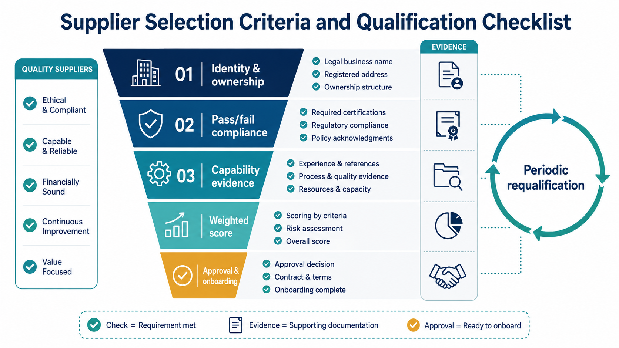
How should businesses define vendor selection criteria before contacting suppliers?

Getting vendor selection criteria right before outreach begins is one of the most overlooked steps in sourcing. Without criteria, every supplier conversation is an open-ended negotiation where the supplier frames the terms. With criteria, the organization maintains control over the process and the outcome.

Must-have vs nice-to-have criteria

Selection criteria should be divided into two groups: mandatory requirements that disqualify a supplier if unmet, and preference factors that influence scoring but don’t eliminate candidates.

CriterionTypeWeight example
On-time delivery rate ≥ 95%Must-havePass/fail
ISO 9001 or relevant certificationMust-havePass/fail
Pricing within 10% of market benchmarkMust-havePass/fail
Capacity to meet required order volumeMust-havePass/fail
Supplier diversity certification (HUBZone, WBENC)Nice-to-have+10 points
Track record with public sector clientsNice-to-have+5 points
Dedicated account managementNice-to-have+5 points

Scoring logic

Once criteria are defined, a weighted scoring model prevents sourcing decisions from drifting based on familiarity or convenience. Assign weights to each factor that reflect actual business priorities — not theoretical ones. A category with strict compliance requirements should weight compliance higher than price. A commodity category dominated by interchangeable goods should weight price and delivery more heavily than relationship depth.

The scoring model doesn’t need to be complex. A ten-point scale across five to eight criteria, multiplied by assigned weights, produces a defensible, repeatable decision framework that takes less time than a consensus discussion and produces more consistent outcomes.

Approval thresholds

Approval thresholds determine when a sourcing decision needs additional review. A $10,000 one-off purchase might be approved by a category manager after two competitive quotes. A $500,000 annual supply agreement likely needs a full RFP, legal review, and executive sign-off. Documenting these thresholds before procurement activity begins prevents inconsistency and protects the organization from audit risk.

For organizations with supplier diversity mandates, selection criteria present the natural place to embed diversity requirements — not as a checkbox, but as a substantive evaluation factor. HUBZone-certified and WBENC-certified suppliers like Hubzone Depot can count toward Tier 1 supplier diversity reporting, which is a measurable procurement outcome, not just a compliance formality.

What steps should a vendor sourcing process follow from intake to award?

A structured vendor sourcing process prevents the most common failure points: unclear requirements, unconsolidated supplier data, and awards that don’t translate into ongoing accountability.

Intake checklist

Every sourcing process begins with a clear request. Intake captures what is needed, in what quantity, by when, to what specification, and under what constraints. Poor intake — vague specs, missing quantities, no delivery context — is the single most common reason sourcing processes run longer than they should. A consistent intake form covers:

  • Item description and technical specification
  • Required quantity and any minimum/maximum thresholds
  • Target delivery date and location
  • Budget or price target (where available)
  • Compliance requirements (certifications, regulations, diversity goals)
  • Stakeholder who owns the decision

Shortlist rules

With requirements confirmed, the next step is identifying potential suppliers. A market scan reviews known and new suppliers against intake criteria, covering national distributors, manufacturers, specialty suppliers, and open-market channels. A viable shortlist typically contains three to five suppliers per category — enough to generate competitive tension without creating evaluation overhead. Suppliers who can’t meet must-have criteria should be excluded at this stage, not after quotes have been collected.

Award memo

The full sourcing process covers intake, market scan, shortlist, RFQ or RFP, evaluation, negotiation, and award. Each stage has a clear owner and a clear output.

StageOutputOwner
IntakeConfirmed requirementStakeholder + Procurement
Market scanSupplier longlistProcurement
Shortlist3–5 qualified suppliersProcurement
RFQ / RFPCompetitive quotes or proposalsSupplier
EvaluationScored comparisonProcurement
NegotiationAgreed termsProcurement + Legal
Award memoDocumented decision with rationaleCategory Manager

The award memo is often skipped but should never be. It protects the organization during audits, supports renewal negotiations, and gives context to successors when team members change. A sourcing decision that exists only in someone’s memory is a governance risk.

When should a team use an RFQ, an RFP, or direct negotiation?

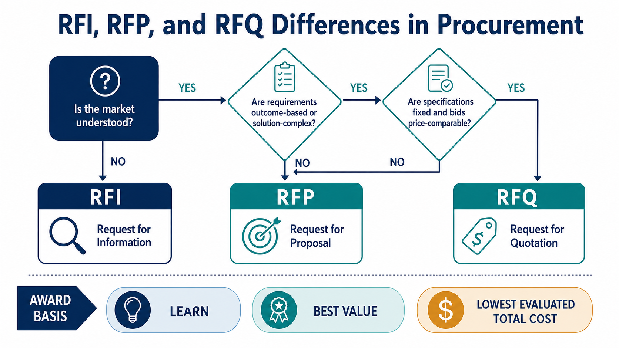
RFQ vs RFP

An RFQ (Request for Quotation) is appropriate when requirements are well-defined and the decision will be driven primarily by price, lead time, and supplier compliance with specifications — the product or service doesn’t need to be designed, it needs to be priced. An RFP (Request for Proposal) is appropriate when the solution isn’t fully specified, when multiple approaches might work, or when service quality, methodology, and long-term capability matter as much as cost.

FactorRFQRFP
Requirements clarityHigh — fully specifiedLower — solution-based
Decision driverPrice + deliveryPrice + quality + methodology
Process timeFast (days to weeks)Slower (weeks to months)
Best forCommodity goods, standard servicesComplex services, custom solutions
OutputCompetitive quotesFull proposals for evaluation

Small one-off buys and urgent requirements

For low-value, non-recurring purchases — which represent the majority of tail spend by transaction count — a full RFQ process is often disproportionate to the purchase value. These situations call for a leaner mechanism: a quick multi-source price comparison or a managed sourcing partner who handles the legwork.

Hubzone Depot’s Spotbuy Program handles exactly this scenario. Instead of running internal RFQs for every one-off or hard-to-procure item, procurement teams submit requests and receive itemized, competitive quotes across national suppliers and open-market channels — fast, transparent, and compliant with Tier 1 diversity reporting requirements. It’s sourcing without the overhead.

Negotiated awards

Direct negotiation — bypassing a formal RFQ or RFP — is appropriate when a supplier holds unique capabilities unavailable elsewhere, when an existing relationship is being renegotiated, or when urgency makes the time cost of a competitive process greater than the risk of accepting current terms. Negotiated awards should still be documented, with clear rationale for bypassing the competitive process. Without documentation, every bypass becomes normalized and the strategy erodes.

What risks should you evaluate before choosing a vendor?

Risk evaluation shouldn’t happen after a vendor is selected — it should be part of the selection criteria. Organizations that treat risk and price as separate decisions end up making sourcing choices they regret under pressure.

Operational risk

Operational risk covers a supplier’s ability to deliver reliably: capacity, lead times, geographic exposure, single points of failure in their own supply chain, and responsiveness to issues. A supplier who matches price but can’t guarantee delivery continuity creates more cost than they save. Before selection, it’s worth asking: Does this supplier have sufficient capacity for our volume? What is their on-time delivery rate? Are they dependent on a single manufacturer or geography? How do they handle order spikes or supply disruptions?

Financial risk

A supplier’s financial stability directly affects procurement continuity. Financially stressed suppliers are more likely to increase prices unexpectedly, reduce service quality, delay fulfillment, or fail entirely. Reviewing financial health before signing a long-term agreement is not excessive caution — it’s basic due diligence. Warning signs include extended payment terms requests, difficulty providing trade references, or unusual pricing variability between quotes.

Compliance risk

Compliance risk varies by category and sector. In regulated industries and government procurement, suppliers must meet specific certifications, security requirements, and legal obligations. NIST SP 800-161r1 — the U.S. government’s supply chain risk management framework — provides a structured approach to identifying compliance and security risks across vendor relationships (https://csrc.nist.gov/pubs/sp/800/161/r1/upd1/final). Even for organizations outside government, the framework’s tiering logic for prioritizing risk by supplier criticality and exposure is directly applicable to commercial procurement programs.

Backup plans

The right question isn’t whether a vendor will fail — it’s how quickly the organization can respond when one does. Backup planning means identifying at least one alternative qualified supplier per critical category before a disruption occurs, not after. Organizations that do this proactively maintain procurement continuity. Those that don’t make expensive emergency sourcing decisions exactly when they can least afford to.

How can supplier diversity strengthen a vendor sourcing strategy?

Supplier diversity is sometimes treated as a separate compliance program — tracked by a different team, reported at year-end, and loosely connected to actual sourcing decisions. That model underperforms. When diversity goals are embedded directly in sourcing criteria and processes, they produce both better supplier variety and more defensible procurement outcomes.

Diversity objectives in sourcing

The U.S. Small Business Administration’s HUBZone Program supports procurement from certified small businesses in historically underutilized business zones, with the explicit goal of stimulating economic activity in underserved communities (https://www.sba.gov/federal-contracting/contracting-assistance-programs/hubzone-program). For federal contractors and SLED organizations, engaging HUBZone-certified suppliers directly supports Tier 1 spend reporting and contract compliance goals.

Setting explicit diversity objectives in a vendor sourcing strategy — rather than reviewing diversity participation retroactively — means procurement teams consider qualified diverse suppliers during the shortlist stage, not after the award decision has already been made.

Reporting

Diversity participation is only measurable if it’s tracked consistently. A sourcing strategy that integrates diversity objectives should include: supplier classification at onboarding (HUBZone, WBENC, MBE, SBE, etc.), spend tracking by diversity category reported at least quarterly, specific targets by category or total spend percentage, and qualification screening that identifies diverse suppliers alongside standard suppliers during market scans.

Qualification screening

One of the most persistent misconceptions about supplier diversity is that it requires accepting lower performance or higher cost. In practice, qualified diverse suppliers compete effectively on price and delivery — especially in categories where relationship-based buying has created incumbent supplier concentration. A properly structured sourcing process surfaces those suppliers rather than filtering them out by default.

Hubzone Depot is a woman-owned, HUBZone-certified Tier 1 supplier. Organizations working with Hubzone Depot count that spend toward both diversity goals and procurement efficiency — without making a tradeoff between the two.

Which KPIs show whether a vendor sourcing strategy is actually working?

Strategy without measurement is planning without accountability. The KPIs that matter for vendor sourcing aren’t activity metrics — they’re outcome metrics that confirm whether the sourcing process is actually producing value.

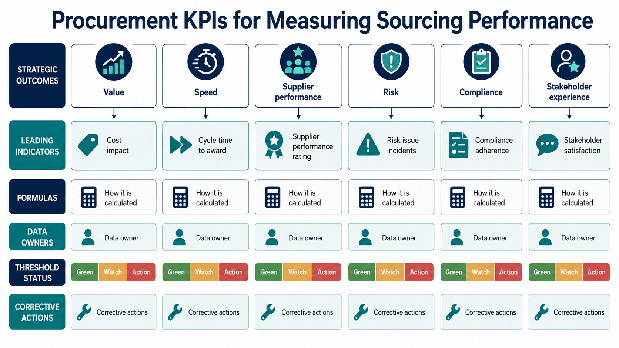
Sourcing KPIs

KPIWhat it measuresTarget
Cycle time (intake to award)Sourcing process speedCategory-specific benchmarks
Quote coverage% of purchases with competitive quotes≥ 80% of addressable spend
Savings vs baselineCost reduction vs prior period or benchmarkCategory-specific
Supplier acceptance rate% of shortlisted suppliers who respond to RFQs≥ 70%
On-time delivery (OTD)% of orders delivered on the agreed date≥ 95%
Issue rate% of orders with quality, delivery, or invoice issues< 5%
Diversity spend %Spend with certified diverse suppliersPer organizational goal

Reporting cadence

A sourcing strategy that’s only reviewed at year-end doesn’t create accountability. High-performing procurement teams review sourcing performance monthly at the category level and present quarterly summaries to senior leadership. This cadence creates early warning signals when a category is trending in the wrong direction — before the cost compounds into a problem that requires a reactive fix.

Executive dashboard

For senior stakeholders, three KPIs carry the most weight: savings vs baseline (is the sourcing strategy reducing cost?), supplier issue rate (are chosen vendors performing as expected?), and diversity spend percentage (is the organization meeting its supplier diversity commitments?). A simple one-page dashboard covering these three metrics communicates more about sourcing effectiveness than a comprehensive operational report that no executive has time to read in full.

What common mistakes weaken vendor sourcing results over time?

Even well-intentioned sourcing strategies degrade when the wrong habits become normalized. These are the most common failure patterns — and how to correct them before they become structural problems.

Avoidable mistakes

Price-only decisions. Selecting vendors based solely on lowest quoted price ignores delivery performance, service reliability, compliance risk, and total cost. A supplier who quotes 8% lower but delivers 20% of orders late doesn’t create savings — they create operational disruption that costs more than the price difference ever would have saved.

Vague specifications. When intake requirements are incomplete, suppliers quote different things. Comparing those quotes produces the illusion of competitive analysis without the substance. Specific, consistent specifications are the foundation of any meaningful RFQ process.

No scorecards. Without ongoing performance tracking, renewal decisions are made on impression rather than evidence. A quarterly summary of delivery performance, issue frequency, and pricing compliance is enough to inform disciplined sourcing decisions — and to support renegotiation when the evidence warrants it.

Weak stakeholder alignment. Procurement can define sourcing criteria, but if business units bypass the process for convenience, the strategy doesn’t hold. Alignment requires clear policies, easy-to-follow processes, and consistent reinforcement from leadership.

No post-award review. The award isn’t the end of the sourcing process — it’s the beginning of supplier management. Organizations that skip post-award reviews lose the ability to enforce what was negotiated and send no signal to the supplier that performance is being monitored.

Recovery moves

When sourcing results are below expectations, the fastest recovery path usually isn’t switching suppliers — it’s fixing the process that led to a poor selection. Reviewing the original selection criteria, confirming that intake requirements were clear, and checking whether performance tracking was in place will identify the root cause faster than an emergency RFQ that risks repeating the same mistakes.

Governance fixes

The governance fixes that prevent these mistakes from recurring include: documented intake requirements, a standard supplier evaluation template, defined approval thresholds, and a quarterly performance review calendar. None of these are complicated to implement — but without a deliberate effort to build them, they don’t emerge organically. Good sourcing governance is built once and maintained continuously, not rebuilt after every failure.

When should a company change or refresh its vendor sourcing strategy?

A sourcing strategy that worked well two years ago may not be right today. Markets shift, supplier landscapes change, and organizational requirements evolve. The best vendor sourcing strategy isn’t a static document — it’s a framework that gets reviewed and updated when conditions warrant it.

Review triggers

Specific events should trigger a sourcing strategy review even between scheduled cycles:

  • Volume growth: When purchasing volume in a category increases significantly, the sourcing model that worked at lower volume may no longer generate competitive leverage.
  • Repeated delivery delays: If the same suppliers are underperforming quarter after quarter, the issue may be structural — wrong sourcing model, wrong supplier set, or weak contract terms.
  • Category expansion: When an organization moves into new product lines, geographies, or service types, the existing supplier base may not cover the new requirements.
  • Supplier exits: When a major supplier exits a category, the strategy needs to adapt quickly — ideally before the disruption, using pre-qualified alternatives.
  • New compliance goals: Regulatory changes, new contract requirements, or updated diversity targets may require revisiting which suppliers qualify and how they are evaluated.

Annual reviews

Even without specific triggers, sourcing strategies benefit from annual structured reviews. These should cover: spend performance vs baseline by category, supplier performance summary, market pricing benchmarks vs current contracted rates, diversity spend participation vs targets, and changes in organizational priorities that affect sourcing. Annual reviews don’t need to be long — a focused half-day with the right data is more productive than a multi-day strategy retreat that produces good slides and no decisions.

Market shifts

When broader market conditions change — commodity price swings, logistics disruptions, geopolitical risks affecting specific supply chains — reactive sourcing is expensive. Organizations with a documented sourcing strategy and pre-qualified backup suppliers can respond quickly. Those without one scramble. The sourcing strategy isn’t just a cost management tool — it’s a resilience asset that delivers its highest return exactly when conditions are most difficult.

How can procurement teams scale vendor sourcing without losing control?

Scaling sourcing doesn’t mean adding more people to do more of the same thing. It means building a sourcing infrastructure that handles higher volume, more categories, and more complexity without a proportional increase in risk or administrative burden.

Governance

The infrastructure of scalable sourcing consists of a small number of reusable tools: intake templates, supplier evaluation scorecards, RFQ/RFP frameworks, and award documentation forms. Teams that create these tools once and apply them consistently get faster and more consistent results as volume increases. Teams that improvise each process from scratch get slower and less consistent. Governance defines who can approve which sourcing decisions, what documentation is required at each stage, and what escalation path applies when a decision falls outside normal parameters. Without governance, scale creates chaos. With it, scale creates compounding leverage.

Templates and preferred supplier lists

Preferred supplier lists (PSLs) are one of the most underused scalability tools in procurement. A PSL identifies pre-qualified, pre-approved suppliers by category who can be used without running a new competitive sourcing process each time. Orders route to PSL suppliers faster, with lower administrative overhead and more predictable quality. Building and maintaining a PSL requires initial investment in supplier qualification — but the efficiency return compounds over time as the list covers more categories and more transaction volume.

Team bandwidth and escalation rules

As sourcing volume grows, the pressure to skip process steps increases. Escalation rules define when it’s acceptable to bypass normal process steps — and what documentation is required when that happens. Without escalation rules, every bypass becomes normalized over months, and the strategy erodes quietly rather than visibly.

For organizations whose internal procurement capacity can’t keep pace with sourcing demand, a managed procurement partner can function as an extension of the internal team. Hubzone Depot operates this way — handling RFQs, supplier comparison, and quote management across categories where the internal team doesn’t have bandwidth or category-specific market access. The result is sourcing capacity that scales with demand, not with headcount.

What should the conclusion include before a new vendor sourcing strategy is rolled out?

Before a vendor sourcing strategy is implemented, confirming that foundational elements are in place and that the rollout sequence is realistic prevents the common outcome of a well-written strategy that sits unused — rather than a working process that changes outcomes.

Vendor Sourcing Strategy Readiness: Summary Table

ElementStatus checkOwner
Spend data by categoryConsolidated and current?Finance / Procurement
Intake process documentedConsistent template in use?Procurement
Supplier evaluation criteria definedWritten and approved?Category Manager
Preferred supplier list startedAt least top 3 categories covered?Procurement
RFQ/RFP templates readyAvailable to the team?Procurement
Approval thresholds documentedSigned off by leadership?Leadership + Procurement
KPI reporting baseline setBenchmarks established?Analytics / Procurement
Diversity goals embeddedTargets defined and tracked?Procurement + Leadership

Expert recommendations

  • Start with the highest-spend categories. A sourcing strategy that tries to cover everything at once usually covers nothing well. Identify the top five categories by spend and build sourcing processes for those first.
  • Fix the intake process early. Vague requirements are the root cause of most sourcing failures. A consistent intake form pays dividends throughout the entire sourcing lifecycle.
  • Document everything. Award decisions, supplier selection rationale, and exception approvals all need to be on record — not for bureaucracy, but to learn from past decisions and defend them when audited.
  • Embed diversity from day one. Supplier diversity goals that are retrofitted into an existing sourcing strategy are harder to achieve than goals built in from the start.

Sources

First 30-day rollout actions

  1. Days 1–5: Pull spend data by category for the prior 12 months. Identify the top 10 categories by total spend and transaction count.
  2. Days 6–10: Review the existing supplier base. Flag suppliers without current contracts, certifications on file, or documented performance history.
  3. Days 11–15: Draft intake template and supplier evaluation scorecard for the top three categories.
  4. Days 16–20: Define approval thresholds and get sign-off from relevant leaders.
  5. Days 21–25: Begin preferred supplier qualification for the top two categories.
  6. Days 26–30: Set KPI baselines and reporting cadence. Schedule the first monthly sourcing review.
Vendor Sourcing Strategy: Definition, Process, and Best Practices

Vendor Sourcing Strategy: Definition, Process, and Best Practices

What is a vendor sourcing strategy, and why does it

What is vendor management in business terms?

Definition and scope

Vendor management in business terms refers to the processes, policies, and activities an organization uses to oversee external supplier relationships across the entire lifecycle — from initial selection and onboarding through performance oversight, contract renewals, and eventual offboarding. It’s not a single department or a software platform. It’s an operating model for how an organization maintains control, visibility, and accountability over the suppliers it relies on.

The Chartered Institute of Procurement & Supply (CIPS) frames supplier oversight as an ongoing governance discipline, not a one-time procurement task (https://www.cips.org/intelligence-hub/sourcing/strategy). That framing matters because it changes the question from “Did we select the right vendor?” to “Are we continuously getting value from the suppliers we’ve selected?”

The vendor lifecycle

Effective vendor management touches every stage of the supplier relationship:

  • Onboarding: Qualifying the supplier, collecting compliance documents, setting up payment terms, and establishing performance baselines.
  • Performance oversight: Tracking delivery, quality, responsiveness, and contract compliance through scorecards and regular reviews.
  • Renewal and renegotiation: Using performance data to inform contract renewals, pricing discussions, and terms improvements.
  • Offboarding: Managing supplier transitions when relationships end — protecting data, ensuring continuity, and closing contract obligations cleanly.

How sourcing and ongoing oversight connect

Vendor management picks up where sourcing leaves off. Sourcing selects the supplier. Vendor management ensures that selection continues to deliver value. Without both, organizations either choose suppliers well but lose control of them — or manage current suppliers well but make poor selection decisions over time. The two functions reinforce each other when they’re connected by shared KPIs, performance records, and consistent governance.

Why is vendor management important for growing companies?

Growth pains that vendor management addresses

Growth creates procurement complexity at a faster rate than most organizations anticipate. New locations require new local suppliers. Expanding product lines create new categories. More revenue means more purchasing volume — and more opportunities for spend to leak into unapproved, unmanaged, or poorly performing supplier relationships.

The core answer to why vendor management is important is this: without it, the costs of poor supplier performance, compliance gaps, and missed savings opportunities scale directly with the business. With it, procurement efficiency improves even as the supplier base expands.

Control gaps that emerge without formal vendor management

In early-stage organizations, informal supplier relationships work — everyone knows the vendors, the owners negotiate directly, and issues get resolved through personal relationships. That model breaks down as teams grow, staff turn over, and the volume of supplier interactions exceeds what any individual can track in their head.

Control gaps that appear without formal vendor management include: suppliers operating under expired contracts, pricing inconsistencies across departments buying from the same vendor, unresolved service failures that never get escalated, and diversity spend that can’t be measured or reported because the data doesn’t exist.

Leadership concerns vendor management resolves

For finance leaders, vendor management creates visibility into committed spend and contract obligations. For operations leaders, it reduces service disruptions by establishing clear performance standards and escalation paths. For compliance and legal teams, it ensures supplier documentation is current, contractual obligations are tracked, and regulatory requirements are met. Vendor management isn’t just a procurement discipline — it’s an organizational risk management tool with direct impact on business performance.

What are the biggest vendor management benefits for operations and finance?

Financial benefits

The financial case for vendor management is built on several compounding benefits. First, organizations with structured vendor oversight are more likely to use the negotiated pricing they’ve already secured — rather than allowing departments to purchase outside preferred suppliers at non-contracted rates. Second, contract expiration tracking prevents costly auto-renewals at outdated terms. Third, performance data supports renegotiation with evidence, replacing the “we’ve always paid this” renewal pattern with a defensible, data-backed conversation.

Benefit areaWithout vendor managementWith vendor management
Spend under contractLow — many purchases off-contractHigh — preferred suppliers used consistently
Renewal processReactive, often auto-renewedProactive, informed by performance data
Issue resolution costHigh — problems discovered lateLower — issues escalated and resolved early
Audit readinessWeak — documentation scatteredStrong — documentation centralized and current

Operational benefits

Operationally, vendor management reduces the frequency and severity of supplier disruptions. Suppliers with active performance monitoring know their performance is being tracked — which creates accountability that informal relationships don’t. Review meetings create a forum for resolving small issues before they become service failures. Escalation paths ensure that problems get to the right people quickly, not after weeks of back-and-forth with a supplier contact who lacks authority to resolve them.

Governance benefits

Governance benefits include: cleaner audit trails for sourcing decisions, contract documentation that’s findable when needed, compliance certifications that are kept current, and diversity spend that can be measured and reported. These benefits aren’t visible day to day, but they become critical during audits, contract disputes, or when leadership needs to demonstrate procurement accountability to boards or regulators.

How does third-party vendor management reduce risk and improve compliance?

Onboarding controls

Third-party vendor management extends the scope of vendor oversight beyond direct suppliers to include subcontractors, technology providers, data processors, and other parties whose performance or failures affect the organization. This expanded scope matters because many significant supply chain risks don’t come from direct suppliers — they come from parties two or three relationships deep.

Onboarding controls for third-party relationships include: due diligence questionnaires covering financial health, compliance certifications, data security practices, and business continuity planning; document collection for required certifications; and contractual terms that establish expectations before the relationship begins.

NIST SP 800-161r1 — the U.S. government’s supply chain risk management publication — provides a structured framework for understanding and managing risks in third-party supplier relationships, which applies to both government contractors and private-sector organizations managing complex supplier ecosystems (https://csrc.nist.gov/pubs/sp/800/161/r1/upd1/final).

Review cadence and escalation paths

Third-party risk doesn’t stay static. A supplier who was financially stable at onboarding may be under stress two years later. A technology provider who met security requirements in one year may have gaps the following year. Regular reviews — annually at minimum for high-risk third parties, more frequently for critical ones — ensure that risk assessments reflect current reality rather than historical snapshots.

Vendor classification

Not all third-party vendors carry the same risk, and treating them uniformly wastes resources. Effective third-party vendor management classifies suppliers by criticality, spend level, data access, and regulatory exposure — then applies review intensity, documentation requirements, and escalation rules that match the actual risk level. Strategic vendors get quarterly reviews. Tactical vendors get annual reviews. Low-risk, low-spend vendors get monitored through KPI dashboards without dedicated review meetings.

What should a vendor management program include from day one?

Minimum viable program

A vendor management program doesn’t need to be comprehensive from the first day — it needs to be functional. The minimum viable version includes four components: a supplier registry with key data fields, a document collection process for compliance and contract files, a performance review schedule for the most critical suppliers, and a named owner for each supplier relationship.

These four elements prevent the most common early failures: suppliers without contracts, compliance documents that are missing or expired, performance issues that never get reviewed, and supplier questions that have no clear internal contact to route to.

ComponentMinimum contentOwner
Supplier registryName, category, contract status, key contactProcurement
Document collectionContract, certifications, insurance, diversity certProcurement + Legal
Performance review scheduleTop 20 suppliers reviewed quarterlyCategory Manager
Relationship ownerNamed internal contact per supplierProcurement / Business Unit

Ownership model

Vendor management programs fail most often not from poor tools or weak processes, but from unclear ownership. Every supplier relationship needs a named internal owner — someone who is accountable for performance, escalation, and renewal decisions. Without ownership, issues accumulate, renewals get missed, and supplier performance degrades unchallenged. The ownership model doesn’t need to be complicated: category managers own strategic suppliers, operational team leads own service vendors, and procurement coordinates the overall registry.

Review schedule

A review schedule defines how often each supplier gets a formal performance discussion. Strategic and high-spend suppliers should be reviewed quarterly. Mid-tier suppliers annually. Low-risk, low-spend vendors can be monitored through dashboards without scheduled meetings. The review schedule shouldn’t be so comprehensive that it creates administrative overhead that no one can sustain — start with the top 20 suppliers by spend and build from there.

Which vendor management basics matter before a process scales?

Basics checklist

Before vendor management scales across a larger supplier base or more complex categories, the basics need to be working reliably. These include supplier segmentation, contract visibility, performance scorecards, communication rules, and change control processes. Organizations that try to add sophisticated vendor management tools onto a foundation that lacks these basics create complexity without capability.

  • Supplier segmentation: Know which suppliers are strategic, which are tactical, and which are commodity-level before designing different oversight levels.
  • Contract visibility: Every active supplier relationship should have a current contract with a known expiration date. Contracts that can’t be found are contracts that can’t be enforced.
  • Scorecards: At minimum, a quarterly delivery and quality performance summary for the top suppliers by spend and criticality.
  • Communication rules: Define who communicates with which suppliers, at what frequency, and through what channel. Informal multi-channel communication creates confusion and version conflicts.
  • Change control: Establish how scope changes, pricing updates, and specification modifications to existing supplier relationships get documented and approved.

Early-stage setup priorities

In the first 90 days of a vendor management program, focus on three things: build the supplier registry, collect missing contract and compliance documents, and run the first round of performance reviews for the top 10 suppliers. Everything else can follow, but these three create the foundation without which scaling is premature.

Minimum controls that scale

The minimum controls that scale without breaking under volume are the ones that are process-based rather than person-dependent. A checklist-based onboarding process scales. An intake form for new supplier requests scales. A quarterly scorecard template scales. An informal process managed by one person’s memory does not scale — it becomes a single point of failure that creates organizational risk when that person leaves.

How do sourcing and vendor management work together after supplier selection?

Sourcing handoff

The sourcing handoff — the point where a newly awarded supplier transitions from procurement management to ongoing relationship management — is one of the most consistently mishandled moments in vendor governance. The sourcing team has context: what was negotiated, why the supplier was selected, what the performance expectations are. The ongoing relationship owner often receives none of that context, starts from scratch, and manages the supplier without the leverage the sourcing process created.

A structured handoff includes: a summary of the sourcing decision and supplier selection rationale, a copy of the signed contract with key terms highlighted, agreed KPIs and baseline performance expectations, and a named relationship owner with defined responsibilities.

Shared KPIs

Sourcing and vendor management work together most effectively when they share KPIs. Sourcing should be evaluated not just on initial savings, but on whether those savings hold over time. Vendor management should be evaluated not just on relationship quality, but on whether the supplier is delivering what sourcing negotiated. Shared KPIs create alignment between the two functions and prevent the common outcome where sourcing claims a saving that vendor management never realizes.

Role clarity after award

After a supplier award, role clarity prevents the most common governance gap: everyone thinking someone else is managing the relationship. The sourcing team’s involvement typically ends at contract signature. The category manager or operational team lead becomes the primary relationship owner. Procurement maintains the contract record and renewal calendar. Legal monitors obligations. Finance tracks invoices against contracted terms. Each role has a defined piece of the supplier relationship — not an overlapping, undefined shared responsibility.

What are the 5 benefits of vendor management that leaders notice first?

Benefit 1: Cost control that actually holds

The most immediate benefit leaders notice is that negotiated pricing starts being used consistently. Without vendor management, different departments often buy from the same supplier at different rates — or bypass preferred suppliers entirely. With a managed program, spend routes through contracted suppliers at contracted rates, and the savings from negotiation show up in actual spend data rather than just theoretical projections.

Benefit 2: Service consistency

Organizations with vendor management programs experience fewer supplier-related service disruptions. Performance standards are set, monitored, and enforced. Suppliers who know their performance is being tracked respond more consistently than those who aren’t. The variance between best-case and worst-case supplier performance decreases — which directly improves operational reliability.

Benefit 3: Faster issue resolution

BenefitWhat changesBusiness impact
Cost controlSpend routes to contracted suppliersRealized savings match negotiated savings
Service consistencyPerformance standards actively enforcedFewer disruptions, lower variance
Issue resolutionEscalation paths defined and followedProblems resolved in days, not weeks
Better forecastingSupplier performance data informs planningSupply chain planning becomes more accurate
Stronger leveragePerformance evidence used in renegotiationBetter terms at renewal

When escalation paths are defined and owned, issues that would otherwise sit unresolved in email chains get routed to someone with authority to fix them. Issue resolution time drops. Operational impact from supplier problems shrinks.

Benefit 4: Better forecasting

Performance data from managed vendor relationships informs planning in ways that ad hoc supplier management can’t. Organizations that track on-time delivery rates, lead time variability, and quality performance can build those patterns into supply chain planning with more accuracy — reducing safety stock requirements, improving order timing, and reducing the cost of emergency sourcing.

Benefit 5: Stronger negotiation leverage

The fifth benefit that leaders notice — especially as programs mature — is the improvement in negotiation outcomes at contract renewal. Evidence-based negotiations, supported by performance scorecards, issue histories, and market benchmarks, consistently produce better terms than renewal conversations based on relationship familiarity alone. The data doesn’t just support the organization’s position — it often reveals that the existing supplier hasn’t earned the pricing they’re requesting.

How can better vendor management improve service levels and accountability?

SLA design

Service Level Agreements (SLAs) define the minimum acceptable performance standard for a supplier relationship. Without SLAs, performance expectations are implied and unenforceable. With them, there’s a documented standard against which performance can be objectively measured, and a contractual basis for escalation when performance falls below it.

Effective SLA design covers: on-time delivery rates, quality and defect thresholds, response time for inquiries and issues, escalation protocols for service failures, and remedies when SLAs are consistently missed. SLAs that are too vague can’t be enforced. SLAs that are too detailed create administrative overhead without proportional benefit. The right level of specificity matches the criticality of the supplier relationship.

Scorecards

Supplier scorecards translate SLA performance into a format that’s useful for reviews, renegotiations, and internal reporting. A well-designed scorecard covers four or five key metrics — delivery, quality, responsiveness, pricing accuracy, and compliance — scored consistently over time. The trend matters more than any single period. A supplier whose delivery performance is improving is a different risk profile than one whose performance is declining, even if both are currently at 90%.

Quarterly business reviews and escalation management

Quarterly business reviews (QBRs) are the structured forum where scorecard results get discussed with senior supplier contacts. QBRs serve three purposes: reviewing performance against agreed standards, aligning on priorities for the next quarter, and building the relationship depth that makes difficult conversations easier when performance issues arise.

Escalation management ensures that issues identified in scorecards or QBRs translate into corrective action — with owners, timelines, and follow-up checkpoints. Without this step, QBRs become performance theater: issues get acknowledged and forgotten rather than resolved.

Where does vendor-managed inventory fit into a broader vendor strategy?

VMI use cases

Vendor-managed inventory (VMI) is a specific inventory model where the supplier takes responsibility for managing stock levels at the buyer’s location — monitoring consumption, triggering replenishment, and maintaining agreed inventory thresholds. VMI is a subset of vendor management, not a synonym for it. Understanding where it fits prevents confusion between inventory management and the broader discipline of supplier governance.

VMI works best in stable, high-frequency categories where demand patterns are predictable, supplier performance is reliable, and the administrative cost of managing replenishment manually outweighs the cost of giving the supplier visibility into inventory data. Common applications include MRO (maintenance, repair, and operations) supplies, packaging materials, and high-turnover consumables.

Where VMI does not fit

VMI is not appropriate where: demand is highly variable or seasonal, where product specifications change frequently, where supplier trust hasn’t been established through a track record of performance, or where the inventory category carries significant compliance or quality risk. Giving a supplier inventory management authority in these situations creates more risk than it reduces.

Risk tradeoffs

The principal tradeoff in VMI is control for convenience. The supplier gains visibility into consumption data and decision-making authority over replenishment. The buyer gains reduced administrative burden and potentially better stock availability. Managing that tradeoff requires clear SLAs, regular inventory audits, and performance monitoring — the same foundations that support any well-run vendor management program.

Which KPIs help prove vendor management advantages and benefits?

KPI library

KPIWhat it measuresTarget range
On-Time In-Full (OTIF)Delivery completeness and timing≥ 95%
Defect or reject rateQuality performance< 2%
Issue response timeSupplier responsiveness to problemsWithin 24–48 hours
Spend under management% of spend through contracted suppliers≥ 80%
Issue closure timeSpeed of corrective action resolutionWithin agreed SLA window
Contract renewal on time% of contracts renewed before expiration100%
Savings realization rateNegotiated savings vs actual savings captured≥ 90%

Executive reporting

For leadership reporting, the KPIs that matter most are the ones that translate to business outcomes: spend under management (is procurement discipline holding?), OTIF (are suppliers delivering reliably?), and savings realization (are negotiated savings being captured?). These three metrics, trended over time, tell an executive everything they need to know about whether the vendor management program is working.

Supplier scorecards

At the operational level, supplier scorecards should be updated monthly for strategic suppliers and quarterly for the broader supplier base. Scorecards that are updated only at renewal time provide no early warning capability — they describe history without enabling correction. The value of a scorecard is in catching performance degradation before it becomes a service failure, not in documenting failures after they’ve already cost the organization.

What common mistakes stop companies from seeing vendor management benefits?

Mistake patterns

No supplier segmentation. Treating all suppliers the same — with identical review frequency, documentation requirements, and oversight intensity — creates overhead for low-risk suppliers while missing the depth of oversight that high-risk suppliers require. Segmentation is the first step in building a scalable program.

Poor documentation. Vendor management programs that rely on individuals rather than systems are fragile. When the person who manages a key supplier relationship leaves, their knowledge leaves with them. Contract terms get lost. Performance history disappears. Documentation prevents this — and it doesn’t require sophisticated software to work.

No named owner. Supplier relationships without a clear internal owner are supplier relationships that no one is accountable for. Issues escalate to everyone and get resolved by no one. Ownership isn’t a bureaucratic formality — it’s the single most important structural element of a working vendor management program.

Weak follow-up. Performance reviews that produce action lists but no follow-up mechanism are reviews that don’t produce change. Every corrective action needs an owner, a due date, and a follow-up checkpoint — otherwise the review becomes a recurring acknowledgment of the same problems.

Reactive renewals. Organizations that only engage with supplier contracts when they’re about to expire lose all leverage in the renewal process. Proactive renewal management — starting six months before expiration for strategic suppliers — creates time to benchmark alternatives, negotiate improvements, and make a considered decision rather than a rushed one.

Quick fixes

The fastest recovery paths for programs with these weaknesses are: add segmentation by assigning every supplier to a tier (strategic, tactical, commodity), assign a named owner to every active contract, and schedule a review of the ten most critical suppliers in the next 30 days. These three steps don’t require technology, budget approval, or process redesign — they require decisions and follow-through.

Governance improvements

Sustainable governance improvements include: a standard onboarding checklist, a contract expiration calendar with 90- and 180-day alerts, a quarterly scorecard template, and a defined escalation path for supplier performance issues. These are the structural elements that prevent the common mistakes from recurring.

How should businesses build a practical vendor management guide?

Guide outline

A practical vendor management guide isn’t a theory document — it’s a how-to manual that tells the team exactly what to do at each stage of the supplier relationship. The guide should cover: how to onboard a new supplier, what documentation is required, how to conduct a performance review, what escalation paths look like, how renewals are handled, and how suppliers are offboarded.

Each section should include: a description of the process, a checklist of required steps, the owner of each step, and a template or form where relevant. A guide that requires readers to interpret or fill in gaps creates inconsistency. A guide that provides specific, actionable steps creates repeatability.

Ownership and accountability

The guide should assign ownership not just at the process level, but at the decision level. Who approves new suppliers? Who can modify contract terms? Who escalates performance issues above the category manager level? Clear ownership prevents the common failure mode where a process is documented but no one is accountable for following it.

Rollout sequence

Roll out the vendor management guide in stages, not all at once. Start with the highest-spend, highest-risk supplier relationships. Get the onboarding and performance review processes working consistently for those before expanding to the full supplier base. A guide that applies to ten critical suppliers and works reliably creates more value than a guide that nominally covers all suppliers but is followed inconsistently across none of them.

What should the conclusion include before launching or improving a vendor management program?

Summary table: Vendor Management Program Launch Readiness

ElementStatus checkOwner
Supplier registry createdAll active suppliers listed with key data?Procurement
Contracts documentedActive contracts on file with expiration dates?Legal + Procurement
Suppliers segmentedStrategic, tactical, commodity tiers assigned?Category Manager
Relationship owners assignedNamed owner for each critical supplier?Procurement + Business Units
Review schedule setFirst quarterly reviews scheduled for top 20 suppliers?Category Manager
KPI baselines establishedDelivery, quality, and spend benchmarks on record?Analytics / Procurement
Escalation paths definedClear chain from issue to resolution owner?Procurement + Leadership
Diversity spend trackedCertified diverse suppliers identified and tagged?Procurement

Expert recommendations

  • Start with the highest-risk, highest-spend relationships. Don’t try to build a comprehensive program from day one. Focus on the suppliers whose failure would hurt the organization most, and build the program outward from there.
  • Make ownership non-negotiable. Every active supplier relationship must have a named internal owner. No exceptions. This single rule prevents more problems than any other structural element of vendor management.
  • Measure what actually matters. Track KPIs that reflect real business outcomes — delivery performance, cost realization, issue resolution speed — not activity metrics like “number of reviews held.”
  • Connect diversity goals to everyday sourcing decisions. Supplier diversity reporting that’s meaningful requires that diverse suppliers are identified at onboarding and tracked consistently. Hubzone Depot’s HUBZone and WBENC certifications make Tier 1 diversity spend reporting straightforward for organizations whose procurement programs include managed sourcing support.

Sources

Next-step checklist

  1. Week 1: Build or update the supplier registry. Every active supplier on record with contract status and named owner.
  2. Week 2: Collect missing compliance and contract documents for the top 20 suppliers by spend.
  3. Week 3: Run the first performance reviews for the five most critical supplier relationships.
  4. Week 4: Define segmentation tiers and assign every supplier to a tier based on spend, criticality, and risk.
  5. Month 2: Establish KPI baselines and reporting cadence. Set renewal calendar alerts for the next 12 months.
  6. Month 3: Review and document escalation paths. Confirm that every team member who manages a supplier relationship knows what to do when performance issues arise.
Vendor Management Benefits: Why It Matters and How to Build a Practical Program

Vendor Management Benefits: Why It Matters and How to Build a Practical Program

What is vendor management in business terms? Definition and scope

What is a vendor management process template, and when should you use one?

Template purpose

A vendor management process template is a structured document — or set of documents — that defines how an organization manages supplier relationships from initial intake through contract execution, performance oversight, and eventual offboarding. Its purpose is to create consistency: the same steps followed, the same data collected, and the same decision gates applied regardless of who is managing the relationship or which category is involved.

Without a template, vendor management processes vary by team, by category manager, and by institutional memory. One person’s onboarding process involves three documents. Another’s involves twelve. One team reviews supplier performance quarterly. Another hasn’t reviewed theirs in two years. Templates eliminate that variation by establishing a shared standard that doesn’t depend on any individual’s interpretation of “how things are done here.”

The Chartered Institute of Procurement & Supply (CIPS) frames process standardization as a foundational element of procurement maturity — not a bureaucratic formality, but a structural requirement for organizations that want sourcing and supplier decisions to compound in value over time (https://www.cips.org/intelligence-hub/sourcing/strategy).

Owners and document governance

A vendor management process template needs a named owner — typically the procurement lead or category manager — and a defined review cycle, usually annual. Without an owner, templates become outdated without anyone noticing. Without a review cycle, they accumulate workarounds and informal amendments that make the documented process diverge from actual practice.

The template itself should be version-controlled, accessible to everyone who uses it, and connected to the governance structure that it describes. A template that lives in one person’s folder is not a process template — it’s a personal reference document.

What should a vendor management plan template include from intake to offboarding?

Plan sections and required data fields

A complete vendor management plan template covers the full supplier lifecycle. Each stage has specific inputs, required data fields, decision points, and owners. The plan is the master reference that connects intake forms, contract documents, performance scorecards, and renewal checklists into a coherent process.

Lifecycle stageRequired data fieldsKey output
Intake and qualificationSupplier name, category, spend tier, compliance docsQualified supplier entry in registry
Contract setupContract type, terms, SLAs, expiration date, ownerSigned contract on file
OnboardingPayment setup, system integration, stakeholder introductionSupplier ready to transact
Performance oversightKPIs, review cadence, scorecard template, escalation pathRegular performance reviews
RenewalExpiration alert trigger, benchmarking, negotiation notesRenewed or replaced contract
OffboardingTransition plan, data handling, final invoice clearanceClean exit documentation

Process document structure

The plan template should be structured as a process document, not a policy statement. It describes what happens, in what order, by whom, using which tools and forms. Each step includes: a description of the action, the input required to start the step, the output produced when it’s complete, and the person or role responsible. This structure makes the template usable as a training resource for new team members and as an audit reference for compliance reviews.

Offboarding controls

Offboarding is the most consistently underdocumented stage in vendor management templates. When a supplier relationship ends — whether due to contract non-renewal, poor performance, or business change — the process should cover: transition of services or supplies to a replacement supplier, retrieval or destruction of company data held by the outgoing supplier, final invoice processing and payment reconciliation, and documentation of the exit rationale for future reference.

How does a procurement vendor management process move across teams?

Role map and team responsibilities

Vendor management is never owned by a single team. It moves across procurement, operations, legal, finance, accounts payable, and business unit stakeholders — each with specific responsibilities at different stages. Clarity about who does what prevents the most common failure mode: everyone assuming someone else is managing a critical piece of the supplier relationship.

TeamPrimary responsibilitiesKey handoffs
ProcurementSupplier qualification, sourcing, contract setup, registry managementHands off to Legal at contract review, to Business Unit at onboarding
LegalContract review, compliance terms, liability clauses, dispute resolutionReturns approved contract to Procurement for signature coordination
Finance / APPayment terms setup, invoice processing, spend trackingNotified by Procurement of new supplier, confirms setup before first order
Business UnitDay-to-day relationship management, performance feedback, escalationPerformance issues escalated to Procurement; renewal decisions escalated to leadership
OperationsDelivery tracking, quality verification, logistics coordinationScorecard inputs provided to Procurement for quarterly reviews

Handoffs and approval routing

The weakest points in cross-functional vendor management processes are always the handoffs — moments where responsibility transfers from one team to another and context can be lost. Effective handoffs are documented: a clear trigger event, a defined handoff package, and a confirmation step that the receiving team has what they need to proceed. Without this, supplier onboarding stalls at legal review, contract execution waits on payment setup, and performance issues sit unresolved because no one knows who’s responsible.

Exception routing

Not every vendor management case follows the standard process. A supplier might need expedited onboarding for an urgent requirement. A contract dispute might require legal escalation outside the normal cycle. Exception routing defines how non-standard situations get handled — which approval level is required, which steps can be compressed, and what documentation is required to justify the exception. Without exception routing, every unusual case becomes an informal negotiation with unpredictable outcomes.

Which steps belong in a vendor management process diagram or flowchart?

Diagram nodes and decision points

A vendor management process diagram visualizes the lifecycle stages, decision points, and handoff moments that the plan template describes in text. The most useful diagrams show: entry points (where does a new supplier relationship begin?), decision gates (which approvals are required before moving to the next stage?), parallel activities (what happens simultaneously vs. sequentially?), and exit conditions (what triggers a transition to the next stage or an exception path?).

Diagram elementWhat it representsExample
Start nodeProcess entry pointNew supplier request submitted
Activity boxA process step with a defined outputCollect compliance documents
Decision diamondA yes/no gate that routes the flowSupplier meets qualification criteria?
SwimlaneTeam or role responsible for that sectionProcurement / Legal / Finance
End nodeProcess completion or exit pointSupplier onboarded and ready to transact

Swimlanes and flow ownership

Swimlane diagrams are the most useful format for cross-functional vendor management processes because they show both the sequence of activities and the ownership of each activity simultaneously. Each horizontal lane represents a team or role. Activities sit in the lane of the team responsible for them. Handoff arrows cross lane boundaries and make the transition of responsibility visible.

Flowchart legends and common mapping mistakes

Common mistakes in vendor management flowcharts include: showing too much detail at the process level (individual tasks instead of process stages), not showing decision points, and mapping the ideal process rather than the actual one. A useful flowchart represents what actually happens — including exception paths and failure modes — not the theoretical best-case sequence. Diagrams that only show the happy path are accurate for 20% of cases and useless for the other 80%.

How do you create a vendor management program from scratch?

First 30 days

Creating a vendor management program from scratch is a sequenced process, not a simultaneous deployment of all components. In the first 30 days, the priority is establishing the foundation:

  • Build the supplier registry — list every active supplier with name, category, contract status, spend tier, and named owner
  • Collect missing contracts and compliance documents for the ten most critical supplier relationships
  • Define supplier segmentation tiers: strategic, tactical, and commodity
  • Assign a named internal owner to every active contract

First 90 days

In the first 90 days, add process structure to the foundation:

  • Design and implement the onboarding checklist — a standard set of steps and documents required before any new supplier can transact
  • Run the first round of performance reviews for strategic and high-spend suppliers
  • Establish the KPI baseline — collect available data on delivery, quality, and spend for the top 20 suppliers
  • Design the escalation path — who receives which types of supplier issues, at which severity levels

Stakeholder signoff and success criteria

A vendor management program that launches without stakeholder alignment across procurement, legal, finance, and business units won’t sustain. Success criteria should be defined before launch — not as activity targets (“we will run quarterly reviews”) but as outcome targets (“on-time delivery will improve by 10% within six months” or “100% of active contracts will be on file within 90 days”). Stakeholder signoff on both the process design and the success criteria creates accountability for the program from the start.

What does a strong vendor management strategy template look like in practice?

Goals and segmentation

A vendor management strategy template connects high-level procurement goals to the operational processes that support them. It starts by stating what the program is designed to achieve — cost control, risk reduction, diversity goals, service improvement — and then shows how each process element supports those outcomes.

Segmentation is the first practical decision in the template: how many tiers, what criteria define each tier, and what oversight intensity applies to each tier. A common three-tier model assigns strategic suppliers to intensive oversight (quarterly QBRs, detailed scorecards, executive relationships), tactical suppliers to standard oversight (annual reviews, standardized KPIs), and commodity suppliers to lightweight monitoring (dashboard-based, exception-triggered reviews).

Governance controls

The governance controls section of the template defines the policies and approval rules that enforce process consistency. This includes: which decisions require which approval levels, what documentation is required at each process stage, what exceptions are permissible and under what conditions, and how performance issues are escalated.

Decision typeApproval requiredDocumentation required
New supplier onboarding (< $50K/year)Category ManagerOnboarding checklist, compliance docs
New supplier onboarding ($50K–$500K/year)Procurement DirectorAbove + competitive sourcing record
New supplier onboarding (> $500K/year)CPO / VPAbove + legal review + executive brief
Contract renewal without renegotiationCategory ManagerPerformance summary, market benchmark
Contract renewal with material changesProcurement Director + LegalFull negotiation record

Stakeholder review structure

The template should specify who participates in which type of review. QBRs for strategic suppliers typically involve: the internal relationship owner, the category manager, a senior supplier contact, and an operations or finance representative. Annual reviews for tactical suppliers typically involve the category manager and the supplier account manager. Commodity supplier reviews happen through dashboard monitoring with exception-triggered escalation.

How should policy and governance rules be documented for consistency?

Policy sections

A vendor management policy document establishes the rules that the process template implements. It covers: scope (which supplier relationships fall under the policy), roles and responsibilities (who owns what), required documentation standards, approval thresholds, review cadence requirements, retention rules for supplier records, and exception handling procedures.

Policy documents should be written in plain language that a business unit stakeholder — not just a procurement professional — can understand and apply. Policy that requires interpretation creates inconsistency. Policy that is clear and specific creates compliance.

Governance controls

Governance controls are the structural mechanisms that enforce policy compliance. They include: approval workflows that route decisions through the right people before they’re finalized, document collection requirements that must be met before a supplier can transact, renewal alerts that prevent contracts from expiring without review, and escalation triggers that route performance issues to the appropriate oversight level.

Document ownership and exception handling

Every policy document and process template needs a version control record and a named owner who is responsible for keeping it current. Policies that haven’t been reviewed in three years are not governance — they’re liability. The owner is responsible for reviewing the policy annually, incorporating lessons from exceptions and edge cases, and updating the document when organizational requirements change.

How can teams streamline vendor management processes across departments?

Bottlenecks in cross-departmental processes

The most common bottlenecks in cross-departmental vendor management processes are: legal review delays that hold up contract execution, finance setup delays that prevent first orders, and unclear ownership in the onboarding handoff between procurement and business units. Identifying these bottlenecks requires mapping the actual process — not the intended one — and measuring the time spent at each stage.

Cross-team SLAs

Internal SLAs between procurement, legal, finance, and business units create accountability for turnaround times within the vendor management process. Legal review should have a committed turnaround for standard contracts. Finance setup should have a target completion time from the moment they receive the supplier information. Business unit acknowledgment of a new supplier should have a defined window. Without internal SLAs, each team optimizes for its own workload rather than the overall process cycle time.

Process optimization ideas

Practical streamlining improvements include: a parallel review workflow where legal and finance review contracts simultaneously rather than sequentially; a pre-approved contract template for standard supplier agreements that eliminates custom legal review for low-risk relationships; a self-service onboarding portal where new suppliers submit their own compliance documents; and a standardized escalation template that reduces the back-and-forth time when performance issues need cross-team coordination.

Where does vendor management process automation create the biggest ROI?

Low-effort automations with high impact

The highest-ROI automations in vendor management are usually the simplest: contract expiration alerts, document expiration reminders, and performance review scheduling triggers. These require minimal technical complexity but eliminate the manual tracking that consumes significant time and creates risk when overlooked. A contract that auto-alerts 90 and 180 days before expiration never expires without review. A compliance document that auto-alerts when it’s approaching expiration never lapses unnoticed.

High-impact automations that require more investment

Automation areaProcess impactInvestment level
Contract expiration alertsEliminates missed renewalsLow
Compliance document trackingEliminates expired certification riskLow
New supplier intake form routingReduces onboarding cycle timeLow to medium
Automated scorecard data collectionReduces manual KPI compilation timeMedium
Invoice exception flaggingReduces payment disputes with suppliersMedium
Approval workflow routingReduces approval delay and error rateMedium to high
Risk monitoring alertsImproves proactive issue detectionHigh

Tool selection criteria

When selecting automation tools for vendor management, the most important criteria are: integration with existing procurement and finance systems (data should flow, not require manual entry), role-based access controls (different teams need different views and permissions), auditability (every action should be logged with a timestamp and user), and configurability (processes differ enough between organizations that rigid tools create workarounds). Avoid selecting tools based on feature count — select based on fit with the processes that actually need to improve.

How should accounts payable connect to the vendor management process?

AP handoff and vendor setup

Accounts payable is the downstream executor of vendor management decisions made upstream. For AP to function efficiently, the vendor management process must provide complete, accurate supplier information before the first transaction: legal entity name, remittance address, payment terms, tax identification, bank details for EFT, and any approvals required before payment.

When this information is incomplete or inaccurate at handoff, AP spends time chasing corrections, first invoices are delayed, and the supplier experience suffers. A structured AP handoff — triggered when a supplier is approved and contract is executed — ensures AP receives a complete supplier data package rather than assembling it piecemeal.

Invoice governance and payment controls

AP provides a critical feedback loop into vendor management: invoice exceptions reveal contract compliance issues. An invoice that doesn’t match contracted pricing indicates either a supplier billing error or a contract that isn’t being applied correctly. An invoice from a supplier not on the approved vendor list indicates a sourcing bypass. Tracking invoice exceptions by supplier gives vendor management visibility into process adherence that performance scorecards alone don’t capture.

Issue escalation

AP should have a clear escalation path for supplier disputes — payment holds, pricing disagreements, or contested charges — that routes issues to the appropriate relationship owner rather than being resolved through informal negotiation. Payment controls protect the organization financially. Escalation paths ensure that payment disputes don’t damage supplier relationships through mishandled communication.

Which complexity indicators show that the current process needs redesign?

Complexity indicators

Vendor management processes that have become too complex or too fragmented show consistent warning signs. These complexity indicators signal that redesign — not incremental improvement — is needed:

  • Supplier count: More than 80% of spend concentrated in fewer than 20% of suppliers, but review processes that treat all suppliers equally — creating overhead without proportional value.
  • Exception rate: More than 15-20% of supplier transactions require manual intervention, approval exceptions, or process bypasses — indicating that the standard process doesn’t fit real operating conditions.
  • Approval delays: Average contract approval time exceeding two weeks for standard agreements — signaling that the approval process has more gates than required for the risk level.
  • Missing ownership: More than 25% of active supplier relationships without a named internal owner — indicating that ownership assignment hasn’t been enforced.
  • Manual rework: Significant time spent correcting data, chasing missing documents, or rebuilding information that should have been captured during onboarding.

Audit questions for self-assessment

A useful self-assessment asks: Can anyone on the team find the current contract for any active supplier within 10 minutes? Is there a named owner for every supplier relationship with more than $50K in annual spend? Are performance reviews happening at the documented cadence for the top 20 suppliers? Are contract expiration dates being tracked and triggering renewal reviews at least 90 days out? If the answer to any of these is no, the complexity indicators are signaling a process gap.

Redesign triggers

A full process redesign is warranted when: exception rates are high and rising, the existing tools and templates no longer match how the organization operates, a significant change in supplier base scope or volume has outpaced the current process design, or a compliance audit has identified structural gaps that can’t be addressed through incremental fixes.

How can you measure and improve your vendor management process over time?

Maturity model and KPI review

Vendor management process improvement should follow a maturity model that defines what “better” looks like at each stage. A five-level maturity framework provides structure for continuous improvement without implying that perfection is the goal.

Maturity levelCharacteristicsPriority improvement
Level 1 — Ad hocNo standard process, reactive managementBuild supplier registry and assign owners
Level 2 — DefinedBasic templates exist, inconsistently appliedEnforce consistent process adoption
Level 3 — ManagedConsistent process, KPIs tracked, reviews happeningImprove data quality and reporting
Level 4 — OptimizedData-driven decisions, proactive risk managementAdd automation and cross-functional integration
Level 5 — PredictiveContinuous improvement embedded, benchmarked externallyStrategic supplier co-development and innovation

Optimization backlog

An optimization backlog is a maintained list of process improvement ideas — gathered from team feedback, audit findings, exception pattern analysis, and benchmarking — prioritized by impact and implementation effort. Reviewing the backlog quarterly and committing to two or three improvements per quarter creates a sustainable continuous improvement rhythm without the overhead of a formal improvement program.

Governance reviews

Annual governance reviews should assess: whether the process templates still match actual operating practice, whether the segmentation criteria still reflect the current supplier base, whether the approval thresholds are calibrated to current risk levels, and whether the KPIs are still measuring what matters most to the business. These reviews should produce documented decisions — not just observations — about what changes, what stays, and what gets retired.

What should a vendor management plan example look like for a mid-sized organization?

Example plan structure

For a mid-sized organization with 100–500 active suppliers across three to six spend categories, a practical vendor management plan example covers:

  • Supplier registry: A maintained list of all active suppliers with category, tier designation, contract status, expiration date, named owner, and primary contact.
  • Tier definitions: Strategic (top 10% by spend, high-risk, or high-complexity), tactical (mid-spend, moderate complexity), commodity (low-spend, low-risk, or standardized).
  • Review cadence: Strategic suppliers reviewed quarterly; tactical reviewed annually; commodity monitored via dashboard.
  • Scorecard template: Four to six KPIs tracked per strategic supplier, updated monthly, reviewed in QBR format quarterly.
  • Escalation path: Issue types and severity levels mapped to internal owners and response timelines.
  • Renewal calendar: All contract expiration dates tracked with 90-day and 30-day alert triggers.

Rollout checklist for mid-sized organizations

  1. Complete supplier registry: every active supplier listed and tiered
  2. Contract collection: 100% of strategic and tactical supplier contracts on file
  3. Owner assignment: named owner for every strategic and tactical supplier
  4. First quarterly reviews: top 10 suppliers reviewed in first 60 days
  5. KPI baselines: delivery, quality, and spend data collected for scorecard initialization
  6. Policy document: one-page governance summary distributed to all teams involved in supplier management

Governance handoffs

For a mid-sized organization, the most important governance handoffs are: procurement to legal (contract review and execution), legal to procurement (executed contract for registry filing), procurement to AP (new supplier payment setup), and category manager to business unit (ongoing relationship ownership post-onboarding). Documenting these handoffs explicitly — rather than relying on informal coordination — closes the gaps where supplier relationships fall through the cracks.

How mature is your vendor management program today?

Maturity self-assessment across five dimensions

Assessing program maturity honestly requires reviewing five dimensions: policy coverage, data quality, automation level, review discipline, and executive reporting. Each dimension sits at one of the five maturity levels described earlier — and most organizations will find that different dimensions are at different levels.

DimensionSelf-assessment questionGap indicator
Policy coverageIs there a documented policy that all teams follow?Inconsistent process application across teams
Data qualityIs supplier data complete, current, and accessible?Missing contracts, unknown expiration dates
AutomationAre renewals, reviews, and alerts triggered automatically?Manual tracking in spreadsheets
Review disciplineAre performance reviews happening at the documented cadence?Reviews skipped when teams are busy
Executive reportingDoes leadership receive regular vendor management metrics?No supplier-level data in leadership reports

Gap analysis

The output of the maturity self-assessment should be a gap analysis that identifies: the current level for each dimension, the target level (one step higher is realistic; jumping two levels rarely works), and the specific changes required to close the gap. Gap analysis is most useful when it’s specific — “we don’t have a contract expiration tracking process” is actionable; “our data quality could be better” is not.

Ownership checkpoints

NIST SP 800-161r1 emphasizes ownership accountability as a prerequisite for any supply chain risk management improvement (https://csrc.nist.gov/pubs/sp/800/161/r1/upd1/final). Before investing in process improvements, tools, or automation, confirm that each component of the vendor management process has a named owner who is accountable for its performance. A well-designed process with no owner will underperform a simpler process with clear ownership every time.

What should the conclusion include before you roll out the template company-wide?

Pre-rollout summary table

Readiness elementStatus checkOwner
Supplier registry completeAll active suppliers listed with tier and owner?Procurement
Process templates finalizedIntake, onboarding, review, and renewal forms ready?Procurement Lead
Governance policy approvedSigned off by leadership?CPO / Legal
KPI baselines establishedCurrent performance benchmarks collected?Analytics / Procurement
Ownership matrix completeNamed owners for all strategic and tactical suppliers?Category Managers
AP integration confirmedFinance ready to support new onboarding workflow?Finance / Procurement
Pilot completedTemplate tested on 5–10 suppliers before broad rollout?Procurement Lead
Training deliveredAll relevant team members trained on new process?Procurement Lead

Expert recommendations

  • Pilot before scaling. Test the template on a representative set of five to ten suppliers before rolling it out to the full supplier base. Piloting surfaces the gaps and edge cases that design sessions miss.
  • Prioritize process over tools. A well-designed process running in spreadsheets outperforms a poorly designed process in sophisticated software. Get the process right before selecting technology to support it.
  • Make the template a living document. The process template will need to be updated as the organization’s supplier base evolves, as regulatory requirements change, and as the team learns what works. Build in the review cycle from the start.

Sources

Rollout actions

  1. Week 1: Finalize and version-control all process templates. Assign template owner.
  2. Week 2: Complete supplier registry and tier assignments.
  3. Week 3: Run pilot with five to ten suppliers across two tiers.
  4. Week 4: Incorporate pilot feedback. Finalize templates.
  5. Month 2: Train all relevant team members. Distribute policy document.
  6. Month 3: Roll out to full supplier base. Set 90-day check-in to assess adoption and identify gaps.

For organizations that need external sourcing support as they build internal vendor management capacity, Hubzone Depot provides managed procurement services — handling sourcing requests, RFQs, and supplier comparison across categories where internal bandwidth is limited. Internal link opportunity: https://hubzonedepot.com/spotbuy/

Vendor Management Process Template: Plan, Flowchart, and Process Design Guide

Vendor Management Process Template: Plan, Flowchart, and Process Design Guide

What is a vendor management process template, and when should

What are vendor management techniques, and why do they matter?

Definition and goals

Vendor management techniques are the specific methods, tools, and practices procurement and operations teams use to govern supplier relationships throughout the lifecycle — from onboarding through performance oversight, issue resolution, and renewal. The definition matters less than the practical question: which of these techniques actually improve visibility, reduce risk, and protect the organization from supplier-related disruptions?

The Chartered Institute of Procurement & Supply (CIPS) frames supplier management as a continuous governance discipline requiring structured methods for measuring performance, managing relationships, and aligning supplier activity with organizational goals (https://www.cips.org/intelligence-hub/sourcing/strategy). In other words, vendor management techniques are how that discipline gets applied in practice.

Where they fit in the supplier lifecycle

Different techniques apply at different lifecycle stages. At onboarding, the relevant techniques involve qualification checklists, document collection, and baseline KPI setting. During active management, the focus shifts to performance scorecards, review meetings, SLA enforcement, and issue tracking. At renewal, the relevant techniques involve performance data analysis, market benchmarking, and negotiation preparation. Understanding which technique applies where prevents teams from applying renewal-stage methods to active management problems — and vice versa.

Business impact of using the right techniques

Organizations that apply consistent, well-matched vendor management techniques experience measurably better outcomes: lower supplier-related disruption rates, more captured negotiated savings, faster issue resolution times, and stronger audit readiness. The technique itself matters less than the consistency with which it’s applied. A simple quarterly scorecard review applied consistently outperforms a sophisticated risk management platform used irregularly.

How can teams improve vendor management without creating more process friction?

Quick wins that reduce friction immediately

The fastest improvements in vendor management don’t require new tools or redesigned processes — they require closing the gaps in what the organization is already doing. Quick wins include: assigning a named owner to every supplier relationship that currently has none, setting contract expiration alerts for the next 12 months, and scheduling the first performance reviews for the five suppliers whose performance most affects operations.

These actions take days to implement, not months. And they create immediate visibility without adding process overhead — because they’re clarifying ownership and accountability that should have existed already.

Governance fixes that don’t add steps

Process friction often comes not from governance being too strict but from governance being unclear — teams don’t know what’s required of them, so they create their own informal workarounds. Fixing governance without adding friction means making the required steps clearer and simpler, not adding more of them. A one-page onboarding checklist that replaces ten informal email exchanges is simpler, not more complex.

Process simplification for different supplier tiers

One of the most practical improvements available to any vendor management team is matching process intensity to supplier tier. Strategic suppliers need detailed oversight: quarterly QBRs, monthly scorecard updates, proactive relationship management. Commodity suppliers need lightweight monitoring: an annual exception-based review and dashboard tracking. Applying the same process to all suppliers creates friction without value for low-risk relationships and under-serves high-risk ones.

Which vendor management tools and techniques solve the biggest day-to-day problems?

Tools vs techniques: understanding the difference

Tools are platforms and applications that support vendor management: contract management systems, supplier portals, performance dashboards, ticketing systems. Techniques are the methods and practices applied within or without those tools: structured review meetings, issue escalation protocols, segmentation frameworks, SLA design. Many organizations invest in tools before they’ve developed the techniques those tools are meant to support — which is why implementations underperform.

ProblemTool solutionTechnique solution
Missed contract renewalsContract management system with alertsRenewal calendar with 90-day review trigger
Inconsistent supplier performancePerformance dashboardQuarterly scorecard + QBR process
Slow issue resolutionTicketing or issue tracking systemDefined escalation path with SLAs by severity
Missing supplier documentsSupplier portal with self-service uploadOnboarding checklist with document requirements
Fragmented spend visibilitySpend analytics platformCategory-level spend review on a quarterly cadence

Low-tech fixes that work at any maturity level

Organizations at early maturity levels don’t need sophisticated platforms to see improvement. A shared spreadsheet-based supplier registry, a standard scorecard template, and a calendar-based review schedule solve the most critical problems — visibility, accountability, and consistency — without requiring significant investment. The goal is to build the discipline before investing in the tooling that scales it.

When automation helps

Automation adds the most value when a process step is: high-frequency, rule-based, error-prone when done manually, or time-sensitive in ways that require immediate action (like a contract expiration alert). Automation adds the least value — or can actively harm — when a process step requires judgment, relationship context, or exception handling that no rule captures consistently.

What factors should companies consider in vendor management before setting policy?

Key factors in policy design

Setting vendor management policy without first understanding the supplier landscape creates policies that don’t fit reality. The key factors to assess before designing policy include:

  • Supplier criticality: Which suppliers, if they failed tomorrow, would materially damage the organization’s ability to operate? These require more intensive policy coverage than commodity suppliers.
  • Contract value: Higher-value contracts warrant more formal governance, approval steps, and documentation requirements.
  • Risk exposure: Suppliers handling data, providing regulated services, or operating in high-risk categories need compliance-specific policy provisions.
  • Service impact: Suppliers whose output directly affects customers or end users need SLA-based oversight. Suppliers who provide internal consumables can be managed more lightly.
  • Internal capacity: The policy must be realistic about what the procurement team can actually administer. A comprehensive policy that no one follows is worse than a simple policy that everyone applies consistently.

Segmentation logic and policy implications

Supplier segmentation — the classification of suppliers into tiers based on spend, risk, and criticality — is the foundational input to policy design. Tier 1 (strategic) suppliers need full-coverage policy: detailed onboarding, ongoing performance reviews, QBRs, escalation procedures, and renewal management. Tier 3 (commodity) suppliers need light-coverage policy: registration, basic compliance documentation, and exception-triggered review. Policy that doesn’t differentiate between these tiers creates disproportionate burden without proportional value.

How do effective vendor management strategies differ from routine supplier follow-up?

Governance model vs reactive check-ins

Routine supplier follow-up is reactive: someone notices a delivery hasn’t arrived, an invoice is disputed, or a service quality issue accumulates complaints. Effective vendor management strategies are proactive: performance is tracked continuously, issues are identified before they escalate, and relationship conversations happen on a cadence, not in response to crises.

The difference shows up most clearly during difficult conversations. An organization that has twelve months of documented performance data can discuss a renewal in factual terms, using evidence. An organization whose follow-up has been reactive shows up to the same conversation without leverage and without clarity about what actually happened over the past year.

KPI ownership and review cadence

Effective vendor management strategies assign clear KPI ownership — someone who is accountable for tracking, reporting, and acting on each KPI — and enforce a consistent review cadence that doesn’t slip when the team is busy. Routine follow-up has no owner and no cadence. It happens when someone remembers or when a problem forces it.

Corrective actions

The final distinction is what happens when performance falls short. Routine follow-up generates a complaint. Effective vendor management strategies generate a documented corrective action: a description of the gap, an agreed remediation plan, a timeline, and a follow-up checkpoint. Corrective actions create accountability for improvement rather than just acknowledging that a problem exists.

What effective vendor management practices prevent small issues from becoming major disruptions?

Prevention habits

The most effective vendor management practices are prevention-oriented, not recovery-oriented. Prevention habits include: regular performance reviews that surface declining trends before they become failures, communication cadences that maintain relationship health between formal reviews, SLA monitoring that identifies near-miss events before they become service failures, and proactive contract renewal management that eliminates the leverage gap created by last-minute renewals.

What’s the practical impact? Organizations that practice these habits consistently experience fewer supplier-related emergencies — not because they get lucky, but because they create the early warning mechanisms that allow problems to be addressed while they’re still small.

Escalation rules and playbooks

When small issues do appear, escalation rules determine whether they get resolved quickly or slowly. An issue log without an owner and a resolution SLA sits unresolved. An issue log with defined owners, severity tiers, and response windows gets closed. Escalation playbooks — documented procedures for the most common supplier issue types — remove the ambiguity that causes resolution delays. Not every organization needs a sophisticated incident management system; most need a simple escalation matrix and the discipline to follow it.

Ownership models that prevent gaps

Issue resolution fails most often at ownership transitions — when a problem moves from the team that identified it to the team with authority to fix it. Ownership models that prevent this failure define: who receives what type of issue, at what severity, within what timeframe, with what escalation path if the initial owner can’t resolve it. This is not complexity — it’s clarity about accountability.

How should teams create the best vendor management strategy for long-term control?

Strategy design: goals, segmentation, and governance priorities

A vendor management strategy for long-term control is built on three components: clear goals (what the program is designed to achieve), supplier segmentation (which suppliers get which level of oversight), and governance priorities (which processes and controls are non-negotiable vs. which are flexible based on context).

Long-term control specifically requires: a supplier registry that stays current rather than becoming outdated within six months, a performance review process that gets executed consistently even during operational peaks, and a contract management discipline that ensures renewals are planned rather than rushed. These three elements create a foundation that sustains program value over time.

Rollout order for a scalable framework

  1. Establish the foundation: Supplier registry, ownership assignments, contract documentation
  2. Add performance management: Scorecards, review schedules, KPI baselines
  3. Add governance controls: Approval thresholds, policy documentation, escalation paths
  4. Add reporting: KPI dashboards, executive summaries, diversity spend tracking
  5. Add continuous improvement: Maturity assessments, backlog reviews, benchmark comparisons

Organizations that try to build all five levels simultaneously usually struggle to sustain any of them. Those that sequence the build, stabilizing each level before adding the next, create programs that actually persist and improve over time.

Which supplier management strategies work best when vendor issues keep repeating?

Root-cause analysis as a supplier management strategy

When the same issue occurs repeatedly with the same supplier, it signals a structural problem — not a one-time mistake. Effective supplier management strategies treat recurring issues as root-cause analysis opportunities, not as repeated complaints. The root cause is usually one of: unclear or unstated specifications, a capacity or capability gap at the supplier level, a contract that doesn’t establish adequate SLAs, or a relationship dynamic where the supplier doesn’t take performance feedback seriously because consequences are unclear.

Corrective action plans

A corrective action plan (CAP) is the formal mechanism for addressing recurring performance issues. A well-structured CAP includes: a description of the issue pattern and its business impact, a root-cause analysis (even a simple one), agreed remediation actions with the supplier, a timeline for completion, and a review checkpoint to confirm resolution. CAPs create accountability on both sides — the supplier commits to specific changes, and the buying organization commits to verifying them.

Switch triggers and replacement thresholds

Not every supplier performance issue can be corrected. Some suppliers have structural limitations — capacity, capability, or financial health — that corrective action plans can’t fix. Defining switch triggers — the conditions under which replacement sourcing begins — before a crisis forces the decision produces better outcomes than making replacement decisions reactively. Typical switch triggers include: CAP failure after two consecutive cycles, delivery performance below threshold for more than three consecutive months, or a compliance gap that can’t be remediated within 30 days.

How do multi-vendor environments change best practices and oversight rules?

Complexity from overlapping providers

Multi-vendor environments — where multiple suppliers contribute to a single service, system, or output — introduce governance complexity that single-vendor relationships don’t have. Handoffs between vendors create accountability gaps: when something goes wrong, each vendor points to the others. Overlapping responsibilities create version conflicts, communication delays, and difficulty establishing whose SLA applies when an issue crosses vendor boundaries.

The best practices for multi-vendor governance address these gaps directly rather than applying single-vendor techniques to a more complex situation.

Shared accountability and escalation ownership

Governance challengeSingle-vendor approachMulti-vendor adaptation
Performance ownershipOne KPI set per supplierIndividual KPIs + integration-point KPIs
Issue escalationDirect to supplierIntegration manager who coordinates across vendors
ReportingIndividual scorecardsCross-vendor performance summary
Contract alignmentIndependent contractsCross-referenced contracts with handoff obligations

Governance in fragmented reporting environments

In multi-vendor environments, reporting fragmentation — where each vendor reports separately without anyone synthesizing the picture — is a significant risk. Assigning an internal integration manager who is accountable for cross-vendor performance and reporting converts fragmented data into actionable governance oversight. This role doesn’t require a dedicated headcount in smaller organizations — it’s a responsibility assigned to the category manager or procurement lead who owns the overall service.

What do strong vendor management practices look like across different business models?

Business vendor management best practices by category type

Strong vendor management practices don’t look identical across all business models — they’re calibrated to the supplier category, the operating model, and the risk profile of the relationship. The principles are consistent; the application varies.

Business modelPrimary vendor focusKey practices
ManufacturingDirect materials suppliersMulti-source strategy, quality scorecards, capacity reviews
Service / professionalSubcontractors, software, facilitiesSLA-based oversight, contract compliance, spend tracking
Retail / distributionProduct suppliers, logistics providersOTIF tracking, inventory performance, freight cost management
Government / SLEDContracted vendors, certified diverse suppliersCompliance documentation, diversity reporting, competitive sourcing

Category differences and operating model choices

What works for direct materials procurement — frequent, detailed performance reviews tied to production impact — is excessive for a corporate services vendor who provides occasional support. Operating model choices should match the oversight level to the business impact of each category. Categories with direct customer impact need intensive oversight. Categories that support internal operations need proportionate oversight. Categories with regulatory compliance requirements need documentation-heavy oversight regardless of spend level.

Are travel vendor management best practices different from standard supplier oversight?

Travel use case and policy requirements

Travel vendor management — managing hotel chains, airlines, car rental providers, and travel management companies — shares the same governance principles as standard vendor oversight but requires additional focus on policy enforcement, exception management, and spend visibility. Travel programs typically involve many individual transactions across many employees, which creates a control challenge that most other vendor categories don’t have.

Key practices for travel vendor management include: preferred vendor lists with negotiated rates that employees are expected to use, booking policy enforcement with defined exception approval processes, and spend tracking by vendor, category, and traveler to identify compliance gaps and opportunity for renegotiation.

Exception handling in travel programs

Travel programs generate more exceptions than most other spend categories because individual travelers often have legitimate reasons to deviate from preferred suppliers — last-minute bookings, specific geographic needs, safety requirements. Exception policies need to balance policy enforcement with operational flexibility. Requiring approval for every exception creates friction that erodes compliance. Allowing unlimited exceptions removes the value of the preferred vendor program entirely. The balance is usually achieved through a streamlined exception approval process with defined criteria, tracked for pattern analysis.

Policy alignment in travel oversight

The distinction between travel vendor management and standard vendor oversight is primarily one of scale and employee behavior. Standard vendor management involves a small number of people managing a relatively small number of vendor relationships. Travel vendor management involves every employee who travels managing dozens of individual transactions. This scale requires policy design, communication, and enforcement mechanisms that standard supplier management programs don’t need.

Which KPIs prove that vendor management best practices are working?

KPI shortlist

KPIWhat it measuresTarget range
On-Time In-Full (OTIF)Delivery completeness and timeliness≥ 95%
Defect / reject rateQuality performance< 2%
Issue response timeSupplier responsiveness to problemsWithin 24–48 hours
Issue closure timeSpeed of corrective action resolutionWithin agreed SLA
Renewal completion rate% of contracts renewed before expiration100%
Spend under management% of spend through contracted, preferred suppliers≥ 80%
Savings realization rateCaptured savings vs negotiated savings≥ 90%

Dashboards and review cadence

KPIs are only useful if they’re reviewed at the right frequency by the right audience. Operational KPIs (OTIF, defect rate, issue resolution) should be reviewed monthly by the category manager. Strategic KPIs (spend under management, savings realization, renewal completion) should be reviewed quarterly by procurement leadership. Executive KPIs (a simplified view of supplier performance, savings, and risk exposure) should be reviewed quarterly by senior leadership or at every relevant board reporting cycle.

Supplier scorecards as proof of practice

Supplier scorecards serve two purposes: they give suppliers transparent feedback on their performance, and they give internal stakeholders evidence that vendor management practices are being applied consistently. A scorecard history that shows twelve consecutive months of data, reviewed at each QBR, documents a level of governance maturity that no audit can dispute. That documentation has value beyond the individual supplier relationship — it demonstrates organizational discipline.

What mistakes weaken even well-designed vendor management strategies?

Common breakdowns

Inconsistent ownership. A vendor management strategy that relies on informal ownership — where everyone thinks someone else is managing the relationship — is a strategy that isn’t being managed. Consistent, documented ownership is the foundational prerequisite for everything else.

Weak documentation. Decisions, agreements, and performance records that exist only in people’s memories create fragility. When team members change, institutional knowledge walks out the door. Documentation isn’t bureaucracy — it’s organizational memory.

No segmentation. Applying the same oversight intensity to a $50 annual spend vendor as a $5 million strategic supplier wastes resources and misses risk. Segmentation is how organizations allocate governance effort where it has the highest impact.

Poor follow-up. Corrective actions and commitments made in QBRs that have no follow-up mechanism become performance theater. Every commitment needs an owner, a date, and a verification step — otherwise the QBR produces acknowledgment, not improvement.

Low stakeholder alignment. A vendor management program that procurement owns but business units bypass becomes a compliance exercise with no operational impact. Alignment requires visible leadership support, clear policies, and processes designed to be easy enough that bypassing them isn’t worth the effort.

Warning signs

Warning signs that a strategy is breaking down include: the same supplier performance issues appearing in consecutive quarterly reviews without resolution, contract renewals regularly happening within 30 days of expiration, business units regularly purchasing outside approved suppliers, and supplier scorecards that haven’t been updated in more than 90 days.

Corrective actions for strategy recovery

When a vendor management strategy is underperforming, the recovery path starts with diagnosis: which of the above breakdowns is most responsible for the gap? Fix the ownership problem first, the documentation problem second, the segmentation problem third. Attempting to improve data quality or add automation before ownership and documentation are working is building on an unstable foundation.

What should the conclusion include before new vendor management techniques are rolled out across the supplier base?

Summary table: Vendor Management Techniques Readiness

Technique areaStatus checkOwner
Supplier segmentationAll active suppliers assigned to a tier?Procurement
Scorecard templatesKPI set defined for each tier?Category Manager
Review scheduleQBR and annual review cadence set for all tiers?Category Manager
Escalation matrixIssue types, severity, and owners documented?Procurement + Business Units
CAP processCorrective action plan template ready?Procurement
KPI baselinesCurrent performance benchmarks established?Analytics / Procurement
Ownership matrixNamed owner for every strategic supplier?Procurement

Expert recommendations

  • Match technique intensity to supplier tier. Apply the most rigorous techniques — detailed scorecards, formal QBRs, corrective action processes — to the suppliers where performance failure would hurt the organization most.
  • Build technique discipline before adding tools. A team that consistently applies a simple quarterly scorecard review creates more value than one that has a sophisticated vendor management platform but uses it inconsistently.
  • Make escalation paths explicit. The single fastest improvement available to most vendor management programs is a clearly documented, consistently followed escalation process. Issues that have a path get resolved. Issues that don’t have a path sit.

Sources

First-step checklist before rollout

  1. Confirm supplier segmentation tiers are current and complete
  2. Select the two to three techniques that address the most critical current gaps
  3. Assign an owner to each technique and define the success metric
  4. Pilot on the top five suppliers before rolling out broadly
  5. Schedule a 60-day review to assess adoption and adjust before full deployment

For organizations building vendor management techniques alongside active procurement needs, Hubzone Depot provides managed sourcing support that can run in parallel — handling RFQs, supplier evaluation, and procurement execution while internal teams focus on governance improvements. See https://hubzonedepot.com/ for current service details.

Vendor Management Techniques: Best Practices, Tools, and Strategies

Vendor Management Techniques: Best Practices, Tools, and Strategies

What are vendor management techniques, and why do they matter?

What is a vendor management office, and when does a company need one?

VMO purpose

A vendor management office (VMO) is a dedicated organizational function responsible for governing supplier relationships across the enterprise. Where individual category managers or business unit leads manage specific vendor relationships, the VMO provides the overarching structure: the policies, standards, governance routines, and performance frameworks that make supplier oversight consistent across teams, categories, and geographies.

The VMO is not a procurement replacement — it’s the governance layer that sits above individual procurement decisions. Its mandate is to ensure that vendor relationships across the organization are managed to a consistent standard, that risks are visible and escalated, and that supplier performance data informs renewal, replacement, and investment decisions.

Maturity triggers

Most organizations don’t need a formal VMO from day one. The function becomes necessary when specific maturity triggers appear:

  • Scale: When the supplier base grows large enough that individual management becomes inconsistent without a coordination layer — typically 50 or more active contracts, or significant third-party spend.
  • Regulatory pressure: When compliance requirements — data privacy, government contracting, financial regulation — demand formal documentation of supplier governance and third-party risk controls.
  • Repeated failures: When supplier performance issues recur across multiple categories without systemic resolution, signaling that the problem is governance design, not individual supplier quality.
  • Executive visibility: When leadership needs consistent, comparable supplier performance data and the current model can’t provide it — because each team tracks different things in different formats.

Common use cases

VMOs are most common in financial services, healthcare, government contracting, and large technology organizations — sectors where third-party risk and supplier governance carry regulatory weight. But the underlying logic applies to any organization that relies on multiple suppliers for critical services and needs a structured way to manage that dependency. Vendor management office best practices aren’t sector-specific; they’re governance principles that scale up or down depending on supplier complexity and organizational maturity.

What vendor management office structure works best for lean and mature organizations?

Centralized model

In a centralized VMO model, all supplier governance — policy ownership, performance reviews, escalation management, and reporting — sits within a single dedicated team. This creates consistency and control. Every vendor relationship follows the same process, uses the same scorecards, and escalates through the same path. The tradeoff is reduced proximity: the VMO team may be less familiar with the day-to-day operational context of each category or business unit, which can slow issue resolution and stakeholder alignment.

Federated model

In a federated model, each business unit or category team owns vendor relationships directly, but operates within a shared governance framework defined by the VMO. The VMO sets standards, provides tools, and owns enterprise-level reporting — but doesn’t own the day-to-day relationships. Execution sits close to the business. The tradeoff is consistency: a federated model requires strong governance discipline in every business unit, and inconsistency is harder to detect until reporting surfaces it.

Shared-services model and scaling path

ModelBest forTradeoffScaling path
CentralizedRegulated sectors, high uniformity needsReduced category-level contextAdd category liaisons as scope grows
FederatedLarge, diverse organizationsConsistency depends on business-unit disciplineAdd central standards team to reduce drift
HybridMid-market or transitional organizationsGovernance handoffs need clear definitionClarify which decisions centralize over time
Shared servicesOrganizations with overlapping vendor basesService-model design complexityConsolidate once governance matures

Most organizations move through the centralized model first — for simplicity and control — and evolve toward federated or hybrid models as the business scales and governance matures. Starting federated without established standards typically produces fragmentation.

Which roles and responsibilities should a vendor management office own directly?

Core roles

The core roles within a vendor management office align to the primary governance functions the VMO is accountable for. These are not all necessarily full-time headcount — in lean organizations, multiple functions may sit with a single person. What matters is that each function has a named owner, not that each has a dedicated role.

VMO rolePrimary responsibilitiesInterfaces with
VMO Lead / Head of Vendor GovernanceProgram ownership, executive reporting, policy authorityCPO, CFO, Legal, Board
Vendor Performance AnalystScorecard management, KPI tracking, dashboard maintenanceCategory managers, Operations
Third-Party Risk AnalystRisk tiering, due diligence, compliance tracking, incident escalationLegal, Compliance, IT
Contract and Renewal CoordinatorExpiration tracking, renewal alerts, obligation monitoringLegal, Procurement
Supplier Diversity CoordinatorCertified supplier tracking, diversity spend reporting, qualifying new diverse suppliersProcurement, Finance, Leadership

Role boundaries

Role boundaries define what the VMO owns directly versus what it coordinates. The VMO owns governance standards, policy design, enterprise reporting, and escalation frameworks. It coordinates — but doesn’t own — individual purchase decisions, day-to-day supplier communication, contract negotiation, and invoice processing. Blurring these boundaries creates confusion about accountability and slows down both procurement execution and governance decisions.

Ownership matrix

An ownership matrix maps each vendor governance function to its owner — whether that’s the VMO, the category manager, legal, finance, or the business unit. It should be reviewed annually and updated when organizational structure changes. The most common failure point in VMO-adjacent governance is the gap between what the ownership matrix says and what people actually do — which is why the matrix needs to be a living document, not a document-for-its-own-sake.

How should procurement, finance, legal, and business owners work with the VMO?

RACI example

Effective VMO governance uses a RACI model — Responsible, Accountable, Consulted, Informed — to define how each function participates in vendor governance decisions. Without explicit RACI clarity, the same decision gets made multiple times, or not at all, because everyone thinks someone else owns it.

Decision / ActivityVMOProcurementLegalFinance/APBusiness Unit
Supplier onboarding approvalARCCI
Contract negotiationIRAIC
Performance review executionARIIC
Renewal decisionARCCC
Risk escalation to executiveR/ACCII
Diversity spend reportingRCIAI

Issue escalation

The VMO’s role in issue escalation is to ensure that issues identified at the category or business unit level get routed to the right authority — quickly and with the right context. The VMO does not resolve operational issues directly; it ensures they have an owner, a timeline, and a follow-up checkpoint. Without the VMO’s coordination function, escalation depends on individual initiative, which creates inconsistency in resolution speed and quality.

Contract handoff and renewal approvals

Contract handoff — the process by which an executed contract moves from legal into active governance — is the moment where the VMO’s role begins. The VMO receives the contract summary, registers the expiration date and key obligations, assigns a performance tracking category, and schedules the first review milestone. Renewal approvals follow the same path in reverse: the VMO presents performance evidence, market benchmarks, and a renewal recommendation to the appropriate decision authority.

What governance routines keep a vendor management office effective over time?

Meeting cadence

Effective VMO governance runs on a predictable cadence of structured reviews that don’t slip under operational pressure. The cadence matches review frequency to supplier tier and governance need — not everyone gets the same meeting schedule.

  • Monthly: Operational review of active issues, KPI exceptions, and upcoming renewals. Internal team meeting; no supplier participation required.
  • Quarterly: Supplier QBRs for strategic vendors. Performance scorecard review, corrective action follow-up, joint planning for next quarter.
  • Quarterly: VMO performance report to procurement leadership covering aggregate KPIs, issue trends, and risk status.
  • Annually: Policy review, supplier tier reassignment, governance model assessment, and executive reporting on program outcomes.

Governance calendar

A governance calendar maps all VMO activities — reviews, policy updates, renewals, reporting cycles — to the calendar year. Published and visible to stakeholders, it prevents governance tasks from being surprised or deferred. Contract renewals that appear on the calendar 180 days out get planned. Renewals that appear 30 days out get rushed. The calendar is one of the simplest high-value tools available to any VMO.

Review packs

Review packs are standardized documents prepared for each governance meeting — containing current KPI performance, open issues with status, upcoming renewals, risk flags, and diversity spend updates. Standardized packs allow the VMO to run consistent meetings without rebuilding context from scratch each time. They also create an institutional archive: a year of review packs provides a supplier performance history that supports renewal decisions, renegotiations, and, when needed, termination justification. Service quality, compliance, and supplier-diversity oversight all benefit from being part of the standard pack rather than handled separately.

Which dashboards and review packs help leaders see vendor health clearly?

Dashboard design

VMO dashboards serve different audiences with different information needs. A single dashboard that tries to serve both the category manager and the CFO typically serves neither well. Effective dashboard design starts by defining the audience, then working backward to the metrics that audience needs to take action.

AudienceKey metricsUpdate frequency
Category managersOTIF, defect rate, issue queue, scorecard trendWeekly
Procurement leadershipSpend under management, savings realization, renewal pipelineMonthly
Risk / ComplianceRisk tier distribution, overdue due diligence, open remediation itemsMonthly
Executives / CFOTotal supplier risk exposure, savings vs target, top 10 supplier summaryQuarterly
BoardMaterial risk summary, diversity spend, incident status, program healthQuarterly or annually

Review cadence and audience by stakeholder type

Dashboard data is only useful when it reaches the right person at the right moment for a decision. A dashboard that’s updated monthly but only reviewed at year-end doesn’t create accountability. Review cadence should match the pace at which each stakeholder needs to act. Category managers need weekly operational visibility. Executives need quarterly strategic summaries. Boards need annual or event-triggered risk briefings.

Hubzone Depot provides clients with data-driven insights and advanced reporting across RFQ activity, supplier performance, and diversity spend — giving organizations visibility into procurement outcomes without building complex internal reporting infrastructure.

How should a vendor management office report to executives and the board?

Executive summary

Executive reporting from the VMO should be short, specific, and action-oriented. The executive audience doesn’t need operational detail — they need a clear view of: how the supplier base is performing overall, what risks require their attention, whether vendor management is delivering its committed outcomes, and what decisions they need to make.

A strong executive summary covers: a performance traffic-light across the top supplier categories, a summary of open material risks with remediation status, a spend and savings update against targets, and a renewal pipeline for the next 90 days.

Board metrics

Board-level vendor management reporting focuses on material risk and governance assurance — not operational detail. The board needs to understand: whether the organization has visibility into critical third-party dependencies, whether risk controls are working, and whether procurement governance is operating to the standard it’s committed to.

Board metricWhat it confirmsReporting frequency
Critical supplier risk summaryVisibility into top-10 supply concentrationAnnually + event-triggered
Open material risk itemsUnresolved risks that could affect operationsQuarterly
Supplier diversity spendCompliance with diversity commitmentsAnnually
Program governance healthPolicy coverage, review completion rateAnnually

Escalation thresholds

Best practices for vendor management board reporting require clear escalation thresholds — the defined conditions under which a supplier issue moves from operational management to executive or board attention. These thresholds prevent governance surprises by ensuring that decision-makers are informed before issues become crises. Typical thresholds include: revenue impact above a defined level, data or security incident, sole-source failure with no backup supplier, or regulatory breach by a critical third party.

What staffing model helps a VMO stay useful without becoming bureaucratic?

Lean team model

A lean VMO for mid-sized organizations often operates with two to four people: a VMO lead who owns governance, policy, and executive reporting; a performance analyst who maintains scorecards and dashboards; and a risk or compliance coordinator for due diligence and documentation. In this model, the VMO sets standards and coordinates governance across category managers and business units rather than executing every supplier review directly.

Enterprise team model

Larger organizations with significant third-party exposure — financial services, healthcare, large government contractors — typically need a more structured VMO team: dedicated risk analysts by category, a reporting team, a contracts coordinator, and a supplier diversity function. The enterprise model supports more intensive oversight and regulatory reporting but requires active management to avoid creating administrative overhead that slows procurement execution.

Outsourced support

Organizations that can’t justify full internal VMO headcount have a practical alternative: outsourcing specific VMO functions — due diligence, reporting, diversity spend tracking — to a specialized procurement partner. Hubzone Depot provides managed procurement and sourcing support that can supplement internal governance capacity, handling RFQ execution and supplier oversight functions that would otherwise require dedicated internal staff.

How can a vendor management office support supplier diversity, compliance, and service quality together?

Diversity reporting

Supplier diversity reporting is most accurate when it’s embedded in the VMO’s standard governance processes — not handled as a separate annual exercise. The VMO’s supplier registry should classify every supplier by diversity certification at onboarding. Spend tracking should capture diversity-certified spend by category and quarter. Reporting should be available on demand, not reconstructed at year-end from incomplete records.

The U.S. Small Business Administration’s HUBZone Program establishes certification standards for businesses operating in historically underutilized zones, with the goal of directing federal and commercial procurement spend toward qualified diverse suppliers (https://www.sba.gov/federal-contracting/contracting-assistance-programs/hubzone-program). VMOs that track HUBZone-certified spend alongside WBENC and other diversity categories give their organizations a complete diversity reporting picture.

Hubzone Depot is a HUBZone-certified and WBENC-certified Tier 1 supplier. Organizations that work with Hubzone Depot can count that spend toward diversity commitments — making diversity performance management operationally straightforward.

Compliance checkpoints

Compliance checkpoints in the VMO’s governance calendar ensure that supplier certifications, regulatory documentation, and contractual obligations are reviewed on a defined schedule — not discovered to have lapsed during an audit. Annual due diligence renewals, insurance certificate updates, data security attestations, and diversity certification renewals all belong on the compliance calendar. The VMO coordinates these checkpoints even when other teams own the underlying relationship.

Service governance

Service quality governance connects VMO reporting to operational performance tracking. When a supplier’s service quality is declining, the VMO’s role is to ensure that the decline is visible, escalated, and addressed before it affects customers or internal operations. This requires the VMO to have a regular view of operational KPIs — not just strategic metrics — and a defined process for escalating service concerns to the appropriate decision authority.

What mistakes make vendor management office structures fail?

Warning signs

Unclear mandate. A VMO without a clear mandate — what it owns, what it coordinates, what authority it has — defaults to advisory status. Teams route around it. The VMO produces reports no one acts on. A mandate should be documented and signed off by executive leadership before the VMO is operational.

Duplicate ownership. When both the VMO and category managers believe they own the same vendor governance decision, neither takes accountability. Duplicate ownership is the most common structural failure in VMO design. Resolving it requires explicit RACI documentation and leadership enforcement.

Weak reporting. A VMO that produces reports no executive uses has lost its leverage. Reporting needs to be designed for its audience — what they need to decide, not what the VMO wants to share. Weak reporting usually means wrong level of detail, wrong frequency, or metrics that don’t connect to business outcomes.

No authority. A VMO without authority to escalate, enforce standards, or require corrective action from suppliers or internal teams becomes a coordinator without consequence. Authority doesn’t mean veto power over all procurement decisions — it means clearly defined governance rights that allow the VMO to function as intended.

Too much process overhead. VMOs that add process steps without proportional governance value create resistance. The right overhead is minimal — enough to ensure consistency and accountability, not so much that teams treat governance as a cost rather than a benefit.

Redesign triggers

Redesign triggers include: consistent bypass of VMO processes by business units, executive dissatisfaction with VMO reporting quality, supplier risks that surface unexpectedly rather than being tracked proactively, and staff turnover within the VMO that leaves institutional knowledge gaps. Any of these signals that the current structure isn’t working as intended.

Recovery moves

The fastest VMO recovery path starts with mandate clarification — re-aligning the VMO’s scope and authority with executive stakeholders. Once scope is clear, RACI documentation and a governance calendar rebuild the operating foundation. Process simplification (removing steps that don’t add governance value) reduces the friction that creates bypass behavior.

What should the conclusion include before a VMO is launched or redesigned?

Pre-launch summary table

Readiness elementStatus checkOwner
VMO mandate documentedScope and authority signed off by leadership?CPO / Executive Sponsor
Organizational structure chosenCentralized, federated, or hybrid model selected?VMO Lead
Ownership matrix completeRACI across procurement, legal, finance, business units?VMO Lead
Governance calendar builtReview cadence and reporting schedule documented?VMO Lead
KPI and dashboard design doneMetrics and audiences defined for each stakeholder level?VMO Analyst
Supplier registry currentAll active suppliers tiered and documented?Procurement
Diversity reporting enabledDiversity classification in supplier registry?VMO / Procurement
Escalation thresholds definedBoard and executive escalation conditions documented?VMO Lead + Legal

Expert recommendations

  • Start with mandate clarity. No VMO design works without a clear, leadership-endorsed mandate. Define what the VMO owns, what it coordinates, and what authority it has before designing structure or processes.
  • Match model to maturity. Lean organizations need lean VMO models. Enterprise models deployed before the foundation is ready create overhead without value. Start simple, scale as governance matures.
  • Make reporting actionable. Executive and board reporting should be designed backward from the decisions those audiences need to make — not forward from the data the VMO has available.
  • Embed diversity governance from day one. Supplier diversity reporting is harder to retrofit than to build in. A governance calendar and supplier registry that classify diversity at onboarding create accurate, auditable diversity data without extra effort later.

Sources

VMO launch rollout checklist

  1. Week 1: Finalize mandate document. Get executive sign-off.
  2. Week 2: Select organizational model. Define core roles and assign owners.
  3. Week 3: Complete RACI across procurement, legal, finance, and business units.
  4. Week 4: Build governance calendar for first 12 months.
  5. Month 2: Design and publish dashboards. Run first VMO governance review.
  6. Month 3: Conduct first executive reporting cycle. Assess gaps. Adjust model before scaling.
Vendor Management Office Best Practices: Structure, Roles, and Reporting

Vendor Management Office Best Practices: Structure, Roles, and Reporting

What is a vendor management office, and when does a

What is vendor performance management, and why does it matter?

Definition

Vendor performance management is the systematic process of measuring, tracking, and improving supplier performance against agreed standards throughout the life of a vendor relationship. It transforms the supplier relationship from an assumption — that the vendor is performing as contracted — into a governed, evidence-based discipline with defined KPIs, structured reviews, and documented corrective action pathways.

The distinction matters practically. Without vendor performance management, service level failures accumulate silently. Pricing drifts above contracted rates without challenge. Deliveries become inconsistent without corrective pressure. Issues get raised informally and forgotten without resolution. With it, performance data creates accountability on both sides — the supplier to deliver, and the buying organization to measure, communicate, and act on what it finds.

Business case

The business case for vendor performance management best practices rests on four outcomes that consistently appear in organizations that implement structured oversight:

  • Improved service reliability: Suppliers that know their performance is being tracked consistently perform better — not because of surveillance, but because expectations are clear and accountability is real.
  • Stronger negotiation position: Renewal conversations informed by twelve months of performance data are more productive than those that rely on memory and relationship warmth alone.
  • Faster issue resolution: A defined escalation process connected to scorecard data resolves problems faster than informal complaint loops.
  • Better procurement decisions: Accumulating supplier performance history informs sourcing strategy — which suppliers to expand, which to manage down, and which to replace.

Common blind spots

The most common blind spots in vendor performance management are: tracking activity metrics (number of orders placed, reviews held) instead of outcome metrics (on-time delivery rate, defect frequency); reviewing performance only at renewal time, when it’s too late to course-correct; and running scorecards that collect data but never produce corrective action. None of these measure performance — they create the appearance of oversight without the substance.

What process should a vendor performance management program follow from baseline to review?

Baseline

The first step in any vendor performance management process is establishing a baseline — collecting current performance data that represents a realistic starting point. Without a baseline, the first review has nothing to compare against, and improvement claims have no foundation. A baseline covers: on-time delivery rate for the past 90 days, defect or quality incident rate, average response time to issues, invoice accuracy rate, and current pricing vs contracted pricing.

Setting the baseline also surfaces immediate problems. Most organizations that complete their first formal baseline discover performance gaps they weren’t aware of — not because the supplier is unusually poor, but because no one was systematically measuring.

Scorecards

Scorecards are the operational instrument of vendor performance management. A well-designed scorecard tracks four to six KPIs per vendor tier, updated at a defined frequency (monthly for strategic suppliers, quarterly for tactical), and scored consistently using pre-agreed formulas that don’t require judgment calls to produce.

Scorecard elementWhat it containsUpdate frequency
KPIs with current period dataDelivery, quality, responsiveness, pricing complianceMonthly / quarterly
Trend indicatorImproving, stable, or declining vs prior periodEach update
Open issuesActive issues with owner and resolution statusEach update
Action items from prior reviewCommitted actions and completion statusEach update
Overall ratingWeighted aggregate score or traffic-lightEach update

Review meetings and corrective actions

The scorecard creates the data. The review meeting creates the accountability. Effective review meetings are structured around: a scorecard walkthrough for the current period, root-cause discussion for any KPI misses, corrective action commitments with owners and timelines, and review of the prior period’s corrective actions for completion. Review meetings that don’t produce documented, time-bound action items produce discussion, not improvement. The vendor risk management process flow for performance runs from baseline to scorecard to review to corrective action to follow-up — in a consistent, repeatable cycle.

Which dashboard types help teams track vendor performance without drowning in data?

Types of vendor management dashboards

Different dashboard types serve different decision needs. The most useful dashboards in vendor performance management are designed for a specific audience and update at a frequency that matches how often that audience needs to act. Organizations that build a single dashboard for all stakeholders usually end up with a dashboard that’s too detailed for executives and too shallow for category managers.

Dashboard typePrimary audienceKey metricsUpdate frequency
Operational dashboardCategory managers, operations leadsOTIF, issue queue, open corrective actionsWeekly
Executive dashboardProcurement VP, CFOSavings realization, top risk, renewal pipelineMonthly
Risk dashboardRisk / compliance teamTier-1 risk items, overdue due diligenceMonthly
Renewal dashboardProcurement lead, legalUpcoming expirations, performance trend by vendorMonthly / as-needed

Audience by role and reporting frequency

The reporting frequency for each dashboard should match the pace at which its audience makes decisions. Operations teams make decisions weekly — they need current data. Executives make strategic decisions monthly or quarterly — they need trend data. Boards make oversight decisions annually or when escalated — they need risk summaries and assurance that governance is functioning. Mismatching update frequency to decision cadence produces dashboards that are either stale when needed or overwhelming in volume.

How should teams choose fair KPIs for different vendor types?

Strategic vendors

Strategic vendors — those providing high-value, high-criticality services or goods — warrant the most comprehensive KPI sets. These typically cover five to eight metrics across delivery, quality, commercial compliance, responsiveness, and relationship health. KPIs for strategic vendors should be agreed bilaterally: the supplier needs to understand what’s being measured and how, so they can manage to the standards rather than learning of shortfalls only at review time.

Tail-spend vendors

Tail-spend vendors — low-value, non-critical, or one-off suppliers — don’t justify the same KPI complexity. A two-metric scorecard (delivery completion and issue frequency) tracked quarterly is proportionate and sustainable. Applying strategic-vendor KPI rigor to tail-spend suppliers creates unnecessary overhead without proportional governance value. Hubzone Depot’s Spotbuy Program handles tail-spend sourcing with built-in transparency — itemized quotes, supplier identification, and delivery tracking — which gives procurement teams the oversight they need without requiring them to build separate scorecards for each one-off purchase.

Service vendors and logistics vendors

Service vendors need KPIs calibrated to service quality and responsiveness, not just delivery timing. Relevant metrics include: time to resolve support requests, SLA compliance rate, escalation frequency, and stakeholder satisfaction scores from business unit users. Logistics vendors need delivery-centric KPIs: transit time compliance, damage rate, carrier-to-carrier handoff accuracy, and claims resolution speed. Applying delivery-only metrics to a professional services relationship — or service-quality metrics to a freight carrier — produces KPI sets that don’t reflect actual performance risk.

How often should vendor performance reviews happen to stay useful?

Review triggers

Review frequency should be determined by supplier criticality and performance volatility — not by administrative convenience. The right cadence is the one that provides enough visibility to act before problems escalate, without creating meeting overhead that the team can’t sustain.

  • Monthly operational reviews: For suppliers whose performance affects operations daily — key logistics partners, critical service providers, high-volume goods suppliers.
  • Quarterly QBRs: For strategic suppliers where relationship depth and forward planning matter alongside performance tracking.
  • Annual reviews: For tactical suppliers with stable performance and moderate criticality.
  • Event-triggered reviews: For any supplier following a significant service failure, contract change, or market disruption, regardless of tier.

Meeting agenda

A structured agenda ensures that every review produces comparable outputs regardless of who’s facilitating. A standard QBR agenda covers: scorecard review for the quarter, root-cause discussion for any metric misses, corrective action status from the prior quarter, forward-looking priorities for the next quarter, and commercial discussion if relevant (pricing, scope, renewal timeline). Agendas that don’t include corrective action follow-up produce reviews that repeat the same issues without resolution.

Stakeholder participation

Review effectiveness depends on having the right people in the room — or on the call. The internal side needs the relationship owner and at least one operational stakeholder who can speak to actual service experience. The supplier side needs a contact with authority to commit to changes and access to their own performance data. Reviews attended only by account managers who can’t make decisions are meetings that produce commitments no one can keep.

What escalation rules turn poor vendor performance into corrective action?

Escalation ladder

An escalation ladder defines the path a performance issue takes from identification to resolution, with decision authority increasing at each step. Without an escalation ladder, issues stall at the level where they were first identified — because no one has both the visibility and the authority to move them forward.

Escalation levelTriggerOwnerTimeline
Level 1 — Issue logSingle KPI miss or isolated service failureCategory managerResolution within SLA window
Level 2 — Formal noticeRepeated KPI miss over 2+ periods or SLA breachProcurement leadCorrective Action Plan within 30 days
Level 3 — Executive escalationCAP failure, service disruption, compliance breachProcurement Director / VMO LeadResolution plan within 15 days
Level 4 — Contract actionPersistent failure after Level 3; remedies exhaustedLegal + ExecutiveContract remedy within agreed notice period

Corrective action plans

A Corrective Action Plan (CAP) is the formal document that translates a performance problem into an agreed remediation pathway. A strong CAP includes: a clear description of the performance gap and its impact, an agreed root-cause analysis, specific actions the supplier will take, timelines for completion, and review checkpoints to confirm progress. CAPs without timelines and checkpoints are wishes, not plans.

Contract levers

When corrective actions fail to restore performance, contract levers provide the remediation mechanism. These include: service credits for SLA misses, price renegotiation for persistent underperformance, contract termination for cause following documented escalation, and replacement sourcing initiated before termination to ensure supply continuity. Contract levers are most effective when they’re defined in the original agreement — not negotiated in a crisis after the fact.

How can performance management strengthen renewals, negotiations, and savings outcomes?

Renewal prep

Performance data is the most powerful asset in a contract renewal conversation. An organization that enters renewal with twelve months of documented scorecard history — showing delivery performance, issue frequency, resolution quality, and pricing compliance — negotiates from a factual position. One that enters renewal without this data negotiates from impression and relationship warmth, which is the supplier’s preferred starting point.

Renewal prep should begin 90 to 180 days before expiration for strategic suppliers: pull performance trend data, benchmark current pricing against market, identify any open issues that need resolution before renewal, and define the target outcome for the new contract period.

Negotiation evidence

Performance scorecards, issue logs, and corrective action histories convert qualitative concerns into quantifiable evidence. “Your delivery performance has been below 92% for three consecutive quarters, against a contracted 97% target” is a specific, documentable negotiation point. “We’ve been having delivery problems” is not. Organizations that document performance evidence consistently over time accumulate leverage that compounds at each renewal cycle.

Savings discussions

Savings discussions in renewals are most effective when grounded in data: market pricing benchmarks showing that the supplier’s current rate is above the market range, or total cost analysis showing that delivery failures have created hidden costs that offset the contracted price advantage. Hubzone Depot’s 14.8% average realized savings across its Spotbuy engagements reflects what structured, data-supported sourcing and performance management consistently produces — not an occasional outcome.

What data issues make vendor dashboards unreliable?

Data hygiene

Dashboard data is only as reliable as its source. The most common data quality issues that undermine vendor performance dashboards are: missing baseline data (no comparable starting point makes trends meaningless), inconsistent metric definitions (different teams measuring “on-time delivery” differently), delayed data entry (data updated weeks after the period it covers), and disputed metrics (supplier and buyer disagree on what was delivered, when, and to what standard).

Data hygiene for vendor performance management starts with three controls: defined metric definitions that every team uses consistently, a data entry process that captures performance data within days, not weeks, of the reporting period, and a supplier confirmation step that resolves disputed data before the scorecard is finalized.

Governance controls

Dashboard governance controls prevent data quality problems from recurring. These include: a named data owner for each KPI, a defined source system for each metric, a validation process before data appears in the scorecard, and a periodic audit of scorecard data against source records. Without these controls, dashboards accumulate errors that no one detects until a renewal conversation or an audit exposes the inconsistency.

Owner accountability

Every KPI in a vendor performance dashboard needs an owner — someone who is responsible for collecting the data, validating its accuracy, and updating the scorecard on schedule. Dashboards with no owner drift. Updates become irregular. Data quality degrades. The scorecard stops reflecting actual performance and starts reflecting the last time someone had bandwidth to update it. Owner accountability is the single most important structural control in any performance management program.

How should performance oversight differ for strategic vendors and tail-spend suppliers?

Strategic supplier oversight

Strategic suppliers — those contributing directly to business outcomes, holding significant spend, or carrying high risk — warrant intensive, structured oversight. This means monthly scorecard updates, quarterly QBRs with senior contacts on both sides, documented corrective action processes, joint planning for the next period, and executive-level escalation paths for material failures. Strategic supplier performance management is a continuous investment, not a periodic administrative exercise.

Tactical supplier oversight

Tactical suppliers — mid-spend, moderate criticality — benefit from annual or semi-annual structured reviews, quarterly scorecard updates, and a clear escalation path if performance drops below threshold. The oversight level is enough to catch problems early without consuming governance bandwidth that strategic suppliers need more urgently.

Tail-spend exceptions

Tail-spend suppliers — low value, one-off, or commodity — are best managed through exception-based oversight rather than proactive review. An issue tracking system that captures delivery failures and invoicing problems by supplier provides visibility without requiring scheduled review meetings for every small transaction. When exception frequency triggers a threshold, the supplier gets escalated to a more structured review process temporarily.

For organizations using Hubzone Depot’s Spotbuy Program to handle tail-spend sourcing, the program’s built-in transparency — itemized quotes, supplier identification, and delivery management — provides a baseline of tail-spend oversight that most organizations lack when sourcing informally through individual buyer requests.

What mistakes weaken vendor performance management best practices over time?

Warning signs

Vanity metrics. Tracking metrics that look good but don’t reflect real performance — such as “number of reviews completed” instead of issue resolution rate — creates a false picture of governance quality. Vanity metrics satisfy reporting requirements without creating accountability.

Irregular reviews. Review cadence that slips when the team is busy defeats the purpose of a performance management program. Performance problems that would have been caught in a regular quarterly review become contract crises when reviews are skipped for two quarters.

No follow-up. Action items committed in reviews that have no follow-up mechanism get forgotten. The review produced an agreement; no one verified the agreement was executed.

Weak ownership. Scorecards without a named owner become outdated. Reviews without a named internal lead become optional. Performance management without ownership accountability becomes administrative theater.

Disconnected dashboards. Dashboards that show performance data but aren’t connected to corrective action processes or renewal decisions are decoration, not governance. The value of performance data is in what it drives — decisions and accountability — not in the data itself.

Correction steps and governance resets

When vendor performance management is underperforming, the fastest correction is a governance reset focused on the three highest-value elements: assign a named owner to each active scorecard, schedule the next review for the five most critical suppliers within 30 days, and confirm that at least one corrective action from the prior cycle has been formally closed. These three actions restore accountability momentum faster than redesigning the entire performance framework.

What should the conclusion include before a vendor performance process is launched or refreshed?

Pre-launch summary table

Readiness elementStatus checkOwner
KPIs defined per supplier tierAgreed metric set for strategic, tactical, tail-spend?Category Manager
Baselines collectedCurrent performance data on file for top 20 suppliers?VMO / Procurement
Scorecard templates finalizedConsistent format in use across all tiers?VMO Analyst
Review calendar publishedQBR and monthly review schedule set for 12 months?Category Manager
Escalation ladder documentedLevels 1–4 defined with owners and timelines?VMO Lead
Data ownership assignedNamed owner for each KPI in the scorecard?Procurement / Analytics
Dashboard design completeAudience-specific dashboards built and tested?VMO Analyst

Expert recommendations

  • Start with baselines, not scorecards. A scorecard without a baseline is a number without context. Collect 90 days of current performance data before launching the first formal review cycle.
  • Review for action, not documentation. Every review should produce at least one documented action item with an owner and a due date. Reviews that produce no action items are reviewing performance that’s either perfect or not being managed.
  • Match complexity to criticality. A tail-spend supplier doesn’t need an eight-metric scorecard. A strategic supplier with a $5 million annual contract does. Match oversight intensity to business impact.

Sources

Rollout checklist

  1. Week 1: Collect baselines for top 10 suppliers by spend.
  2. Week 2: Finalize KPI sets by supplier tier. Assign scorecard owners.
  3. Week 3: Build scorecard templates and dashboard design.
  4. Week 4: Publish review calendar. Schedule first QBR for 3 most critical suppliers.
  5. Month 2: Run first reviews. Document corrective actions.
  6. Month 3: Follow up on corrective actions. Adjust KPIs based on first-cycle learnings.
Vendor Performance Management Best Practices: Process, Dashboards, and Reviews

Vendor Performance Management Best Practices: Process, Dashboards, and Reviews

What is vendor performance management, and why does it matter?

    Let's get you to the right place

    We just need a few quick details.

    How can we reach you?

    Please provide your contact information.

    You may receive marketing communications from Stripe including product updates, industry news and events. You can unsubscribe at any time.

    Thank You! You've successfully subscribed to our newsletter. Stay tuned for updates and insights.