What is a vendor sourcing strategy, and why does it matter?
Vendor sourcing definition
A vendor sourcing strategy is a deliberate, structured approach to identifying, evaluating, and selecting external suppliers that support an organization’s procurement goals. It shifts purchasing decisions from reactive and transactional to informed, planned, and value-driven. Rather than sourcing whatever is needed on the spot — and whoever answers the phone first — a strategy establishes a consistent framework for how supplier decisions get made.
The Chartered Institute of Procurement & Supply (CIPS) defines sourcing strategy as capturing decisions that inform and direct all sourcing activity, aligned to organizational goals and market positioning (https://www.cips.org/intelligence-hub/sourcing/strategy). That framing matters. A vendor sourcing strategy isn’t just a procurement template — it’s a deliberate plan for how an organization creates leverage and reduces risk across its entire supplier base.
Business goals that sourcing strategy supports
Vendor sourcing serves several interconnected goals that go well beyond getting a competitive quote:
- Cost control: Consolidating suppliers and understanding market pricing reduces the risk of overpaying — especially on recurring or high-volume purchases.
- Resilience: Organizations with a documented sourcing strategy are less exposed when a supplier fails, delivery slips, or a category becomes unpredictable.
- Compliance and diversity: A structured approach ensures suppliers meet internal standards, certifications, and — for government contractors — supplier diversity requirements.
- Governance: Consistent criteria reduce the risk of ad hoc supplier choices that create contract gaps, pricing inconsistencies, or accountability blind spots.
Common triggers that turn sourcing reactive into strategic
Most organizations start thinking seriously about a vendor sourcing strategy after a specific pain point surfaces. These triggers include sustained cost increases with no corrective mechanism, repeated delivery failures from a single supplier, pressure to meet diversity spend targets, or an expansion into new categories where internal expertise is limited.
Tail spend is a particularly common trigger. When purchasing volume is spread across hundreds of low-dollar transactions with no formal sourcing process, the administrative cost and compliance risk accumulate quickly. Hubzone Depot’s Spotbuy Program is designed precisely for this scenario — offering a structured sourcing model that handles one-off and hard-to-procure items without requiring procurement teams to build separate supplier relationships for every request.
How does vendor sourcing differ from procurement in day-to-day operations?
Sourcing vs procurement matrix
“Sourcing” and “procurement” are often used interchangeably, but they describe different levels of activity. Understanding the difference affects who owns which decisions, what tools are needed, and where responsibility sits.
| Dimension | Vendor Sourcing | Procurement |
|---|
| Focus | Supplier selection and strategy | Transaction execution |
| Time horizon | Medium to long term | Short to near term |
| Key activities | Market research, RFQ/RFP, supplier evaluation | PO creation, invoicing, delivery management |
| Ownership | Category managers, procurement leads | Buyers, AP teams, business units |
| Deliverable | Preferred supplier list, contracts, sourcing decisions | Fulfilled purchase orders, processed invoices |
| Trigger | Category need, strategic review | Demand from internal stakeholders |
Sourcing operates upstream. Procurement executes what sourcing has set up. But that distinction breaks down in practice — especially in leaner teams where the same person owns both functions simultaneously.
When they overlap
In mid-sized organizations, sourcing and procurement are often handled by the same team or the same individual. This creates a workload challenge: when procurement activity peaks — month-end, budget season, urgent buys — sourcing planning gets delayed. The result is that sourcing drifts from strategic to reactive, and supplier choices get made based on availability, not value.
A clear ownership model helps. At minimum, sourcing decisions above a certain spend threshold should require documented justification, market comparison, and an approved supplier or RFQ process. Below that threshold, operational procurement can move faster without formal sourcing steps.
Where handoffs fail
The most common failure point is the handoff between sourcing decisions and ongoing procurement management. A sourcing process may identify the right supplier and negotiate competitive terms — but if that decision isn’t converted into a contract, a preferred supplier entry, or buyer-facing guidance, the next person to place an order will start from scratch. Spend data becomes fragmented. Negotiated rates go unused. The sourcing investment doesn’t compound into lasting value.
What makes effective vendor sourcing strategies different from ad hoc buying?
Planning discipline
Ad hoc buying is what happens when demand appears and someone responds to it without a prior framework. It’s fast in the short term and expensive over time. Effective vendor sourcing strategies introduce planning discipline before the buying decision — not after.
This means knowing which categories consume the most spend, which suppliers dominate each category, and what market conditions affect pricing. It also means segmenting supplier relationships: not every vendor warrants the same level of attention, but every vendor decision should be traceable to a deliberate choice.
The CIPS sourcing strategy framework recommends aligning sourcing decisions to organizational market position and using tools like the Kraljic Matrix to determine which supplier relationships should be strategic partnerships versus arm’s-length transactions (https://www.cips.org/intelligence-hub/sourcing/strategy). This segmentation logic is what separates a true strategy from a list of preferred suppliers.
Evaluation criteria and supplier benchmarks
Effective sourcing strategies don’t just identify a supplier — they compare multiple options against consistent criteria. This typically includes:
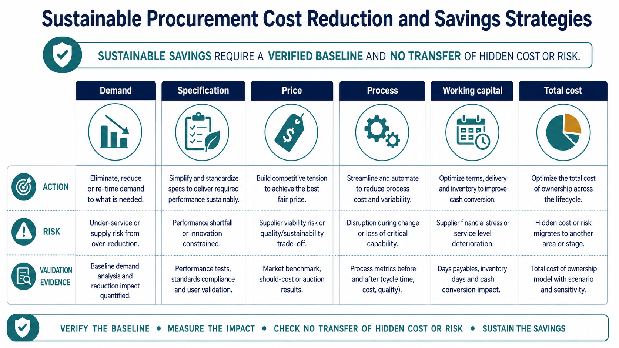
- Price and total cost: Unit cost is one factor, but freight, lead times, minimum order quantities, and payment terms all affect the true cost of a supplier relationship.
- Market intelligence: Understanding what similar organizations pay for the same category gives procurement a defensible baseline for negotiation.
- Supplier benchmarks: Delivery performance, quality history, responsiveness, and financial stability help distinguish suppliers who look good on paper from those who perform reliably over time.
The difference between an organization that captures these benchmarks and one that doesn’t compounds quickly. Teams with benchmarks renegotiate with evidence. Teams without them renew at whatever rate the supplier proposes.
Approval rules and post-award follow-up
Effective sourcing strategies formalize two things that ad hoc buying typically skips: approval thresholds and post-award accountability. Approval thresholds define which purchases need competitive quotes, which require full RFP processes, and which can be handled via preferred suppliers without further bidding. Post-award follow-up tracks whether the supplier is actually delivering on what was agreed — on time, at the contracted price, meeting service levels.
Both elements reduce the common outcome where a sourcing process produces excellent results on paper but doesn’t survive first contact with operational reality.
Which vendor sourcing models work best for direct, indirect, and tail-spend categories?
Not every category needs the same sourcing model. Applying an enterprise-scale RFP process to a one-off equipment purchase wastes time. Using no formal sourcing process for a $2 million direct spend category creates unacceptable risk. The right model depends on spend volume, supply risk, and category complexity.
Direct spend
Direct spend covers the goods and materials that go into the product or service being delivered. These purchases tend to be high-value, high-frequency, and supply-sensitive. The most effective sourcing models for direct spend are single-source, dual-source, multi-source, and category-based approaches — each with distinct tradeoffs.
| Model | Best for | Tradeoff |
|---|
| Single-source | Specialized materials, proprietary components | High concentration risk |
| Dual-source | High-volume, critical components | More relationship management required |
| Multi-source | Commodity categories with many suppliers | Harder to optimize pricing |
| Category-based | Complex spending with sub-categories | Requires dedicated category expertise |
| Local sourcing | Time-sensitive or region-specific needs | May limit competitive options |
| Global sourcing | Cost-sensitive categories with deep markets | Higher lead time and freight risk |
Indirect spend
Indirect spend includes everything that supports operations without going directly into the product: office supplies, IT services, facilities, logistics, and professional services. Indirect spend often has more supplier options than direct, which means competitive sourcing creates more leverage — but it also means sourcing decisions are more fragmented across business units.
Centralized indirect sourcing, where one team owns the category strategy, consistently outperforms decentralized approaches when spend data is consolidated and category volume justifies the investment. The challenge is organizational: business units often resist giving up purchasing autonomy, even when centralized sourcing demonstrably reduces cost.
Tail spend
Tail spend consists of low-dollar, high-frequency, or one-off purchases that collectively account for a large share of supplier count but a small share of total spend. These are the hardest to manage through traditional sourcing models because the transaction overhead often exceeds the savings opportunity on any individual purchase.
Effective tail spend management typically involves channeling purchases through a preferred distributor or using a managed sourcing model — like Hubzone Depot’s Spotbuy Program — where sourcing specialists handle one-off requests across national and open-market suppliers without the internal overhead of running a full RFQ for each item. The result is faster procurement, competitive pricing, and compliant Tier 1 diversity spend — without adding workload to the internal team.
How should businesses define vendor selection criteria before contacting suppliers?
Getting vendor selection criteria right before outreach begins is one of the most overlooked steps in sourcing. Without criteria, every supplier conversation is an open-ended negotiation where the supplier frames the terms. With criteria, the organization maintains control over the process and the outcome.
Must-have vs nice-to-have criteria
Selection criteria should be divided into two groups: mandatory requirements that disqualify a supplier if unmet, and preference factors that influence scoring but don’t eliminate candidates.
| Criterion | Type | Weight example |
|---|
| On-time delivery rate ≥ 95% | Must-have | Pass/fail |
| ISO 9001 or relevant certification | Must-have | Pass/fail |
| Pricing within 10% of market benchmark | Must-have | Pass/fail |
| Capacity to meet required order volume | Must-have | Pass/fail |
| Supplier diversity certification (HUBZone, WBENC) | Nice-to-have | +10 points |
| Track record with public sector clients | Nice-to-have | +5 points |
| Dedicated account management | Nice-to-have | +5 points |
Scoring logic
Once criteria are defined, a weighted scoring model prevents sourcing decisions from drifting based on familiarity or convenience. Assign weights to each factor that reflect actual business priorities — not theoretical ones. A category with strict compliance requirements should weight compliance higher than price. A commodity category dominated by interchangeable goods should weight price and delivery more heavily than relationship depth.
The scoring model doesn’t need to be complex. A ten-point scale across five to eight criteria, multiplied by assigned weights, produces a defensible, repeatable decision framework that takes less time than a consensus discussion and produces more consistent outcomes.
Approval thresholds
Approval thresholds determine when a sourcing decision needs additional review. A $10,000 one-off purchase might be approved by a category manager after two competitive quotes. A $500,000 annual supply agreement likely needs a full RFP, legal review, and executive sign-off. Documenting these thresholds before procurement activity begins prevents inconsistency and protects the organization from audit risk.
For organizations with supplier diversity mandates, selection criteria present the natural place to embed diversity requirements — not as a checkbox, but as a substantive evaluation factor. HUBZone-certified and WBENC-certified suppliers like Hubzone Depot can count toward Tier 1 supplier diversity reporting, which is a measurable procurement outcome, not just a compliance formality.
What steps should a vendor sourcing process follow from intake to award?
A structured vendor sourcing process prevents the most common failure points: unclear requirements, unconsolidated supplier data, and awards that don’t translate into ongoing accountability.
Intake checklist
Every sourcing process begins with a clear request. Intake captures what is needed, in what quantity, by when, to what specification, and under what constraints. Poor intake — vague specs, missing quantities, no delivery context — is the single most common reason sourcing processes run longer than they should. A consistent intake form covers:
- Item description and technical specification
- Required quantity and any minimum/maximum thresholds
- Target delivery date and location
- Budget or price target (where available)
- Compliance requirements (certifications, regulations, diversity goals)
- Stakeholder who owns the decision
Shortlist rules
With requirements confirmed, the next step is identifying potential suppliers. A market scan reviews known and new suppliers against intake criteria, covering national distributors, manufacturers, specialty suppliers, and open-market channels. A viable shortlist typically contains three to five suppliers per category — enough to generate competitive tension without creating evaluation overhead. Suppliers who can’t meet must-have criteria should be excluded at this stage, not after quotes have been collected.
Award memo
The full sourcing process covers intake, market scan, shortlist, RFQ or RFP, evaluation, negotiation, and award. Each stage has a clear owner and a clear output.
| Stage | Output | Owner |
|---|
| Intake | Confirmed requirement | Stakeholder + Procurement |
| Market scan | Supplier longlist | Procurement |
| Shortlist | 3–5 qualified suppliers | Procurement |
| RFQ / RFP | Competitive quotes or proposals | Supplier |
| Evaluation | Scored comparison | Procurement |
| Negotiation | Agreed terms | Procurement + Legal |
| Award memo | Documented decision with rationale | Category Manager |
The award memo is often skipped but should never be. It protects the organization during audits, supports renewal negotiations, and gives context to successors when team members change. A sourcing decision that exists only in someone’s memory is a governance risk.
When should a team use an RFQ, an RFP, or direct negotiation?
RFQ vs RFP
An RFQ (Request for Quotation) is appropriate when requirements are well-defined and the decision will be driven primarily by price, lead time, and supplier compliance with specifications — the product or service doesn’t need to be designed, it needs to be priced. An RFP (Request for Proposal) is appropriate when the solution isn’t fully specified, when multiple approaches might work, or when service quality, methodology, and long-term capability matter as much as cost.
| Factor | RFQ | RFP |
|---|
| Requirements clarity | High — fully specified | Lower — solution-based |
| Decision driver | Price + delivery | Price + quality + methodology |
| Process time | Fast (days to weeks) | Slower (weeks to months) |
| Best for | Commodity goods, standard services | Complex services, custom solutions |
| Output | Competitive quotes | Full proposals for evaluation |
Small one-off buys and urgent requirements
For low-value, non-recurring purchases — which represent the majority of tail spend by transaction count — a full RFQ process is often disproportionate to the purchase value. These situations call for a leaner mechanism: a quick multi-source price comparison or a managed sourcing partner who handles the legwork.
Hubzone Depot’s Spotbuy Program handles exactly this scenario. Instead of running internal RFQs for every one-off or hard-to-procure item, procurement teams submit requests and receive itemized, competitive quotes across national suppliers and open-market channels — fast, transparent, and compliant with Tier 1 diversity reporting requirements. It’s sourcing without the overhead.
Negotiated awards
Direct negotiation — bypassing a formal RFQ or RFP — is appropriate when a supplier holds unique capabilities unavailable elsewhere, when an existing relationship is being renegotiated, or when urgency makes the time cost of a competitive process greater than the risk of accepting current terms. Negotiated awards should still be documented, with clear rationale for bypassing the competitive process. Without documentation, every bypass becomes normalized and the strategy erodes.
What risks should you evaluate before choosing a vendor?
Risk evaluation shouldn’t happen after a vendor is selected — it should be part of the selection criteria. Organizations that treat risk and price as separate decisions end up making sourcing choices they regret under pressure.
Operational risk
Operational risk covers a supplier’s ability to deliver reliably: capacity, lead times, geographic exposure, single points of failure in their own supply chain, and responsiveness to issues. A supplier who matches price but can’t guarantee delivery continuity creates more cost than they save. Before selection, it’s worth asking: Does this supplier have sufficient capacity for our volume? What is their on-time delivery rate? Are they dependent on a single manufacturer or geography? How do they handle order spikes or supply disruptions?
Financial risk
A supplier’s financial stability directly affects procurement continuity. Financially stressed suppliers are more likely to increase prices unexpectedly, reduce service quality, delay fulfillment, or fail entirely. Reviewing financial health before signing a long-term agreement is not excessive caution — it’s basic due diligence. Warning signs include extended payment terms requests, difficulty providing trade references, or unusual pricing variability between quotes.
Compliance risk
Compliance risk varies by category and sector. In regulated industries and government procurement, suppliers must meet specific certifications, security requirements, and legal obligations. NIST SP 800-161r1 — the U.S. government’s supply chain risk management framework — provides a structured approach to identifying compliance and security risks across vendor relationships (https://csrc.nist.gov/pubs/sp/800/161/r1/upd1/final). Even for organizations outside government, the framework’s tiering logic for prioritizing risk by supplier criticality and exposure is directly applicable to commercial procurement programs.
Backup plans
The right question isn’t whether a vendor will fail — it’s how quickly the organization can respond when one does. Backup planning means identifying at least one alternative qualified supplier per critical category before a disruption occurs, not after. Organizations that do this proactively maintain procurement continuity. Those that don’t make expensive emergency sourcing decisions exactly when they can least afford to.
How can supplier diversity strengthen a vendor sourcing strategy?
Supplier diversity is sometimes treated as a separate compliance program — tracked by a different team, reported at year-end, and loosely connected to actual sourcing decisions. That model underperforms. When diversity goals are embedded directly in sourcing criteria and processes, they produce both better supplier variety and more defensible procurement outcomes.
Diversity objectives in sourcing
The U.S. Small Business Administration’s HUBZone Program supports procurement from certified small businesses in historically underutilized business zones, with the explicit goal of stimulating economic activity in underserved communities (https://www.sba.gov/federal-contracting/contracting-assistance-programs/hubzone-program). For federal contractors and SLED organizations, engaging HUBZone-certified suppliers directly supports Tier 1 spend reporting and contract compliance goals.
Setting explicit diversity objectives in a vendor sourcing strategy — rather than reviewing diversity participation retroactively — means procurement teams consider qualified diverse suppliers during the shortlist stage, not after the award decision has already been made.
Reporting
Diversity participation is only measurable if it’s tracked consistently. A sourcing strategy that integrates diversity objectives should include: supplier classification at onboarding (HUBZone, WBENC, MBE, SBE, etc.), spend tracking by diversity category reported at least quarterly, specific targets by category or total spend percentage, and qualification screening that identifies diverse suppliers alongside standard suppliers during market scans.
Qualification screening
One of the most persistent misconceptions about supplier diversity is that it requires accepting lower performance or higher cost. In practice, qualified diverse suppliers compete effectively on price and delivery — especially in categories where relationship-based buying has created incumbent supplier concentration. A properly structured sourcing process surfaces those suppliers rather than filtering them out by default.
Hubzone Depot is a woman-owned, HUBZone-certified Tier 1 supplier. Organizations working with Hubzone Depot count that spend toward both diversity goals and procurement efficiency — without making a tradeoff between the two.
Which KPIs show whether a vendor sourcing strategy is actually working?
Strategy without measurement is planning without accountability. The KPIs that matter for vendor sourcing aren’t activity metrics — they’re outcome metrics that confirm whether the sourcing process is actually producing value.
Sourcing KPIs
| KPI | What it measures | Target |
|---|
| Cycle time (intake to award) | Sourcing process speed | Category-specific benchmarks |
| Quote coverage | % of purchases with competitive quotes | ≥ 80% of addressable spend |
| Savings vs baseline | Cost reduction vs prior period or benchmark | Category-specific |
| Supplier acceptance rate | % of shortlisted suppliers who respond to RFQs | ≥ 70% |
| On-time delivery (OTD) | % of orders delivered on the agreed date | ≥ 95% |
| Issue rate | % of orders with quality, delivery, or invoice issues | < 5% |
| Diversity spend % | Spend with certified diverse suppliers | Per organizational goal |
Reporting cadence
A sourcing strategy that’s only reviewed at year-end doesn’t create accountability. High-performing procurement teams review sourcing performance monthly at the category level and present quarterly summaries to senior leadership. This cadence creates early warning signals when a category is trending in the wrong direction — before the cost compounds into a problem that requires a reactive fix.
Executive dashboard
For senior stakeholders, three KPIs carry the most weight: savings vs baseline (is the sourcing strategy reducing cost?), supplier issue rate (are chosen vendors performing as expected?), and diversity spend percentage (is the organization meeting its supplier diversity commitments?). A simple one-page dashboard covering these three metrics communicates more about sourcing effectiveness than a comprehensive operational report that no executive has time to read in full.
What common mistakes weaken vendor sourcing results over time?
Even well-intentioned sourcing strategies degrade when the wrong habits become normalized. These are the most common failure patterns — and how to correct them before they become structural problems.
Avoidable mistakes
Price-only decisions. Selecting vendors based solely on lowest quoted price ignores delivery performance, service reliability, compliance risk, and total cost. A supplier who quotes 8% lower but delivers 20% of orders late doesn’t create savings — they create operational disruption that costs more than the price difference ever would have saved.
Vague specifications. When intake requirements are incomplete, suppliers quote different things. Comparing those quotes produces the illusion of competitive analysis without the substance. Specific, consistent specifications are the foundation of any meaningful RFQ process.
No scorecards. Without ongoing performance tracking, renewal decisions are made on impression rather than evidence. A quarterly summary of delivery performance, issue frequency, and pricing compliance is enough to inform disciplined sourcing decisions — and to support renegotiation when the evidence warrants it.
Weak stakeholder alignment. Procurement can define sourcing criteria, but if business units bypass the process for convenience, the strategy doesn’t hold. Alignment requires clear policies, easy-to-follow processes, and consistent reinforcement from leadership.
No post-award review. The award isn’t the end of the sourcing process — it’s the beginning of supplier management. Organizations that skip post-award reviews lose the ability to enforce what was negotiated and send no signal to the supplier that performance is being monitored.
Recovery moves
When sourcing results are below expectations, the fastest recovery path usually isn’t switching suppliers — it’s fixing the process that led to a poor selection. Reviewing the original selection criteria, confirming that intake requirements were clear, and checking whether performance tracking was in place will identify the root cause faster than an emergency RFQ that risks repeating the same mistakes.
Governance fixes
The governance fixes that prevent these mistakes from recurring include: documented intake requirements, a standard supplier evaluation template, defined approval thresholds, and a quarterly performance review calendar. None of these are complicated to implement — but without a deliberate effort to build them, they don’t emerge organically. Good sourcing governance is built once and maintained continuously, not rebuilt after every failure.
When should a company change or refresh its vendor sourcing strategy?
A sourcing strategy that worked well two years ago may not be right today. Markets shift, supplier landscapes change, and organizational requirements evolve. The best vendor sourcing strategy isn’t a static document — it’s a framework that gets reviewed and updated when conditions warrant it.
Review triggers
Specific events should trigger a sourcing strategy review even between scheduled cycles:
- Volume growth: When purchasing volume in a category increases significantly, the sourcing model that worked at lower volume may no longer generate competitive leverage.
- Repeated delivery delays: If the same suppliers are underperforming quarter after quarter, the issue may be structural — wrong sourcing model, wrong supplier set, or weak contract terms.
- Category expansion: When an organization moves into new product lines, geographies, or service types, the existing supplier base may not cover the new requirements.
- Supplier exits: When a major supplier exits a category, the strategy needs to adapt quickly — ideally before the disruption, using pre-qualified alternatives.
- New compliance goals: Regulatory changes, new contract requirements, or updated diversity targets may require revisiting which suppliers qualify and how they are evaluated.
Annual reviews
Even without specific triggers, sourcing strategies benefit from annual structured reviews. These should cover: spend performance vs baseline by category, supplier performance summary, market pricing benchmarks vs current contracted rates, diversity spend participation vs targets, and changes in organizational priorities that affect sourcing. Annual reviews don’t need to be long — a focused half-day with the right data is more productive than a multi-day strategy retreat that produces good slides and no decisions.
Market shifts
When broader market conditions change — commodity price swings, logistics disruptions, geopolitical risks affecting specific supply chains — reactive sourcing is expensive. Organizations with a documented sourcing strategy and pre-qualified backup suppliers can respond quickly. Those without one scramble. The sourcing strategy isn’t just a cost management tool — it’s a resilience asset that delivers its highest return exactly when conditions are most difficult.
How can procurement teams scale vendor sourcing without losing control?
Scaling sourcing doesn’t mean adding more people to do more of the same thing. It means building a sourcing infrastructure that handles higher volume, more categories, and more complexity without a proportional increase in risk or administrative burden.
Governance
The infrastructure of scalable sourcing consists of a small number of reusable tools: intake templates, supplier evaluation scorecards, RFQ/RFP frameworks, and award documentation forms. Teams that create these tools once and apply them consistently get faster and more consistent results as volume increases. Teams that improvise each process from scratch get slower and less consistent. Governance defines who can approve which sourcing decisions, what documentation is required at each stage, and what escalation path applies when a decision falls outside normal parameters. Without governance, scale creates chaos. With it, scale creates compounding leverage.
Templates and preferred supplier lists
Preferred supplier lists (PSLs) are one of the most underused scalability tools in procurement. A PSL identifies pre-qualified, pre-approved suppliers by category who can be used without running a new competitive sourcing process each time. Orders route to PSL suppliers faster, with lower administrative overhead and more predictable quality. Building and maintaining a PSL requires initial investment in supplier qualification — but the efficiency return compounds over time as the list covers more categories and more transaction volume.
Team bandwidth and escalation rules
As sourcing volume grows, the pressure to skip process steps increases. Escalation rules define when it’s acceptable to bypass normal process steps — and what documentation is required when that happens. Without escalation rules, every bypass becomes normalized over months, and the strategy erodes quietly rather than visibly.
For organizations whose internal procurement capacity can’t keep pace with sourcing demand, a managed procurement partner can function as an extension of the internal team. Hubzone Depot operates this way — handling RFQs, supplier comparison, and quote management across categories where the internal team doesn’t have bandwidth or category-specific market access. The result is sourcing capacity that scales with demand, not with headcount.
What should the conclusion include before a new vendor sourcing strategy is rolled out?
Before a vendor sourcing strategy is implemented, confirming that foundational elements are in place and that the rollout sequence is realistic prevents the common outcome of a well-written strategy that sits unused — rather than a working process that changes outcomes.
Vendor Sourcing Strategy Readiness: Summary Table
| Element | Status check | Owner |
|---|
| Spend data by category | Consolidated and current? | Finance / Procurement |
| Intake process documented | Consistent template in use? | Procurement |
| Supplier evaluation criteria defined | Written and approved? | Category Manager |
| Preferred supplier list started | At least top 3 categories covered? | Procurement |
| RFQ/RFP templates ready | Available to the team? | Procurement |
| Approval thresholds documented | Signed off by leadership? | Leadership + Procurement |
| KPI reporting baseline set | Benchmarks established? | Analytics / Procurement |
| Diversity goals embedded | Targets defined and tracked? | Procurement + Leadership |
Expert recommendations
- Start with the highest-spend categories. A sourcing strategy that tries to cover everything at once usually covers nothing well. Identify the top five categories by spend and build sourcing processes for those first.
- Fix the intake process early. Vague requirements are the root cause of most sourcing failures. A consistent intake form pays dividends throughout the entire sourcing lifecycle.
- Document everything. Award decisions, supplier selection rationale, and exception approvals all need to be on record — not for bureaucracy, but to learn from past decisions and defend them when audited.
- Embed diversity from day one. Supplier diversity goals that are retrofitted into an existing sourcing strategy are harder to achieve than goals built in from the start.
Sources
First 30-day rollout actions
- Days 1–5: Pull spend data by category for the prior 12 months. Identify the top 10 categories by total spend and transaction count.
- Days 6–10: Review the existing supplier base. Flag suppliers without current contracts, certifications on file, or documented performance history.
- Days 11–15: Draft intake template and supplier evaluation scorecard for the top three categories.
- Days 16–20: Define approval thresholds and get sign-off from relevant leaders.
- Days 21–25: Begin preferred supplier qualification for the top two categories.
- Days 26–30: Set KPI baselines and reporting cadence. Schedule the first monthly sourcing review.