Explore insightful articles, practical tips, and fresh ideas across different topics. Stay informed, learn something new, and discover content that inspires you.
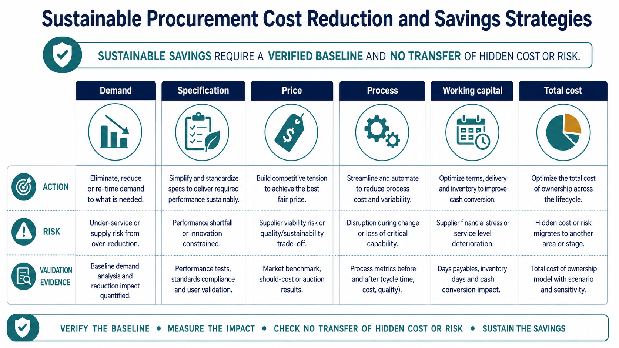
Durable procurement savings improve total cost without shifting hidden cost, service failure, environmental harm, or supply risk elsewhere. Demand, specifications, competition, process, working capital, and lifecycle design provide complementary levers.
Which cost-reduction levers produce sustainable value under different spend conditions?
In practical terms, validated baseline sets the operating boundary, demand lever identifies what the organization is trying to protect or improve, and specification change provides the facts needed to test the opportunity. Commercial result should not be calculated or classified until the population, period, currency or unit, exclusions, and decision owner are explicit.
Decision boundary
Demand management: Use demand management to define the boundary and decision consequence; retain the dated source and explain why the evidence is sufficient.
Specification redesign: Use specification redesign to define the boundary and decision consequence; retain the dated source and explain why the evidence is sufficient.
Competitive sourcing: For competitive sourcing in the definition, preserve the searched population, comparable requirement, response date, exclusions, alternatives, and supported decision. The retained search and response records make the competitive sourcing assessment in this definition independently reviewable.
Consolidation: Use consolidation to define the boundary and decision consequence; retain the dated source and explain why the evidence is sufficient.
Should-cost analysis: The definition should set out should-cost analysis with a documented baseline, unit, period, inclusions, formula, rounding rule, and sensitivity range. Finance should be able to reproduce the calculation for should-cost analysis from the evidence retained for this definition.
Evidence and application
A practical application makes the boundary visible. A packaging initiative reduces material and dimensional weight, validates damage rates through a pilot, renegotiates terms, and tracks freight, returns, and customer experience after implementation. The decision file should distinguish observed facts from accepted assumptions, preserve rejected alternatives, and name the evidence that would reopen the decision about process cost.
The main failure is a decision built on the wrong population or evidence, not a shortage of terminology. Price-only reductions can create quality failures, expedited freight, excess inventory, supplier distress, or claims that erase the apparent saving. A reviewer should be able to trace validated baseline to process cost, identify the accountable owner, and see how the expected result will be verified after implementation.
Documentation can remain proportionate to validated baseline. Low-value and reversible demand lever work may use a lighter record, whereas material, regulated, safety-critical, or continuity-sensitive work needs deeper validation. Either treatment of demand lever must be justified by evidence that fits the actual conditions of this decision.
Decision element
Specific application
Evidence or calculation
Action if weak
Demand management
Use demand management to determine whether validated baseline can proceed
Source, date, unit, assumption, and owner for validated baseline
Correct the input, narrow the scope, or route an exception for validated baseline
Specification redesign
Use specification redesign to determine whether demand lever can proceed
Source, date, unit, assumption, and owner for demand lever
Correct the input, narrow the scope, or route an exception for demand lever
Competitive sourcing
Use competitive sourcing to determine whether specification change can proceed
Source, date, unit, assumption, and owner for specification change
Correct the input, narrow the scope, or route an exception for specification change
Consolidation
Use consolidation to determine whether commercial result can proceed
Source, date, unit, assumption, and owner for commercial result
Correct the input, narrow the scope, or route an exception for commercial result
Should-cost analysis
Use should-cost analysis to determine whether process cost can proceed
Source, date, unit, assumption, and owner for process cost
Correct the input, narrow the scope, or route an exception for process cost
How should savings, cost reduction, cost avoidance, and cash-flow benefits be defined and validated?
The operating sequence converts validated baseline into realized saving through explicit handoffs. At each demand lever stage, the record needs an input, responsible role, acceptance test, and usable output; an activity list without those four items is uncontrolled.
Operating sequence
1 — Validated baseline. Use validated baseline to connect the input to a named output and acceptance gate; retain the dated source and explain why the evidence is sufficient.
2 — Demand lever. Use demand lever to connect the input to a named output and acceptance gate; retain the dated source and explain why the evidence is sufficient.
3 — Specification change. Use specification change to connect the input to a named output and acceptance gate; retain the dated source and explain why the evidence is sufficient.
4 — Commercial result. Use commercial result to connect the input to a named output and acceptance gate; retain the dated source and explain why the evidence is sufficient.
5 — Process cost. The workflow should set out process cost with a documented baseline, unit, period, inclusions, formula, rounding rule, and sensitivity range. Finance should be able to reproduce the calculation for process cost from the evidence retained for this workflow.
6 — Risk transfer. In practice, assess risk transfer in the workflow with a plausible disruption scenario, exposure, mitigation, residual risk, trigger, and contingency owner. A color rating alone is not enough to authorize a workflow decision involving risk transfer.
7 — Realized saving. The workflow should set out realized saving with a documented baseline, unit, period, inclusions, formula, rounding rule, and sensitivity range. Finance should be able to reproduce the calculation for realized saving from the evidence retained for this workflow.
Figure: Sustainable Procurement Cost Reduction and Savings Strategies — evidence, decisions, owners, and outputs across the operating flow.
Handoffs and exceptions
One practical sequence works as follows: A packaging initiative reduces material and dimensional weight, validates damage rates through a pilot, renegotiates terms, and tracks freight, returns, and customer experience after implementation. The sequence stops when evidence for demand lever is incomplete instead of passing ambiguity downstream. Rework tied to specification change is coded to its producing stage, separating capacity constraints from definition, approval, supplier-response, or data-quality defects.
Exceptions need their own route. Urgency around validated baseline may compress timing, but it does not erase authority, requirement clarity, commercial comparison, receipt, or post-award evidence. The person accountable for risk transfer defines who can authorize a deviation, which minimum checks remain, and when work returns to the standard path.
Which demand, channel, catalog, and supplier levers reduce indirect procurement cost without shifting risk?
A usable analytical layer makes specification change, commercial result, and process cost comparable. Options for commercial result must share one population, period, unit, currency basis, inclusion rule, and scenario logic; otherwise even a precise score can support the wrong choice.
Measurement and comparison
Tail-spend control: Use tail-spend control to make the evidence comparable across options; retain the dated source and explain why the evidence is sufficient.
Catalogs: Use catalogs to make the evidence comparable across options; retain the dated source and explain why the evidence is sufficient.
Preferred suppliers: For preferred suppliers in the analysis, preserve the searched population, comparable requirement, response date, exclusions, alternatives, and supported decision. The retained search and response records make the preferred suppliers assessment independently reviewable.
Buying channels: Use buying channels to make the evidence comparable across options; retain the dated source and explain why the evidence is sufficient.
Consumption policies: Use consumption policies to make the evidence comparable across options; retain the dated source and explain why the evidence is sufficient.
Sensitivity testing should concentrate on variables capable of changing process cost: volume, mix, timing, price, utilization, recovery, risk, or threshold assumptions as applicable. Showing a base case, downside case, and commercial result break point reveals whether this choice is robust or depends on one optimistic input.
Interpretation and control
The analytical owner should lock the source version, retain calculation logic, and document overrides. A second reviewer reconciles the output to validated baseline and tests whether the criteria for process cost were applied as approved. If a small assumption shift changes the result, the recommendation about commercial result is conditional rather than certain.
Which quality, capacity, service, and continuity safeguards prevent savings from destroying supplier performance?
Control design begins with the failure that matters: Price-only reductions can create quality failures, expedited freight, excess inventory, supplier distress, or claims that erase the apparent saving. The response should combine prevention near validated baseline with detection in workflow, transaction, supplier, invoice, or performance data, and name the owner of correction.
Preventive safeguards
Balance price with quality: The control design should set out balance price with quality with a documented baseline, unit, period, inclusions, formula, rounding rule, and sensitivity range. Finance should be able to reproduce the calculation for balance price with quality from the evidence retained for this control design.
Capacity: The control design should test capacity with dated operating evidence, a measurable acceptance threshold, the consequence of failure, and a corrective-action owner. This turns capacity into an operating test for the control design rather than a descriptive claim.
Cash flow: Use cash flow to pair prevention with an exception and escalation path; retain the dated source and explain why the evidence is sufficient.
Service levels: The control design should test service levels with dated operating evidence, a measurable acceptance threshold, the consequence of failure, and a corrective-action owner. This turns service levels into an operating test for the control design rather than a descriptive claim.
Innovation: Use innovation to pair prevention with an exception and escalation path; retain the dated source and explain why the evidence is sufficient.
Detection and correction
A material process cost exception needs four records: observed condition, expected value, authorized disposition, and closure evidence. Trend process cost exceptions by root cause instead of treating each as an isolated task. Repeated defects in process cost or risk transfer indicate that process, master data, contract, training, or supplier action needs redesign.
Controls over risk transfer must remain proportionate to this decision. Too many risk transfer approvals can push users outside the process, while automatic approval can conceal bad master data. Monitor cycle time with compliance, sample approved and rejected cases, and test whether corrective actions changed realized saving rather than merely closing a ticket.
How can Hubzone Depot's Spotbuy service support cost control for one-off and tail-spend purchases?
For the use case, Hubzone Depot describes SpotBuy as a route for one-off and non-catalog requests: the buyer submits a need, sourcing specialists compare available channels, and the buyer receives an itemized quote with cost and lead-time information. In practice, this discrete sourcing support does not transfer the buyer's policy, competition, approval, contract, funding, receipt, or risk responsibilities tied to process cost.
Service fit
Defined scope: The request evaluated can be bounded using validated baseline and a clear completion criterion.
Comparable evidence: The buyer can compare returned information against specification change on the same unit and time basis.
Decision authority: An internal owner remains accountable for process cost and any exception or award related to this decision.
Operational follow-through: Receiving, payment, credit, or performance evidence can confirm realized saving after action under the approved approach.
Proportionate route: The effort matches value, urgency, complexity, regulatory exposure, and reversibility.
Intake and buyer control
An intake package should include a precise item or service requirement, quantity, specifications, acceptable substitutions, delivery location, need date, budget context, approval status, and quote-comparison fields. Resolve missing fields in the intake before comparing quotes or audit findings, because different assumptions about validated baseline, service, timing, quantity, or eligibility can make similar-looking results non-comparable.
The next step is to review Hubzone Depot's SpotBuy page and request only the information needed to test the validated baseline use case. The buyer documents the evaluation method in advance, retains its own approvals, and confirms implementation or credit evidence before reporting an outcome.
Conclusion: What should procurement leaders remember about cost reduction strategies?
The practical conclusion is to connect the original need to an implementable, testable decision. That requires the boundary for validated baseline, the evidence behind specification change, the approval criteria for process cost, and the owner who will verify realized saving.
Implementation priorities
Define: In practice, state the population, period, inclusions, exclusions, and authority for validated baseline.
Verify: In practice, reconcile specification change to a dated source and distinguish facts from assumptions.
Decide: Apply process cost consistently and preserve the rejected alternative.
Implement: Assign risk transfer and specify the required acceptance evidence.
Review: Measure realized saving after implementation and reopen the decision when a material condition changes.
Approve a saving only against a verified baseline and keep it only when finance, operations, and risk evidence confirm realization. The recommendation is strongest when the current requirement, policy or contract, source dates, assumptions, and implementation capacity are verifiable. A material change affecting validated baseline, market availability, regulation, carrier rules, supplier capability, or data quality can change the conclusion.
Decision rule and sources
A final review of this decision should not rely on one score. The process cost record should explain why the chosen path is acceptable, identify residual risk and its owner, and set the next review date or trigger. The resulting record turns realized saving into evidence for the next decision instead of forcing the organization to reconstruct its reasoning from email.
Confirm scope and baseline before committing resources
Specification change
Current, dated record showing specification change
Challenge alternatives and source quality
Process cost
Current, dated record showing process cost
Approve only against explicit criteria
Risk transfer
Current, dated record showing risk transfer
Assign implementation and exception ownership
Realized saving
Current, dated record showing realized saving
Review results and reopen the decision when conditions change
Blog, Business & Logistics
Sustainable Procurement Cost Reduction and Savings Strategies
Durable procurement savings improve total cost without shifting hidden cost, service failure, environmental harm, or supply risk elsewhere. Demand, specifications, competition, process, working capital, and lifecycle design provide complementary levers. Which cost-reduction levers produce sustainable value under different spend conditions? In practical terms, validated baseline sets the operating boundary, demand lever identifies what the organization […]
A GSA Schedule can give a qualified business access to a major federal purchasing channel, but it is not a certification, a customer list, or a guarantee of revenue. It is a long-term contract vehicle under which the U.S. General Services Administration evaluates a vendor's offer, negotiates terms and pricing, and authorizes the vendor to offer approved commercial products, services, or solutions to eligible government buyers.
The application requires more than completing a registration. A prospective contractor must choose the right Special Item Numbers, demonstrate capability and financial responsibility, assemble technical and pricing support, complete required training and registrations, submit through GSA's offer system, and respond to the contracting officer's review. After award, the company must maintain the contract, report sales, keep registrations and certifications current, process modifications, and actively pursue opportunities.
This guide explains GSA Schedule meaning, how the Multiple Award Schedule is structured, what happened to legacy Schedule 70, how to get a GSA contract, and what to check before committing to the application.
What is a GSA Schedule, and what is a GSA contract?
Definition
A GSA Schedule, formally the Multiple Award Schedule or MAS, is a governmentwide contract program for commercial products, services, and solutions. GSA awards Schedule contracts to multiple qualified vendors under common program terms, approved offerings, and negotiated pricing. Eligible agencies and other authorized buyers can then place orders or establish blanket purchase agreements under the applicable ordering procedures.
The phrases GSA contract, GSA Schedule contract, and GSA MAS contract usually refer to the contract awarded to an individual vendor under the MAS program. The Schedule is the overall vehicle; the vendor's contract is its specific authorization to sell approved offerings under that vehicle.
GSA's Multiple Award Schedule overview describes MAS as a program that gives government buyers access to commercial products, services, and solutions from prequalified contractors. Prequalification does not remove competition at the order level. Agencies still conduct market research and follow the applicable procedures when selecting among Schedule sources.
Why agencies use it
Agencies use the Schedule because core terms, contractor qualifications, and ceiling pricing have already been addressed at the contract level. Buyers can search GSA systems, identify vendors under relevant Special Item Numbers, request quotes, and place orders through a more standardized process than creating a new open-market contract for every requirement.
The vehicle can support recurring needs, one-time orders, complex solutions, and blanket purchase agreements. It also allows agencies to consider small-business and socioeconomic set-asides when the applicable rules and market conditions are met.
General Services Administration's role
GSA administers the MAS solicitation, evaluates new offers, negotiates awards, maintains categories and Special Item Numbers, processes contract modifications, and oversees contractor compliance. It also provides acquisition tools, training, eBuy, GSA Advantage!, eLibrary, and guidance for buyers and industry partners.
The ordering agency remains responsible for defining its need, conducting market research, selecting the acquisition approach, evaluating quotes, funding the order, and administering order-level performance. GSA manages the vehicle; it does not choose a vendor for every agency requirement.
What is a GSA Schedule contract, and what are GSA MAS contracts and contract vehicles?
MAS structure
The GSA Multiple Award Schedule organizes commercial offerings into large categories, subcategories, and Special Item Numbers, commonly called SINs. A vendor applies only for the SINs that match its capabilities and evidence. The awarded contract identifies the approved SINs, products or labor categories, pricing, geographic coverage, terms, and other contract data.
MAS component
What it does
Vendor implication
MAS solicitation
Establishes the program requirements and clauses
The offer must comply with the current base solicitation
Category attachment
Adds category and SIN-specific instructions
Evidence varies by the offerings proposed
Special Item Number
Defines a scope of products or services
Only in-scope offerings may be sold under that SIN
Vendor contract
Records the award, pricing, terms, and approved scope
The holder must maintain and perform the contract
Order or BPA
Creates the agency's specific purchase
Competition and performance occur at the order level
Contract vehicles
A contract vehicle is a pre-established mechanism agencies can use to acquire defined products or services. MAS is one vehicle family. Governmentwide acquisition contracts, multi-agency contracts, indefinite-delivery contracts, and agency-specific vehicles are other examples. Their eligibility, scope, ordering rules, and competition differ.
Feature
GSA MAS
GWAC or other multiple-award vehicle
Standalone agency contract
Entry opportunity
A business can generally submit a MAS offer when ready
Often limited to a defined solicitation window
Limited to the specific solicitation
Scope
Broad commercial categories and SINs
Defined by the vehicle's mission and pools
Defined by one agency requirement
Ordering
Authorized buyers issue orders or BPAs
Authorized users issue task or delivery orders
Agency administers the direct contract
Sales guarantee
No guaranteed sales
No guarantee beyond any stated minimum
Depends on the awarded structure
Holder vs. contract distinction
A GSA Schedule holder is the legal entity awarded the contract. Employees, resellers, subcontractors, and teaming partners do not become Schedule holders merely by supporting that company. They may perform or supply under the holder's compliant arrangement, but the holder remains accountable to GSA and the ordering agency.
Likewise, a company's general catalog is not automatically its Schedule catalog. Only approved offerings within awarded scope and contract terms may be represented as available under the GSA contract. This distinction protects both compliance and buyer expectations.
What is GSA Schedule 70, and how does it fit the broader GSA structure?
What Schedule 70 covers
GSA Schedule 70 was the legacy information technology Schedule. It covered a wide range of IT products and services, including hardware, software, professional services, cloud-related capabilities, cybersecurity, telecommunications, and training. The name remains common in older contracts, marketing materials, procurement records, and search queries.
Schedule 70 is no longer a separate current Schedule program. GSA consolidated the legacy Schedules into one Multiple Award Schedule. IT offerings now sit within the MAS IT Category and are organized by current subcategories and SINs. GSA's legacy redirect for Schedule 70 now leads to the Multiple Award Schedule IT Category.
Legacy reference
Current interpretation
What vendors should do
GSA Schedule 70
Former standalone IT Schedule
Use the current MAS solicitation and IT Category attachment
Legacy Schedule 70 SIN
Historical scope identifier
Find the current SIN that covers the offering
Schedule 70 holder
Vendor previously awarded under the IT Schedule
Confirm current MAS contract status and approved SINs
Schedule 70 opportunity
Informal reference to Schedule-based IT buying
Review the actual vehicle, SIN, and order instructions
How it differs from other categories
The IT Category focuses on technology products, services, and solutions. Other MAS categories cover areas such as professional services, facilities, furniture, industrial products, security, transportation and logistics, office management, and scientific or medical offerings. Each category has its own subcategories, SINs, technical scope, and evidence requirements.
A vendor should choose SINs based on the exact scope it can support and document, not on the broadest category label. An IT consulting firm may qualify for professional IT services but not hardware resale, cloud services, cybersecurity testing, or telecommunications unless it meets the separate requirements for those SINs.
Buyers also need to confirm scope at the order level. A product or service being technology-related does not automatically make every IT SIN appropriate. Clear mapping between the requirement, the contractor's awarded scope, and the order is essential.
The practical takeaway is to use "Schedule 70" only as a historical reference. For current applications, market research, and quotes, use MAS IT terminology and verify the contractor's active SINs in GSA's systems.
How do you get on a GSA Schedule, step by step?
Readiness checklist
Start by deciding whether MAS fits the company's market and operating capacity. A Schedule requires ongoing contract administration and business development. The company should have a target agency base, commercial pricing discipline, relevant past performance, stable operations, and the ability to maintain federal registrations and reporting.
GSA's roadmap to get a MAS contract begins with a business decision, required training, a readiness assessment, review of the full solicitation, and the new offeror checklist. These steps should occur before document assembly because they determine whether the application is commercially sensible and administratively supportable.
Identify the customers, requirements, and SINs the company intends to pursue.
Confirm entity registration, legal information, financial records, and responsibility.
Complete required training and the readiness assessment.
Read the current MAS solicitation and applicable category attachments.
Review the new offeror checklist and SIN-specific requirements.
Gather technical, past-performance, pricing, and administrative support.
Offer submission
The offer is submitted through GSA's eOffer process using the current forms, templates, and system requirements. The applicant proposes its legal and administrative data, selected SINs, technical capability, past performance, pricing, terms, and required representations. Product offers may require detailed catalog, sourcing, and compliance information; service offers may require labor categories, qualifications, rates, and experience.
Internal consistency matters. Names, dates, prices, discounts, labor qualifications, project descriptions, and representations should match across the offer. The company should retain the source data and approvals used to prepare pricing.
Negotiation and award
The GSA contracting officer reviews the submission and may request clarification, corrections, additional evidence, or negotiations. The applicant must respond accurately and on time. The review is not complete merely because the eOffer system accepted the upload.
If GSA determines that the company is responsible, the offerings are within scope, the evidence is sufficient, and the negotiated terms are acceptable, it may award the contract. The vendor then publishes required contract information, completes onboarding activities, and begins marketing and competing for orders. Award creates eligibility to participate; it does not create an order backlog.
What are the GSA Schedule requirements and application steps?
Eligibility requirements
GSA guidance for accessing Schedule opportunities identifies common readiness expectations such as corporate experience, financial statements, measurable past performance, and federal compliance. Eligible firms with limited corporate history may use the Startup Springboard pathway when they meet the current criteria and provide acceptable substitute evidence.
Requirement area
What GSA is evaluating
Examples of support
Legal and administrative
The offeror is properly registered and authorized
SAM.gov record, entity data, registrations
Financial capability
The business can perform and sustain the contract
Financial statements and responsibility information
Technical capability
The company can deliver the proposed scope
Experience, methods, personnel, licenses
Past performance
Prior work supports confidence in performance
Relevant projects and accepted performance evidence
Pricing
Proposed rates or products are supportable and competitive
The offer meets solicitation and category requirements
Representations, policies, supply-chain and trade compliance evidence
Required documents
The exact package depends on the current solicitation, category, SIN, and offer type. Common components include corporate and registration information, financial statements, project experience, past-performance records, technical narratives, quality-control information, subcontracting information when applicable, labor category descriptions, professional compensation information, commercial pricing support, and product files for product offers.
Do not rely on an old checklist from a third-party blog. GSA refreshes the MAS solicitation and category attachments. Use the current documents linked through the official roadmap and SAM.gov solicitation record. Complete required GSA templates without changing protected structure or omitting required tabs.
Application timeline
There is no responsible universal promise that every application will be awarded within a fixed number of weeks. Timing depends on offer completeness, category, review workload, clarification cycles, negotiations, and the applicant's response speed. A rejected or withdrawn offer can take longer overall than a careful initial submission.
Plan the work in stages: readiness and market decision, document gathering, technical and pricing preparation, internal quality review, submission, clarification and negotiation, award, and post-award setup. Assign one owner for the application and separate reviewers for technical scope, pricing, legal representations, and final consistency.
The company should also budget for post-award administration. A contract that cannot be maintained is not a successful application, even if the initial award is obtained.
What does it mean to be a GSA Schedule holder or GSA contract holder?
Holder responsibilities
A GSA Schedule holder has an active contract with approved scope, pricing, terms, and obligations. The holder may market that status and compete for eligible Schedule orders, but it must represent the contract accurately. It should not advertise unapproved products, services, labor categories, or partners as if they are included in the award.
The holder must perform orders, maintain required registrations and certifications, comply with applicable clauses, preserve records, and cooperate with GSA and ordering agencies. It also needs operational processes for quote review, order acceptance, fulfillment, invoicing, modifications, and customer service.
Reporting
Reporting requirements depend on the current solicitation and contract. Holders should understand sales reporting, applicable fees, transactional data, order status, subcontracting reporting, and any category-specific obligations. GSA's current contract compliance guidance directs holders to maintain SAM.gov information, renew applicable certifications, comply with clauses requiring ongoing attention, maintain required price-list information, and sign mass modifications within the stated period.
Reporting should be integrated with accounting and order systems. Manual reconstruction after the reporting period increases error risk. The contract owner should reconcile Schedule sales, order identifiers, invoices, and reported data.
Contract maintenance
The contract changes over time. The holder may need modifications to add or delete SINs, products, services, labor categories, locations, or administrative information. GSA may issue solicitation refreshes and mass modifications that require review and acceptance. Pricing, product files, authorized negotiators, points of contact, and online catalogs must remain accurate.
Ongoing activity
Operational control
SAM.gov and certification maintenance
Calendar ownership and pre-expiration review
Solicitation refresh and mass modification
Contract manager assesses and accepts on time
Sales and transactional reporting
Reconciled source data and documented submission
Catalog and pricing updates
Approved modification before representing changes
Performance
Order-level delivery, quality, communication, and issue control
Business development
Pipeline, eBuy monitoring, agency outreach, and quote discipline
Holding the contract is therefore both a sales opportunity and a compliance function. Businesses should assign accountable resources to both sides. A dormant or poorly maintained Schedule can consume time without producing value and may create avoidable contract risk.
What should you check before applying for a GSA Schedule?
First, verify the market. Identify agencies that buy the company's offerings, the relevant SINs, current Schedule competitors, typical order channels, and realistic differentiators. Review federal spending and opportunity data, but do not assume that broad market size will translate into sales for a new holder.
Second, confirm readiness. The business should have an active and accurate SAM.gov registration, financial support, relevant experience, past-performance evidence, documented commercial pricing, and staff who can manage the application and contract. If standard corporate-history requirements are not met, evaluate the current Startup Springboard path rather than omitting evidence.
Decision area
Check before applying
Evidence of readiness
Market fit
Agencies buy the offering through MAS and relevant SINs
Target-account and opportunity analysis
Scope
Proposed products or services fit current SIN definitions
Written scope-to-SIN mapping
Experience
The company can prove comparable performance
Relevant project records and references
Financial capability
The company can fund operations and reporting
Current financial statements and controls
Pricing
Proposed pricing can be supported and maintained
Source data, approvals, discount logic
Administration
Staff can handle reporting, modifications, and compliance
Named contract owner and documented workflow
Sales execution
The team can market and respond after award
Pipeline, outreach plan, and quote process
Third, read the current solicitation before building the offer. Category attachments and SIN requirements control what evidence is needed. The official GSA MAS roadmap provides the current sequence, while the Multiple Award Schedule overview explains the program for buyers and industry.
Apply when the contract supports a credible sales strategy and the company can maintain compliance. If the business is not ready, subcontracting, teaming with an existing holder, or pursuing open-market opportunities can build experience while the readiness gaps are closed.
Buyers evaluating whether to use MAS should also compare it with other authorized acquisition routes, particularly when the requirement is urgent, specialized, or not available under the relevant SIN. Hubzone Depot supports public- and private-sector procurement teams with product sourcing, competitive RFQ and RFP support, Spotbuy purchasing, and supplier-diversity objectives. The appropriate route still depends on the buyer's authority, applicable competition requirements, and the facts of the purchase.
Before submission, hold an internal go or no-go review that includes sales, operations, finance, and the future contract administrator. The team should agree on target customers, minimum acceptable margins, evidence ownership, reporting capacity, and the resources available to answer GSA clarifications. This prevents the application from becoming disconnected from the business that must perform after award.
Blog, Business & Logistics, Latest Article
GSA Schedule: What It Is and How to Get One
A GSA Schedule can give a qualified business access to
Government procurement is the structured process public agencies use to acquire goods, services, construction, and other capabilities. It begins before a solicitation is published and continues after award through contract administration, performance oversight, payment, modifications, and closeout. For vendors, understanding that full lifecycle is essential because a compliant bid can still fail if it responds to the wrong procurement method, misses a mandatory representation, or underestimates the obligations that follow award.
This guide explains government procurement meaning in practical terms, the main types of procurement used across departments, the federal process from requirement definition to administration, and the differences vendors should expect at the state and local level. It also covers contract types, award vehicles, compliance essentials, and the first checks a business should complete before investing time in a bid.
Government rules change, and agencies may operate under additional statutes, supplements, grant conditions, and local ordinances. Vendors should always treat the solicitation and incorporated clauses as the controlling instructions for a specific opportunity.
What is government procurement, and how is it defined?
Definition
Government procurement is the acquisition of supplies, services, construction, technology, and other requirements by a public entity using appropriated or otherwise authorized funds. The process includes defining the need, conducting market research, selecting an acquisition method, publishing or issuing the solicitation, evaluating offers, making an award, and administering the resulting contract.
The federal definition of acquisition is deliberately broad. FAR Subpart 2.1 explains that acquisition begins when agency needs are established and includes requirement definition, solicitation, source selection, award, financing, performance, administration, and related management functions. In other words, procurement in government is not only the moment a purchase order is issued. It is the governed lifecycle used to convert a public need into an accountable contract outcome.
Who it applies to
Government procurement rules apply to the public officials who plan and award the requirement, the program and technical teams that define and oversee performance, and the vendors and subcontractors that compete for and execute the work. The exact regulatory framework depends on the buyer. Federal executive agencies generally operate under the Federal Acquisition Regulation and agency supplements. State, county, municipal, educational, transportation, utility, and other public entities follow their own statutes, ordinances, policies, and funding conditions.
Vendors may also face flow-down obligations as subcontractors even when they do not contract directly with the government. A prime contract can require subcontractors to meet clauses concerning records, cybersecurity, labor, sourcing, reporting, or small-business participation.
Why it differs from commercial buying
Commercial buyers can often negotiate privately and select a supplier using internal policy. Public procurement must also protect competition, public funds, transparency, equal treatment, and the integrity of the award. That creates formal notice, documentation, evaluation, approval, protest, and record-retention requirements that may be unfamiliar to a new vendor.
Government purchasing also uses established contract vehicles. FAR 8.402, for example, describes the Federal Supply Schedule program as a source for commercial products and services. An agency may satisfy a need through an existing vehicle rather than issuing a standalone open-market solicitation. Vendors therefore need to understand not only what an agency buys but how it is authorized to buy it.
What types of procurement exist across government departments?
Goods vs. services vs. construction
The requirement category affects specifications, evaluation, contract clauses, inspection, and payment. Goods procurement covers products ranging from office and industrial supplies to vehicles, equipment, and technology. Services procurement may involve professional, technical, maintenance, logistics, consulting, or operational work. Construction and public works usually add bonding, wage, site, safety, design, schedule, and change-order requirements.
Estimated quantities, ordering rules, ceiling or period
Pricing structure, capacity, response time
Order fulfillment and contract-level reporting
Departments also organize procurement by mission and category. A transportation agency may buy fleet parts, construction, engineering, and operations services. A school district may buy food, technology, furniture, facilities work, and professional services. The same vendor may face different procurement methods depending on the category, value, urgency, funding source, and availability of an existing contract.
Simplified acquisition vs. formal bids
Lower-value requirements may use purchase cards, informal quotes, simplified acquisition procedures, or requests sent to a limited number of sources, subject to the buyer's rules. Larger or more complex requirements may require public notice, sealed bids, competitive proposals, negotiations, or a formal qualification process.
Dimension
Simplified or informal procurement
Formal competitive procurement
Typical use
Lower-value, routine, or readily available needs
Higher-value, complex, or publicly advertised needs
Vendor response
Quote or concise offer
Structured bid or proposal with mandatory volumes
Evaluation
Often price and basic responsibility
Stated technical, past-performance, price, and compliance factors
Timeline
Usually shorter
Longer due to notice, questions, evaluation, and approvals
Documentation
Streamlined but still controlled
Detailed solicitation, evaluation, and award record
Dollar thresholds are not universal across government. Federal thresholds are defined by federal law and regulation, while state and local thresholds vary by jurisdiction and may differ for goods, services, and construction. Vendors should verify the current rule for the issuing entity rather than applying a threshold learned from another agency.
What does the federal government procurement process look like end to end?
Planning and solicitation
The process begins when a program office identifies a need and funding. The agency develops requirements, conducts market research, considers competition and small-business opportunities, selects a contract vehicle and contract type, and prepares an acquisition plan appropriate to the purchase. FAR Part 7 requires acquisition planning and market research so agencies can meet needs effectively, economically, and on time while considering competition and available contract vehicles.
The agency may issue a request for information, sources-sought notice, draft solicitation, or pre-solicitation notice before the formal opportunity. These early notices help validate the market and refine requirements. The final solicitation states the instructions, evaluation factors, representations, clauses, delivery requirements, and submission deadline.
Define the need, outcome, budget, and schedule.
Conduct market research and identify capable sources.
Determine competition, set-aside, vehicle, and contract approach.
Draft requirements, evaluation factors, and contractual terms.
Publish or issue the solicitation and manage questions or amendments.
Evaluation
The evaluation method depends on the solicitation. Sealed bidding emphasizes responsiveness and price under the applicable rules. Negotiated acquisitions may use lowest price technically acceptable, tradeoff, or another stated method. FAR Part 15 governs competitive and noncompetitive negotiated acquisitions and defines proposal weaknesses and deficiencies in terms of performance risk.
The agency evaluates only under the factors and method stated in the solicitation. A vendor should therefore mirror the instructions, address every requirement, and provide evidence where requested. A strong marketing narrative cannot compensate for a missing certification, unsigned form, late submission, or material failure to meet a requirement.
Award and administration
Before award, the agency confirms price reasonableness, responsibility, funding, approvals, and any required negotiations or documentation. Unsuccessful offerors may receive notice and, when applicable, request a debriefing. The winning vendor then moves into contract administration.
Administration includes kickoff, deliverable acceptance, invoices, performance monitoring, modifications, options, subcontracting obligations, records, and issue resolution. The contracting officer controls contractual commitments. Program personnel may direct technical work, but vendors should not assume that every government representative can change scope, price, or schedule.
Closeout confirms final delivery, payment, property disposition, releases, records, and completion of administrative actions. The procurement lifecycle ends only when those obligations are resolved.
How does local government procurement differ from federal procurement?
Local bid thresholds
State and local entities do not operate under one national procurement code. Each jurisdiction may set different thresholds for small purchases, informal quotes, formal bidding, professional services, public works, emergencies, and cooperative contracts. Funding sources can add another layer. A locally administered project using federal grant funds may include federal requirements in addition to state and municipal rules.
Dimension
Federal procurement
State and local procurement
Core rules
FAR plus agency supplements and statutes
State law, local ordinance, policy, and funding conditions
Thresholds
Federal thresholds and agency procedures
Vary by jurisdiction and category
Opportunity systems
SAM.gov and agency or vehicle portals
State, county, city, school, utility, or third-party portals
Vendor registration
SAM.gov for federal awards, plus vehicle-specific steps
Separate registration for each entity or portal may be required
Protest process
Federal statutory and regulatory forums
Administrative or judicial process defined locally
Socioeconomic programs
Federal small-business programs and goals
Local preference or diversity programs vary
The practical rule is simple: read the issuing entity's procurement code and the solicitation. A neighboring city may use different quote requirements or approval levels for the same purchase.
Public notice rules
Federal opportunities are commonly publicized through SAM.gov or an authorized contract vehicle, subject to the applicable rules. Local entities may post on their own websites, e-procurement portals, newspapers of record, plan rooms, or statewide systems. Some opportunities are competed among vendors already qualified under a cooperative or term contract.
Vendors should register for relevant commodity codes and alerts but also monitor agency procurement calendars, board agendas, capital plans, and pre-bid notices. Many local procurements require attendance at a mandatory site visit or pre-bid conference. Missing that event can make a bid ineligible regardless of price.
Vendor registration differences
Federal award generally requires an active entity registration in SAM.gov. Local buyers may require separate vendor, tax, insurance, electronic-payment, licensing, and certification records. Supplier-diversity recognition also varies. A federal HUBZone or WOSB certification may be valuable, but a state or city may have its own program and documentation.
Do not assume that registration is approval for every opportunity. It usually makes the business eligible to receive notices or awards. The solicitation still controls qualifications, responsibility, responsiveness, and evaluation.
What are government procurement contracts, and how does contract procurement work?
Contract types
Government procurement contracts allocate cost, schedule, and performance risk in different ways. FAR Part 16 groups federal contract types into broad fixed-price and cost-reimbursement families and also covers incentive, indefinite-delivery, time-and-materials, labor-hour, and agreement structures.
Contract type or family
Basic structure
Vendor consideration
Firm-fixed-price
Price generally does not adjust based on contractor cost experience
Strong cost estimate and scope control are essential
Cost-reimbursement
Government reimburses allowable costs within the contract structure
Requires an adequate accounting system and detailed cost control
Time-and-materials or labor-hour
Pays fixed labor rates and, where applicable, materials
Labor categories, ceiling, timekeeping, and oversight matter
Indefinite-delivery
Establishes a contract for future task or delivery orders
Base award may not guarantee work beyond the stated minimum
Incentive arrangement
Links fee or price adjustment to defined targets
Measures and incentive formulas must be understood before bidding
Contract type is not the same as procurement method. An RFP is a solicitation method; a firm-fixed-price contract is a risk and payment structure. An IDIQ is an ordering arrangement; task orders are competed or issued under its terms.
Award vehicles
Agencies may award a standalone contract, place an order under a Federal Supply Schedule, use a governmentwide acquisition contract, use a multi-agency contract, establish an IDIQ, or access another authorized vehicle. FAR 8.402 explains the Federal Supply Schedule program and the ability of authorized activities to use Schedule contracts for commercial products and services.
For vendors, vehicle access affects addressable opportunities. A company may be capable of performing the work but unable to compete for an order limited to existing vehicle holders. Teaming, subcontracting, or pursuing the relevant vehicle may be more practical than waiting for a standalone solicitation.
Contract administration
After award, the contractor must follow the statement of work, specifications, clauses, delivery schedule, invoicing instructions, reporting, and communication authority. Changes should be documented through the authorized contracting process. Work performed based on an informal direction may not be payable if the person giving the direction lacked authority.
Administration also includes performance reviews, inspection, acceptance, options, modifications, claims, records, cybersecurity, supply-chain representations, and subcontractor flow-downs where applicable. A government contract should be treated as an operating system, not a document stored after signature.
What does government procurement compliance require, and what best practices keep a bid competitive?
Compliance essentials
Compliance begins with the solicitation instructions. Build a matrix that lists every required section, form, representation, attachment, certification, page limit, file format, signature, and deadline. Assign an owner and final reviewer to each item. Check amendments until the submission closes and acknowledge them exactly as instructed.
Eligibility and responsibility may require active registration, licenses, insurance, financial capability, past performance, an adequate accounting system, security controls, or socioeconomic certification. Requirements vary by opportunity. Do not claim a certification, vehicle, clearance, product origin, or experience that the business cannot document.
After award, compliance shifts to execution. Contractors must meet delivery, quality, labor, security, invoicing, record, reporting, subcontracting, and other incorporated obligations. The proposal team should involve operations before bidding so promises are executable.
Common compliance gaps
The most common gaps are procedural rather than strategic:
submitting after the exact deadline or through the wrong portal;
failing to sign or acknowledge an amendment;
changing required pricing formats or omitting a line item;
using marketing language instead of responding to a measurable requirement;
assuming an expired registration or certification can be corrected after selection;
ignoring flow-down clauses and subcontractor responsibilities;
pricing an ambiguous scope without documenting assumptions or questions.
Another gap is confusing responsiveness with competitiveness. A compliant bid can still be weak if it does not demonstrate relevant experience, staffing, delivery capacity, risk control, or value under the stated evaluation factors.
Competitive-bid best practices
Use the solicitation's structure and terminology. State the requirement, explain the method, provide evidence, and identify the benefit or risk reduction. Cross-reference supporting documents so evaluators can find proof quickly. Price should reconcile across schedules, narratives, and spreadsheets.
Ask questions during the authorized period when requirements conflict or create unpriceable risk. Review the full contract, not only the statement of work. Confirm that suppliers and subcontractors can support the quoted lead time, origin, compliance, and reporting obligations.
Supplier diversity can strengthen a sourcing approach when it is relevant to agency goals or subcontracting requirements, but it should accompany operational capability and compliance. Hubzone Depot is a woman-owned, HUBZone-certified supplier that supports public and private organizations through Spotbuy procurement and supplier-diversity solutions, providing a practical route for one-off, tail-spend, and hard-to-source requirements.
What should you do first before pursuing a government procurement contract?
Begin with readiness, then opportunity selection. Confirm that the legal entity is correctly registered, the business can receive payment, required licenses and insurance are current, and the team can produce evidence for its certifications and past performance. For federal work, review the official SAM.gov registration process and verify that the entity record is active and accurate before the proposal deadline.
Next, identify the procurement path. Is the opportunity a simplified quote, sealed bid, negotiated RFP, Schedule order, task order, set-aside, construction bid, or subcontract? Each path has different eligibility, response, pricing, and protest implications. Read the entire notice, solicitation, attachments, clauses, and amendments before deciding to bid.
Readiness area
First check
Go or no-go question
Registration
Entity and portal records are active and accurate
Can the agency legally award to this entity?
Opportunity fit
Scope, location, vehicle, and set-aside match
Is the business eligible and capable?
Response method
Quote, bid, proposal, or order request is identified
Does the team understand how the award will be made?
Compliance
Mandatory forms, clauses, licenses, and certifications are mapped
Can every requirement be documented by the deadline?
Delivery
Suppliers, staff, lead times, and quality controls are validated
Can the business perform what it proposes?
Price and risk
Cost, cash flow, contract type, and assumptions are reviewed
Is the work commercially sustainable?
Use a disciplined go or no-go review before committing proposal time. A good target fits the company's capabilities, registrations, geography, capacity, past performance, and contract risk. A weak target depends on exceptions, unsupported claims, or a vehicle the company does not hold.
The authoritative references for this guide include FAR 8.402 for Federal Supply Schedule ordering, FAR Part 7 for acquisition planning, FAR Part 15 for negotiated acquisitions, and FAR Part 16 for contract types. Because rules and thresholds can change, verify the current solicitation and issuing agency guidance before submitting.
Blog, Business & Logistics, Latest Article
What Is Government Procurement? Process, Types, and Compliance
Government procurement is the structured process public agencies use to
Supplier risk is rarely visible in a price quote. It appears later as a missed shipment, an expired certificate, a cyber incident, a cash-flow failure, or a subcontractor that cannot meet the terms promised during sourcing. A supplier risk assessment brings those exposures into the procurement decision before the organization commits spend, access, time, and operational dependency to a third party.
This guide explains how to build a supplier risk assessment process that is practical enough to use and structured enough to support consistent decisions. It covers the difference between a one-time assessment and an ongoing supplier risk management program, the categories and scoring methods that belong in a complete framework, and the controls required from onboarding through offboarding. It also shows how risk results should influence awards, contract terms, performance reviews, and escalation.
The goal is not to eliminate all supplier risk. That is neither realistic nor economical. The goal is to understand which risks matter, decide what level of exposure the organization can accept, and apply stronger controls where the potential impact is highest. For procurement teams managing tail spend, one-off purchases, complex RFQs, or diverse-supplier goals, that discipline creates clearer decisions without turning every vendor review into a months-long project.
What is supplier risk assessment, and how is it different from vendor risk assessment?
Definition
A supplier risk assessment is a structured evaluation of the threats and uncertainties associated with buying goods or services from an external organization. It examines both the likelihood of a problem and the business impact if that problem occurs. The review may cover financial stability, operational capacity, legal and regulatory compliance, cybersecurity, geographic exposure, business continuity, quality, and concentration risk.
Vendor risk assessment is generally the same core discipline under a different name. Some organizations use supplier for manufacturers and distributors and vendor for service providers or software companies. Others use the terms interchangeably. What matters is not the label but the scope: the assessment should reflect what the third party will provide, what systems or facilities it can access, how difficult it would be to replace, and what could happen if it fails.
Supplier risk management is the broader program that surrounds these assessments. It establishes the policy, risk categories, scoring model, approval thresholds, monitoring cadence, and escalation path used across the supplier lifecycle. An assessment is an activity within that program, not the entire program.
Why it matters now
Modern supply chains depend on networks of manufacturers, distributors, logistics providers, software platforms, subcontractors, and specialized service firms. A procurement team may have direct visibility into a contracted supplier but limited visibility into the supplier's own dependencies. That makes risk assessment a question of resilience as well as compliance.
NIST SP 800-161 Rev. 1 describes supply chain risk management as an organization-wide activity that includes identifying, assessing, and mitigating risk throughout the supply chain. Although the publication focuses on cybersecurity supply chain risk, its governance principle applies more broadly: risk decisions need defined ownership, consistent criteria, and ongoing treatment rather than a one-time form.
Who owns it in procurement
Procurement usually coordinates the process because it controls intake, sourcing, award, contracting, and supplier records. It should not make every risk decision alone. Finance reviews solvency and credit concerns; legal and compliance assess contractual and regulatory exposure; information security evaluates data and system access; operations and quality validate capacity and performance; and the business owner confirms how critical the supplier is to the service or product.
The clearest operating model gives procurement process ownership, subject-matter teams control over their criteria, and a named executive or risk committee authority over exceptions. That arrangement prevents two common failures: procurement approving risks it is not qualified to judge, or specialist reviews occurring without a single decision record.
How does supplier risk management differ from a single vendor risk assessment?
Program vs. one-off assessment
A single vendor risk assessment answers a specific question at a specific point in time: should the organization approve this supplier for this use? It produces a risk rating, findings, required controls, and a decision. The work may be rigorous, but its validity declines as the supplier's condition, ownership, systems, locations, or scope changes.
A supplier risk management program answers a continuing question: how will the organization identify and control supplier exposure across the portfolio? It defines which suppliers require review, what evidence is needed, how risk is scored, who approves exceptions, how often reassessment occurs, and what events trigger an immediate review. It also connects risk data to contracts, performance management, sourcing strategy, and offboarding.
Dimension
One-time vendor risk assessment
Supplier risk management program
Primary purpose
Decide whether to approve a specific supplier or engagement
Control third-party risk across the full supplier portfolio
Timing
Before onboarding, award, renewal, or a material change
Continuous, with scheduled and event-driven activities
Output
Risk rating, findings, conditions, and approval decision
Policy, tiering, assessments, monitoring, escalation, and reporting
Ownership
Procurement plus reviewers for the specific engagement
Cross-functional governance with named program accountability
Scope
One supplier and defined use case
All in-scope suppliers, categories, and lifecycle stages
Review cycle
May end after sign-off
Repeats according to tier and triggering events
Who reviews results
The review group should match the exposure. A supplier providing standard office goods with no system access may need procurement, finance, and basic compliance checks. A software provider processing personal data may also require information security, privacy, legal, and business continuity review. A sole-source manufacturer supporting a critical operation may require engineering, quality, operations, and executive approval.
A mature program avoids sending every supplier through the same committee. It uses tiering to route low-risk suppliers through a streamlined path and reserves deeper cross-functional review for material exposure. This improves speed while preserving control.
How often it repeats
Reassessment cadence should be risk-based. Critical or high-risk suppliers may warrant annual review and continuous monitoring of selected indicators. Medium-risk suppliers may be reassessed every two years, while low-risk suppliers may be reviewed at renewal or when a trigger occurs. The exact intervals should reflect regulatory obligations, contract length, data access, operational criticality, and the organization's risk tolerance.
Triggers matter as much as the calendar. Ownership changes, adverse financial news, repeated SLA failures, a security event, a new processing location, sanctions exposure, a major subcontractor change, or a substantial increase in spend should reopen the assessment. A current-looking approval date is not evidence of current risk if the underlying facts have changed.
What does a complete supplier risk management framework include?
Risk categories
A complete framework begins with a common risk taxonomy. Categories should be broad enough to cover the supplier portfolio but specific enough to route questions to the right reviewer. Most programs need at least financial, operational, compliance, cybersecurity, geographic, quality, concentration, and reputational risk.
Risk category
Questions the framework should answer
Typical evidence
Financial
Can the supplier remain solvent and fund delivery obligations?
Financial statements, credit data, insurance, payment history
Operational
Does it have the capacity, people, facilities, and continuity plans to deliver?
Capacity data, lead times, continuity plan, references, site review
Compliance
Can it meet applicable laws, contract requirements, and certifications?
Are locations exposed to political, climate, transport, or infrastructure disruption?
Facility and subcontractor locations, route dependencies, country data
Quality
Can it consistently meet specifications and corrective-action expectations?
Quality certifications, defect history, inspection results, CAPA records
Concentration
How dependent is the organization on this supplier or a shared upstream source?
Spend share, single-source components, switching time, alternatives
Reputation and ethics
Could the relationship create public, labor, environmental, or conduct concerns?
Adverse media, code-of-conduct acceptance, ownership and litigation checks
Scoring model
The model should separate inherent risk from residual risk. Inherent risk is the exposure before controls, based on the service, access, location, and criticality. Residual risk is what remains after contract protections, insurance, technical controls, dual sourcing, inventory buffers, monitoring, or corrective actions are applied.
A practical model scores likelihood and impact on defined scales, then applies category weights where necessary. The definitions are more important than the arithmetic. Reviewers need observable anchors for each score. For example, an impact score of 5 might mean a disruption could stop a critical operation, create reportable legal exposure, or cause material financial loss. Without anchors, teams turn scoring into opinion.
Governance and escalation
Governance defines who can accept which level of risk. Low residual risk may be approved by procurement. Medium risk may require the business owner and the relevant control function. High risk may require an executive sponsor, risk committee, or documented exception with a time-limited remediation plan. Some risks should be non-approvable, such as sanctions conflicts, missing legally required licenses, or refusal to accept essential security controls.
The framework should also define evidence retention, reassessment intervals, reporting, and exception expiration. A risk acceptance without an owner, due date, and review trigger is not a control. It is an undocumented transfer of exposure to the future.
What is the step-by-step supplier risk assessment process, from intake to decision?
Intake and data collection
The process starts with a complete intake, not with a generic questionnaire. Procurement should capture the supplier's legal name, ownership, location, goods or services, expected spend, contract term, business owner, data or system access, facility access, subcontracting, and operational criticality. Those facts determine which review modules apply.
Classify the engagement by category, access, criticality, and replaceability.
Assign a provisional risk tier and identify required reviewers.
Request only the documents and answers relevant to that tier.
Validate supplier identity, beneficial ownership, registrations, insurance, and required certifications.
Collect category-specific evidence such as financial statements, continuity plans, security reports, quality records, or references.
The intake record should distinguish supplier statements from independently verified facts. A checked box that says "business continuity plan available" is not equivalent to reviewing the plan's scope, testing date, recovery assumptions, and dependencies.
Scoring the risk
Reviewers assess each applicable category using defined criteria. Findings should be written as clear conditions: what was observed, why it matters, what evidence supports it, and what action is required. The team then calculates inherent risk, identifies controls, and determines residual risk.
Stage
Key question
Output
Inherent risk
What exposure exists before controls?
Initial category scores and overall tier
Control review
Which controls prevent, detect, transfer, or reduce the risk?
Control assessment and evidence record
Residual risk
What exposure remains after controls?
Residual category scores
Treatment
Should the risk be avoided, reduced, transferred, or accepted?
Mitigation plan or exception
Decision
Who has authority to approve this residual risk?
Signed decision and conditions
Decision and sign-off
The decision should be one of four outcomes: approve, approve with conditions, defer pending evidence, or reject. Conditional approval needs specific actions, owners, due dates, and consequences if the supplier does not complete them. Procurement should translate required controls into the contract, statement of work, service levels, insurance clauses, audit rights, security exhibits, or contingency plan.
After sign-off, the supplier record should carry the final tier, approval scope, expiration date, open actions, monitoring requirements, and reassessment date. Monitoring begins when the relationship begins. It is not a separate future project.
How do you conduct a supplier risk assessment from start to finish?
Pre-assessment preparation
Start by defining the decision the assessment must support. A review for a low-value catalog supplier differs from a review for a cloud platform, a sole-source component manufacturer, or a logistics provider handling regulated goods. Document the use case, expected spend, contract duration, locations, data access, service dependencies, and switching time before sending any questionnaire.
Next, map the engagement to the risk taxonomy. Remove questions that cannot affect the decision and add questions needed for the specific category. This keeps the review focused and improves supplier response quality. Assign reviewers in advance so financial, legal, security, quality, and operational evidence does not wait in a shared inbox without an owner.
Evaluation criteria
The assessment should combine document review, independent checks, and direct validation. A practical sequence is:
Confirm legal identity, ownership, registration status, locations, and sanctions results.
Review financial capacity using available statements, credit information, insurance, and payment indicators.
Evaluate operational capacity, lead times, staffing, equipment, inventory, and business continuity.
Check references for performance on comparable scope, not simply whether the customer "liked" the supplier.
Review security, privacy, compliance, quality, and environmental evidence as applicable.
Conduct a site visit or virtual review when the supplier's facilities, production controls, inventory, or physical security materially affect risk.
Score findings, identify gaps, and test whether proposed controls reduce the exposure to an acceptable level.
NIST SP 800-161 Rev. 1 emphasizes integrating supply chain risk into broader risk management and addressing risk across organizational levels. In practical procurement terms, that means the assessment should not live as an isolated questionnaire. Its findings must reach the people who set requirements, approve suppliers, negotiate contracts, and monitor performance.
Sign-off and documentation
Write a short decision memo or structured report with the supplier scope, inherent risk, material findings, controls, residual risk, open actions, and approval authority. Attach or link the evidence used. Record assumptions explicitly, especially when the supplier could not provide complete financial, security, or subcontractor information.
The final package should make the decision reproducible. A reviewer who was not involved should be able to understand why the supplier was approved, what conditions apply, and when the decision must be revisited. If the assessment cannot support that level of clarity, it is not finished.
What should a supplier risk management process cover from onboarding to offboarding?
Onboarding screening
Onboarding should confirm that the supplier approved in the assessment is the supplier created in the procurement and payment systems. Match the legal entity, tax information, banking details, address, ownership, certifications, and contract scope. Fraud controls should separate supplier-data entry from approval and verify sensitive changes through an independent channel.
The risk record should be connected to the supplier master. Store the tier, approval scope, required controls, reassessment date, and open actions in fields that can be reported, not only in an attachment. A supplier approved for office products should not automatically be treated as approved for data processing or critical maintenance work.
Ongoing monitoring cadence
Monitoring should combine performance indicators with risk indicators. Delivery failures, defect rates, invoice disputes, service-level misses, credit deterioration, litigation, ownership changes, cyber incidents, certification lapses, and concentration growth can all change residual risk. High-risk suppliers may need monthly operational monitoring and annual reassessment; lower-risk suppliers may be reviewed at renewal or upon a trigger.
The process should also monitor internal changes. An organization may increase spend, expand a supplier to new sites, share more sensitive data, or eliminate alternative sources. The supplier may not have changed, but the organization's dependency has.
Reassessment triggers
Useful triggers include:
a material change in ownership, leadership, financial condition, or operating location;
repeated KPI or SLA failure;
a security, privacy, safety, quality, or compliance incident;
expiration or suspension of a required certification, license, or insurance policy;
expansion into a new product, service, data type, geography, or business-critical process;
a significant increase in annual spend or switching time;
contract renewal, major amendment, or extension beyond the original approval period.
Offboarding closes access and obligations. Disable accounts, recover badges and assets, confirm data return or destruction, settle open orders, capture final performance, and identify surviving contractual duties such as confidentiality, warranty, records retention, or audit cooperation. The organization should also assess replacement risk before terminating a critical supplier. An exit that removes one risk can create another if continuity has not been planned.
Why is supplier risk management important for organizations that can't absorb supply disruptions?
Cost of inaction
The cost of a failed supplier extends beyond the unpaid invoice or replacement order. It can include expediting, production downtime, employee idle time, emergency sourcing, quality rework, customer penalties, lost revenue, legal review, system restoration, and management attention. Smaller organizations and lean teams often feel these costs more sharply because they have fewer backup suppliers, less safety stock, and less internal capacity to manage a crisis.
Risk management helps the organization decide where redundancy is worth paying for. A commodity item with many substitutes may need light controls. A custom component, regulated service, unique software platform, or critical logistics lane may justify dual sourcing, buffer inventory, stronger continuity clauses, financial monitoring, or an exit plan. The assessment gives those investments a rational basis.
Compliance exposure
Supplier behavior can become the buyer's compliance problem when a third party handles regulated data, performs controlled work, makes representations in a public-sector bid, or operates under flow-down requirements. A contract clause is important, but it does not prove the supplier can comply. Due diligence tests whether required licenses, policies, systems, training, certifications, and records actually exist.
NIST's supply chain risk guidance highlights the danger created by limited visibility into how acquired products and services are developed, integrated, and supported. That concern is especially relevant when an organization cannot easily inspect upstream subcontractors or replace a critical provider after an incident.
Competitive advantage
A disciplined program improves speed as well as protection. Procurement can use pre-defined tiers and evidence requirements instead of inventing a review for every sourcing event. Business teams know what information is needed. Suppliers receive clearer requests. Low-risk purchases move faster, while scarce review capacity is directed toward material exposures.
Risk visibility also strengthens negotiations. If the assessment identifies concentration, weak continuity planning, uncertain lead times, or limited security assurance, procurement can address those issues before award through service levels, audit rights, insurance, pricing protections, reporting, inventory commitments, or alternative-source plans.
For organizations using managed procurement or Spotbuy support, the same principle applies: speed should come from a structured sourcing process and verified channels, not from bypassing due diligence. Hubzone Depot's procurement approach is designed around sourcing, quote transparency, supplier-diversity support, and managed order follow-through, which can help lean teams add control to one-off and tail-spend purchasing.
What role does supplier risk management play in procurement decision-making?
Award criteria
Risk should be an explicit award dimension, not a final veto after the commercial evaluation is complete. The sourcing team can weight price, quality, delivery, technical fit, supplier diversity, implementation, and risk according to the category. For a critical service, operational resilience and cybersecurity may carry more weight. For a standard product with easy substitutes, price and delivery may dominate.
Procurement decision
How the risk result should influence it
Shortlist
Exclude suppliers that fail mandatory legal, ownership, licensing, or capacity checks
Evaluation weighting
Assign risk-related criteria according to category criticality
Award split
Use dual or multi-source awards when concentration risk is unacceptable
Implementation
Add milestones, pilots, acceptance tests, or phased access for uncertain capability
Approval
Route residual risk to the authority defined by the framework
Risk scoring should not be used as a false precision tool. A supplier with a score of 67 is not automatically meaningfully safer than one with 65. Scores organize evidence and support consistent thresholds; reviewers still need to understand material findings and dependencies.
Contract terms
The contract should reflect the risks found. Financial or continuity concerns may justify shorter terms, milestone payments, inventory commitments, parent guarantees, or termination assistance. Security and privacy concerns may require control exhibits, breach notification, testing, access restrictions, and data return. Operational risks may require service levels, remedies, reporting, backup capacity, or step-in rights.
The most effective clauses are measurable. "Supplier will maintain adequate security" is difficult to govern. A defined control standard, evidence requirement, notification period, audit right, and remediation deadline create a usable obligation.
Ongoing sourcing decisions
Risk data should continue to influence allocation, renewal, and category strategy. A supplier that performs well and closes findings may earn more volume. A supplier with repeated incidents may face a corrective-action plan, reduced allocation, or replacement. Category managers should also examine portfolio risk: several approved suppliers may still depend on the same manufacturer, region, carrier, or technology platform.
Procurement therefore needs both supplier-level and portfolio-level views. The first supports individual decisions; the second reveals concentration and correlated risk that no single assessment can show.
How do supplier risk and performance management work together?
Linking risk scores to scorecards
Risk management asks what could go wrong and how severe it could be. Performance management asks what is happening in the relationship now. They should share information but retain distinct measures. A supplier can deliver on time while carrying serious financial or cyber risk. Another may be financially strong but consistently miss quality targets.
Measure type
Examples
What it tells the team
Performance KPI
On-time delivery, defect rate, fill rate, invoice accuracy
Whether current execution meets expectations
SLA measure
Response time, uptime, recovery time, issue resolution
Whether contracted service commitments are being met
Whether future exposure or control strength is changing
Corrective-action measure
Open findings, overdue actions, repeat incidents
Whether the supplier is reducing known risk
The scorecard should show trends and thresholds, not just a blended total. Combining every measure into one number can hide a critical risk behind strong delivery performance. Keep red-flag conditions visible even when the overall score is acceptable.
Joint review cadence
Operational reviews may occur monthly for important suppliers, with quarterly business reviews covering performance, risk, improvement, and commercial topics together. The cadence should match supplier criticality and the speed at which conditions can change. A logistics provider or technology platform may need frequent review; a low-risk catalog supplier may not.
The review agenda should include KPI and SLA trends, incidents, complaints, corrective actions, capacity changes, subcontractor changes, financial or ownership updates, upcoming renewals, certification status, and continuity readiness. Actions need owners and due dates on both sides.
When performance falls below threshold, the team should ask whether the issue changes the risk rating. A single late order may be a performance exception. Repeated misses, loss of key staff, unplanned facility changes, or inability to fund inventory may indicate a larger operational or financial risk. Conversely, a supplier that demonstrates stable performance, transparent reporting, tested continuity, and timely remediation may justify reduced monitoring over time.
Which supplier risk management strategy fits an enterprise sourcing team versus a lean procurement team?
Enterprise model
An enterprise model usually includes a central policy, dedicated third-party risk or supplier-management staff, specialized review functions, technology-enabled workflows, external monitoring data, and portfolio reporting. Suppliers are segmented by criticality and risk, with standardized modules for finance, cyber, privacy, compliance, quality, continuity, geography, and ESG.
The advantage is depth and consistency across a large supplier base. The risk is complexity. If every supplier faces every questionnaire and committee, cycle time increases and business teams create workarounds. Enterprise governance should therefore emphasize tiering, reusable evidence, service-level targets for reviewers, and clear exceptions.
Lean and practical model
A small procurement team can build an effective program without dedicated risk staff by focusing on a minimum viable control set:
Use a short intake to classify spend, criticality, access, geography, and replaceability.
Maintain three risk tiers with defined evidence and approval requirements.
Assign named reviewers in finance, legal, security, and operations for issues within their expertise.
Use a shared scoring rubric and decision template.
Track renewal dates, expiring documents, open actions, and trigger events.
Conduct deeper review only for suppliers whose exposure justifies it.
Capability
Enterprise approach
Lean-team approach
Intake
Integrated workflow with automated routing
Standard form with a required business owner
Monitoring
External feeds plus continuous alerts
Calendar-based reviews and selected trigger alerts
Outside support makes sense when the supplier population or review backlog exceeds internal capacity, when a category requires specialized expertise, or when the organization needs a repeatable process quickly. It can also help with one-off and tail-spend sourcing where creating a new direct supplier relationship for every request would increase administrative risk.
The organization should keep decision authority and risk ownership even when work is outsourced. Define the evidence standard, escalation rules, data handling, turnaround time, and deliverables. A provider can collect and analyze information; management still decides what residual risk the organization will accept.
What are the biggest supplier risk management mistakes that undermine a program?
Common mistakes
The most damaging programs are often not missing a questionnaire. They are missing a decision system. Paperwork is collected, but no one verifies it, links findings to controls, or revisits the supplier after approval. Four failures appear repeatedly:
Paperwork-only checks: the supplier completes a form, but evidence is not reviewed and contradictions are not resolved.
No reassessment cadence: approval is treated as permanent even when the relationship or supplier changes.
Ignoring tail-spend suppliers: low individual spend is mistaken for low risk, despite system access, safety exposure, or aggregated dependency.
No escalation path: reviewers identify concerns but do not know who can accept, remediate, or reject them.
The failure pattern is easy to visualize:
Weak practice
Immediate symptom
Downstream consequence
Control that breaks the chain
Generic questionnaire for every supplier
Low-quality responses and slow cycle time
Business bypasses the process
Tiered, category-specific review
Evidence stored without ownership
Findings remain unresolved
Risk is accepted by default
Named reviewer and due date
Approval without expiration
Old decisions appear current
Changed risk goes unnoticed
Reassessment date and triggers
Risk score without contract action
High-risk terms remain unchanged
Exposure transfers into operations
Contract control checklist
Monitoring limited to spend
Critical low-spend suppliers are missed
Hidden operational or data risk
Criticality and access screening
How to recover
Do not begin recovery by replacing the questionnaire. Start with the supplier inventory and identify the most critical relationships by operational dependency, data access, compliance exposure, and switching time. Review the top tier first, document open findings, and assign decisions. Then build a simplified intake for new suppliers so the backlog does not continue growing.
Existing approvals should be triaged by age and exposure. A two-year-old review for a critical supplier deserves attention before a recent review of a low-risk catalog vendor. Where evidence is incomplete, use time-limited conditional approval rather than pretending the record is complete.
Governance fixes
Publish a short escalation matrix, define non-negotiable rejection criteria, and require every exception to have an owner and expiration date. Report a small set of operational metrics: high-risk suppliers, overdue assessments, overdue remediation, upcoming reassessments, and exceptions nearing expiration. These measures reveal whether the program is functioning without creating a reporting burden larger than the risk work itself.
What are the real benefits of vendor due diligence before you sign a contract?
Risk reduction
Vendor due diligence tests whether the assumptions behind a sourcing decision are true. It can reveal that a supplier relies on a single facility, lacks required insurance, cannot fund the proposed inventory, uses an unapproved subcontractor, has weak security evidence, or cannot provide references for comparable work. Discovering those facts before signature gives the buyer options: select another supplier, reduce scope, add controls, split the award, run a pilot, or accept the risk knowingly.
Due diligence also improves disruption planning. The team can estimate switching time, identify alternative sources, define inventory or data-exit requirements, and determine which events require immediate escalation. These actions do not guarantee continuity, but they reduce surprise.
Negotiation leverage
Assessment findings create specific negotiation points. A supplier with limited continuity capacity may agree to stock commitments, recovery tests, alternate-site provisions, or reporting. A provider with access to sensitive systems may accept tighter security controls and notification requirements. A financially constrained supplier may prefer milestone payments that also protect the buyer from paying too far ahead.
CIPS guidance on sourcing strategy emphasizes aligning sourcing decisions with organizational goals and understanding where value is created across the supply chain. Due diligence supports that alignment because it evaluates more than quoted price. It tests whether the proposed supplier can deliver the operational, compliance, and strategic value on which the award depends.
Audit readiness
A complete due diligence file shows who was reviewed, what evidence was used, which findings were identified, how the risk was treated, and who approved the decision. That record supports internal audit, customer requirements, regulatory review, certification checks, and contract governance.
Audit readiness is not produced by collecting the largest possible document set. It comes from traceability. The evidence should connect to criteria, findings, controls, and approval. Expired certificates, unreviewed policies, and unsigned questionnaires create volume without defensibility.
The business benefit is practical: fewer late-stage surprises, stronger contract protections, faster response when a problem occurs, and a decision record that survives employee turnover. Due diligence is therefore not simply a compliance cost. It is a way to protect the value that procurement is trying to create.
What best practices separate a mature supplier risk management program from a reactive one?
Standardized scoring
A mature program uses common definitions for likelihood, impact, control effectiveness, and residual risk. Reviewers can still apply judgment, but they apply it against observable criteria. The program also records material findings separately from the composite score so a critical issue cannot disappear inside an average.
Practice
Reactive program
Mature program
Intake
Starts after sourcing selects a supplier
Begins when the requirement and exposure are defined
Scope
Same questionnaire for everyone
Tiered modules based on risk and category
Scoring
Reviewer opinion with limited anchors
Defined scales, evidence standards, and residual-risk logic
Approval
Informal email or implied acceptance
Authority matrix with documented conditions
Monitoring
Triggered mainly by incidents
Scheduled and event-driven monitoring
Remediation
Findings remain in reports
Actions have owners, due dates, status, and escalation
Reporting
Counts completed assessments
Shows exposure, overdue actions, trends, and exceptions
Tiered reassessment
Risk-based cadence is more effective than an annual review for every supplier. Critical suppliers receive deeper and more frequent attention. Low-risk suppliers follow a lighter path. The program should combine calendar-based reassessment with event triggers, because important changes rarely wait for the scheduled review date.
Tiering should be reviewed as the relationship evolves. Increased spend, new data access, geographic expansion, a longer switching period, or removal of an alternative source may move a supplier into a higher tier. Strong performance alone should not reduce a tier if inherent exposure remains high.
Cross-functional ownership
Procurement coordinates, but control functions own their decisions. Finance defines financial evidence. Security defines technical requirements. Legal and compliance interpret obligations. Operations validates capacity and continuity. The business owner explains criticality and accepts operational consequences. Senior governance resolves conflicts and approves material exceptions.
The best programs make this collaboration fast by defining service expectations and routing. Reviewers see only the suppliers and questions relevant to them. Procurement receives clear decisions rather than open-ended comments. Suppliers receive one coordinated request instead of conflicting messages from multiple teams.
Documented escalation completes the model. Every high-risk finding should have a treatment decision, owner, deadline, and approval level. Every exception should expire. Every reassessment should consider whether previous commitments were fulfilled. That is what turns supplier risk management from a reactive review into a repeatable operating discipline.
What should your next step be after reading this supplier risk assessment guide?
The best next step is a controlled pilot, not an enterprise-wide rollout. Select the top 10 suppliers by spend, then check whether spend alone captures the organization's real exposure. Add any supplier with critical operational dependency, sensitive data access, long switching time, or material compliance obligations. The resulting pilot group should be small enough to review properly and important enough to reveal where the framework needs adjustment.
Use the pilot to test the full process:
Complete the intake and assign an initial tier.
Apply the risk taxonomy and evidence requirements.
Score inherent risk using defined likelihood and impact criteria.
Review controls and calculate residual risk.
Record findings, treatment, approval, and contract actions.
Set monitoring indicators, reassessment dates, and triggers.
Compare results across suppliers and refine definitions that reviewers interpreted differently.
Framework element
Pilot deliverable
Decision to make before scaling
Intake
Complete supplier scope and criticality record
Which questions are mandatory for every supplier?
Tiering
Initial low, medium, or high classification
Do the thresholds route suppliers correctly?
Assessment
Evidence-backed category findings
Which modules are too broad or too narrow?
Scoring
Inherent and residual risk rating
Are score definitions consistent across reviewers?
Governance
Signed approval or exception
Is approval authority clear and practical?
Treatment
Contract controls and remediation plan
Can actions be tracked to closure?
Monitoring
Indicators, cadence, and triggers
Which signals are useful enough to maintain?
The finished framework should connect supplier risk assessment, vendor due diligence, sourcing decisions, contract controls, performance management, and lifecycle monitoring. When those activities share one risk language and one decision record, procurement can move low-risk work efficiently while giving critical suppliers the attention their exposure deserves.
The primary research references used are NIST SP 800-161 Rev. 1, which provides authoritative supply chain risk management guidance, and the CIPS sourcing strategy resource, which explains how sourcing choices should align with organizational goals and value creation. For organizations that need practical support with one-off, tail-spend, RFQ, or RFP purchasing, Hubzone Depot provides Spotbuy procurement and supplier-diversity support alongside small parcel auditing.
Blog, Business & Logistics, Latest Article
Supplier Risk Assessment: Process, Framework, and Best Practices
Supplier risk is rarely visible in a price quote. It
A vendor risk assessment checklist should help a procurement team make a decision, not simply prove that a form was completed. The best checklists capture the facts that determine exposure, request evidence in proportion to risk, and show exactly when a finding requires remediation, escalation, or rejection. A useful template then turns those checks into a repeatable record that different reviewers can apply consistently.
This guide provides a practical structure for vendor due diligence from first contact through approval and monitoring. It covers company and ownership checks, financial health, insurance, legal and compliance evidence, information security, business continuity, references, operational capacity, scoring, and sign-off. It also explains how to adapt one core supplier risk assessment template for goods, services, tail spend, and higher-risk engagements without rebuilding the process every time.
No downloaded template is a complete program on its own. The organization still needs to define its risk appetite, decision thresholds, evidence standards, reviewers, and reassessment cadence. The framework below is designed to make those decisions visible and easier to govern.
What is vendor due diligence, and how does it relate to a vendor risk assessment?
Definition
Vendor due diligence is the investigative work used to verify that a potential or existing supplier is legitimate, capable, compliant, and appropriate for the proposed relationship. It includes collecting information, validating documents, checking independent sources, testing important representations, and documenting unresolved concerns. The scope depends on what the vendor will provide and the exposure created by the relationship.
A vendor risk assessment uses the due diligence findings to estimate risk and support a decision. Due diligence produces the evidence; the assessment applies criteria, scores likelihood and impact, evaluates controls, and determines residual risk. A questionnaire response stating that a vendor has a business continuity plan is due diligence input. Reviewing the plan, comparing it with the service dependency, and deciding whether the remaining continuity risk is acceptable are assessment activities.
The two terms are often used together because the work is connected. A risk score without due diligence is largely opinion. Due diligence without a decision framework becomes document collection with no clear endpoint.
How it fits the vendor lifecycle
Due diligence is most visible before onboarding, but it should not be limited to initial approval. It may be repeated at contract renewal, when the vendor's scope expands, when ownership changes, after a serious incident, or when financial and performance indicators deteriorate. Offboarding also requires diligence: access must be removed, data returned or destroyed, assets recovered, and continuing obligations confirmed.
CIPS guidance on sourcing strategy explains that sourcing decisions should align with organizational goals and the activities that create value in the supply chain. Vendor due diligence supports that alignment by testing whether a supplier can deliver the promised value without creating unacceptable financial, operational, legal, or security exposure.
Who typically owns it
Procurement usually coordinates intake, supplier communication, evidence collection, and the final decision record. Specialist teams own criteria within their disciplines. Finance evaluates financial condition; legal and compliance review ownership, litigation, sanctions, licenses, and contractual obligations; information security and privacy review systems and data; operations and quality validate capacity, continuity, and performance; and the business owner defines criticality.
The process needs one accountable coordinator even when many reviewers participate. Otherwise, the supplier receives duplicate requests, findings conflict, and no one knows when the assessment is complete. A clear RACI or approval matrix prevents that fragmentation.
What should a vendor risk assessment checklist cover from first contact to sign-off?
Intake checklist
The intake should define the relationship before the organization requests documents. Capture the vendor's legal name, trading names, headquarters, operating locations, ownership, proposed goods or services, expected spend, contract term, business owner, data access, system connectivity, site access, use of subcontractors, delivery locations, and replacement difficulty.
These facts determine the review path. A supplier selling standard products through a one-time purchase does not need the same evidence as a cloud provider processing personal data or a manufacturer supplying a sole-source component. The checklist should therefore begin with classification questions that activate the appropriate modules.
Intake item
Why it matters
Required outcome
Legal entity and address
Confirms who will contract and receive payment
Identity matches registration and banking records
Scope and expected spend
Defines commercial exposure
Goods, services, term, and value are documented
Criticality and replaceability
Measures disruption impact
Switching time and alternatives are identified
Data, systems, or facility access
Routes security, privacy, and physical review
Access is classified before approval
Subcontractors and locations
Reveals fourth-party and geographic exposure
Material dependencies are disclosed
Business owner
Establishes accountability
Named owner accepts scope and operational need
Documentation checklist
The standard evidence set may include formation and registration records, tax information, banking verification, ownership information, financial statements or credit evidence, insurance certificates, licenses, compliance certifications, references, security documentation, continuity plans, quality records, and relevant policies. Each item should have a reason, owner, validation method, and expiration rule.
Documents should be checked for legal entity name, coverage, dates, scope, issuing organization, and consistency with questionnaire responses. An insurance certificate for the wrong entity or an expired certification should not be marked complete because a file was uploaded.
Sign-off checklist
Before approval, confirm that all required review modules are complete, material findings are documented, proposed controls are included in the contract or implementation plan, and residual risk is routed to the correct approver. Open actions need owners and due dates. The final record should state one outcome: approve, conditionally approve, defer, or reject.
Sign-off also needs an expiration date, reassessment cadence, and monitoring requirements. Without those fields, the checklist ends at onboarding even though the risk continues throughout the relationship.
What does a complete vendor due diligence checklist look like in practice?
Identity and ownership checks
Begin with legal existence. Verify the entity's registered name, jurisdiction, active status, tax identity, physical address, and authorized signatory. Compare that information with the contract, invoice instructions, bank account, insurance, and certifications. Material mismatches require resolution before payment setup.
Beneficial ownership matters because the named company may be controlled by another person or entity. Request ownership percentages, parent companies, subsidiaries involved in delivery, and recent changes in control. Screen relevant parties against applicable sanctions and debarment sources. For public-sector, regulated, or high-value engagements, also review conflicts of interest and politically exposed person concerns where appropriate and lawful.
Check
Evidence
Validation
Legal entity status
Formation or registration record
Confirm through the issuing jurisdiction
Beneficial ownership
Ownership declaration or corporate records
Reconcile owners and control percentages
Authorized signatory
Corporate authorization or role evidence
Confirm authority to bind the entity
Banking identity
Bank documentation and verified callback
Match account owner to legal entity
Sanctions and debarment
Screening result with date and scope
Resolve close matches and retain evidence
Conflicts of interest
Signed disclosure
Review by legal or compliance when triggered
Financial checks
Financial review should answer whether the vendor can fund payroll, materials, inventory, insurance, and operations for the proposed scope. Evidence may include audited or management financial statements, credit reports, bank references, insurance, payment history, and customer concentration. Private suppliers may limit disclosure, so the organization should define acceptable alternatives rather than treating missing data as automatically low risk.
Evaluate trends, not only a current ratio or score. Declining revenue, recurring losses, negative cash flow, high leverage, late tax filings, or dependence on one customer can signal fragility. The assessment should also consider contract structure. A financially weaker supplier may be manageable with phased awards, milestone payments, lower initial volume, inventory controls, or a second source.
Legal and compliance checks
Review litigation, regulatory actions, licenses, required certifications, labor and ethical commitments, privacy obligations, environmental requirements, export controls, and industry-specific rules relevant to the engagement. Search results need context: not every lawsuit is material, but repeated claims involving fraud, quality, safety, or contract nonperformance may change the decision.
The checklist should identify mandatory failures that cannot be accepted, such as a sanctions prohibition or missing legally required license. Other findings may be remediated through contract controls or a time-limited action plan. The distinction between non-negotiable eligibility and manageable risk keeps decisions consistent.
How do you build a vendor risk assessment template that scales across suppliers?
Template fields
A scalable template separates shared fields from risk modules. The shared section captures supplier identity, scope, business owner, spend, criticality, access, locations, and subcontractors. Conditional modules then cover financial, operational, security, privacy, compliance, quality, geographic, and reputation risk as needed.
Every assessment field should support a decision. Useful columns include criterion, supplier response, evidence reviewed, reviewer finding, inherent likelihood, inherent impact, control, residual likelihood, residual impact, action, owner, due date, and status. Adding a field is easy; maintaining it across hundreds of suppliers is not. Remove fields that do not affect routing, scoring, approval, or monitoring.
Template component
Purpose
Minimum fields
Supplier profile
Identifies the entity and engagement
Legal name, scope, owner, spend, locations
Inherent-risk screen
Determines review depth
Criticality, access, dependency, regulation
Assessment modules
Records evidence and findings
Criterion, evidence, finding, category score
Risk treatment
Connects findings to action
Control, owner, due date, residual risk
Decision
Shows accountable approval
Outcome, approver, conditions, date
Lifecycle control
Keeps approval current
Tier, monitoring, triggers, reassessment date
Scoring weights
Weights should reflect the category. Cybersecurity may be heavily weighted for software providers but irrelevant for a vendor with no data or system access. Operational capacity and quality may dominate for manufacturing. Financial and delivery risk may matter most for a distributor supporting critical inventory.
Use clear scoring anchors. A likelihood score of 1 might mean the event is unlikely based on strong evidence and controls; 5 might mean active warning signs or repeated occurrence. An impact score of 1 might be easily absorbed; 5 might stop a critical operation or create material legal exposure. Calculate a residual score only after documenting controls.
Customization tips
A free vendor risk assessment template is a starting structure, not a finished governance model. Before rollout, define the supplier population, risk tiers, mandatory rejection criteria, scoring anchors, category weights, approval authority, review cadence, and evidence retention. Pilot the template with real suppliers from different categories and compare how reviewers interpret the same fields.
Keep version control. Record the template version used in each assessment and document why scoring rules change. Historical assessments should remain understandable even after the model is updated. This is particularly important when leadership or auditors compare risk decisions over time.
What should a supplier risk assessment template include for a new spend category?
Category adjustments
Start with the common template and change only the risk modules, evidence, and weights that the new category requires. The identity, ownership, decision, treatment, and lifecycle fields should remain stable. This preserves portfolio reporting and reviewer familiarity.
Category
Additional questions
Evidence emphasis
Typical risk focus
Physical goods
Where are products made and stocked? Are alternates available?
Goods categories often need origin, quality, capacity, inventory, warranty, and alternate-source questions. Services need staffing, qualifications, subcontracting, professional liability, confidentiality, and continuity. Technology needs data classification, access, security controls, incident response, recovery, and exit. The template should reflect the actual failure modes rather than using the same weighting everywhere.
Tail-spend simplification
Tail spend needs a fast path, but low spend should not be confused with low risk. A one-time software purchase can create data exposure. A low-value maintenance service can create facility and safety risk. The intake should screen access, criticality, regulation, brand authenticity, and recurring use before allowing simplified review.
For genuinely low-risk tail-spend purchases, use a compact checklist: verify the legal entity or trusted channel, confirm payment details, check sanctions where required, document price and delivery, avoid unnecessary system access, and record the business owner. Managed purchasing support can reduce the need to onboard a new supplier for every one-off request. Hubzone Depot's Spotbuy model is designed for one-off, tail-spend, and hard-to-source purchases while preserving quote transparency and supplier-diversity support.
The simplified path should include a cumulative-spend or repeat-use trigger. If a vendor becomes recurring, gains access, or grows in importance, it should move into the standard assessment rather than remaining permanently classified as a one-time exception.
How does a supplier risk assessment matrix help you compare vendors objectively?
Matrix structure
A supplier risk assessment matrix converts evidence into a consistent comparison. The simplest version plots likelihood against impact. A more detailed vendor risk assessment matrix scores categories and applies weights. Both approaches are useful when the definitions are clear and reviewers document the evidence behind each score.
Impact / Likelihood
1 – Rare
2 – Unlikely
3 – Possible
4 – Likely
5 – Frequent
1 – Minimal
Low
Low
Low
Low
Medium
2 – Minor
Low
Low
Medium
Medium
Medium
3 – Moderate
Low
Medium
Medium
High
High
4 – Major
Medium
Medium
High
High
Critical
5 – Severe
Medium
High
High
Critical
Critical
The matrix should be applied first to inherent risk and then to residual risk after controls. This prevents strong contract or operational controls from being mistaken for low inherent exposure.
Scoring scale
Define each level with observable criteria. For financial likelihood, a score of 1 might require stable results and no material warning signs; 5 might reflect insolvency indicators or an active inability to meet obligations. For operational impact, 1 may indicate an easily replaced item; 5 may indicate shutdown of a critical service with no short-term alternative.
Weighted scoring can support comparison across suppliers in the same sourcing event. If operational capacity is 30%, financial strength 20%, compliance 20%, security 15%, and geography 15%, apply those weights consistently to all bidders. Do not use the same weights across unrelated categories unless the exposures are genuinely similar.
Decision thresholds
Thresholds should route action, not create automatic truth. Low residual risk may follow standard approval. Medium risk may require mitigation and business-owner sign-off. High risk may require executive approval, a pilot, reduced scope, a second source, or rejection. Critical findings may be non-approvable regardless of the total score.
Objective comparison does not mean removing judgment. It means making judgment traceable. Reviewers should be able to explain why a supplier received each score, which evidence supports it, and what would need to change for the rating to improve.
What questions belong on a vendor risk assessment questionnaire?
Financial questions
Financial questions should test capacity and resilience without requesting information the team will not analyze. Ask how long the company has operated, whether ownership has changed, what percentage of revenue depends on major customers, whether material debt or legal obligations could affect delivery, and whether the vendor can fund the proposed ramp-up. Request supporting evidence appropriate to the risk tier.
Category
Sample question
Evidence to request when material
Financial stability
Has the company experienced a material decline in revenue, liquidity, or access to credit?
What share of revenue comes from the largest customers?
Management schedule or financial note
Insurance
Are required policies current and sufficient for the engagement?
Certificates and relevant endorsements
Capacity funding
Can the vendor finance inventory, staffing, or equipment before payment?
Cash-flow support, bank reference, implementation plan
Security questions
Security questions should reflect the data, systems, and connectivity involved. Ask what information the vendor stores or processes, where it is hosted, who can access it, how access is authenticated, how vulnerabilities are managed, how incidents are detected and reported, which subcontractors are used, and how data is returned or destroyed at exit.
NIST SP 800-161 Rev. 1 treats cybersecurity supply chain risk as an organization-wide concern and emphasizes identifying, assessing, and mitigating risk throughout the supply chain. A questionnaire should therefore connect technical answers to the engagement's business criticality and downstream dependencies rather than treating security as a separate compliance form.
Continuity questions
Ask which facilities, systems, people, carriers, and upstream suppliers are essential; what recovery objectives apply; when the continuity plan was last tested; what the test found; and how customers are prioritized during constrained capacity. For physical products, ask about alternate facilities, inventory, tooling, and raw materials. For services, ask about staffing, remote work, data recovery, and subcontractors.
Also ask what events the vendor will notify the customer about and how quickly. A strong answer identifies triggers, roles, communication channels, and evidence from testing. A weak answer simply states that a plan exists.
What is the standard vendor due diligence process from request to approval?
Request and intake
The business owner submits the need, scope, spend, timeline, criticality, access, locations, and known alternatives. Procurement checks whether an approved supplier can meet the requirement before creating a new vendor. If a new relationship is justified, the intake assigns a provisional tier and activates the relevant due diligence modules.
Confirm business need and sourcing path.
Identify the legal entity and proposed scope.
Screen criticality, access, regulation, geography, and replaceability.
Assign reviewers and evidence requirements.
Send one coordinated request to the vendor.
Verification
Reviewers examine responses and evidence, resolve inconsistencies, and perform independent checks. Legal existence, ownership, sanctions, bank details, licenses, insurance, references, financial capacity, security, continuity, and operational capability are assessed as applicable. Findings should distinguish verified facts, vendor representations, missing evidence, and assumptions.
The team scores inherent risk, evaluates controls, and calculates residual risk. Mitigation may include contract terms, limited access, a phased implementation, secondary sourcing, inventory requirements, insurance, testing, reporting, or corrective actions.
Approval and monitoring
The decision is approve, conditional approval, defer, or reject. Conditional approval should not become an indefinite holding category. Each condition needs an owner, due date, validation method, and consequence for noncompletion.
After approval, procurement creates the supplier master record using verified information and stores the tier, decision scope, open actions, monitoring indicators, and reassessment date. Monitoring may include performance, financial alerts, certification expirations, adverse events, security incidents, ownership changes, and cumulative spend.
The standard process is complete only when the decision can be traced from intake through evidence, scoring, treatment, approval, and lifecycle control. That traceability is what allows a future reviewer to understand not only what the team decided but why.
Procurement should also track cycle time by stage. If an assessment routinely stalls during document collection, specialist review, or business approval, the team can fix the specific handoff rather than weakening the control. A defined service target for each review tier makes the process predictable for both internal stakeholders and vendors.
What should a vendor due diligence report include for auditors and leadership?
Report structure
The report should lead with the decision and material exposure. Leadership does not need a transcript of every questionnaire response. Auditors need enough detail to trace the criteria, evidence, findings, controls, and approval. A layered structure serves both audiences.
Monitoring, reassessment date, triggers, open actions
Red-flag documentation
A red flag should be written as a finding, not a vague concern. State the observed condition, source of evidence, potential impact, existing control, required action, owner, deadline, and escalation level. If management accepts the risk, record who accepted it, why, for what scope, and until what date.
Avoid hiding red flags inside a total score. A sanctions issue, missing legal license, unsupported bank change, or refusal to meet essential security requirements may require rejection even when other categories score well. The report should make those decision rules visible.
Recommendation summary
The recommendation should connect the risk to the commercial decision. Approval may be limited to a defined product, service, location, spend level, or data classification. Conditional approval may require a pilot, reduced access, stronger contract terms, insurance, a second source, or remediation before expansion.
For audit purposes, retain the report with the template version, scoring definitions, source documents, screening date, and approval evidence. For leadership, provide a concise portfolio view of high-risk suppliers, overdue remediation, upcoming reassessments, and exceptions. The same underlying record should support both without creating separate versions of the truth.
Which supplier risk assessment tool fits a small procurement team without dedicated risk staff?
DIY spreadsheet approach
A controlled spreadsheet can work for a small supplier population if the process is simple and ownership is clear. It should include a locked scoring model, data validation, defined risk tiers, reviewer fields, due dates, and a separate evidence repository. Access and version control matter because a locally copied file can quickly create conflicting assessments.
The spreadsheet approach is inexpensive and flexible, but it relies on manual reminders and reporting. It becomes difficult when multiple reviewers, hundreds of suppliers, frequent document expirations, or complex approval paths are involved.
Lightweight software
Lightweight workflow or supplier-management tools add routing, notifications, role-based access, questionnaires, document collection, and dashboards. The best fit is not necessarily the platform with the longest feature list. It is the one that supports the team's actual intake, tiering, evidence, approval, and monitoring model without requiring a large administration effort.
Option
Best fit
Strength
Limitation
Controlled spreadsheet
Small portfolio and simple reviews
Low cost and easy customization
Manual workflow, reminders, and version risk
Lightweight workflow tool
Growing team with repeatable reviews
Routing, notifications, and central records
Configuration and subscription effort
Supplier or third-party risk platform
Large or regulated portfolio
Modules, monitoring, integrations, reporting
Higher cost and implementation complexity
Outsourced support
Backlog, specialist review, or limited staff
Immediate capacity and expertise
Requires clear governance and data controls
Outsourced support
Outsourced support can collect evidence, perform screenings, coordinate questionnaires, and prepare findings. It is useful when the team needs capacity quickly or lacks expertise in financial, security, compliance, or geographic review. The organization should retain approval authority and define standards, turnaround times, confidentiality, evidence ownership, and escalation.
A hybrid model is often practical: keep the intake, tiering, business decision, and supplier relationship in-house; use specialized tools or services for verification, monitoring, and complex assessments. The supplier risk assessment tool should reduce administrative work while preserving a clear decision trail.
When does it make sense to bring in a vendor due diligence consultant instead of doing it in-house?
When to outsource
Outside support is appropriate when the potential impact of a weak review is high and internal capability is limited. Common triggers include entry into a regulated category, acquisition of a critical or sole-source supplier, cross-border ownership, complex subcontracting, sensitive data access, a large assessment backlog, or a transaction with a tight decision deadline.
Vendor due diligence consulting can also help when internal teams disagree about scope or scoring. An independent specialist can establish a risk taxonomy, tiering model, evidence standards, and approval framework. The decision to outsource should be based on risk and capacity, not on the belief that an external report transfers accountability.
What a consultant delivers
A defined engagement may include identity and ownership verification, sanctions and adverse-media screening, financial analysis, litigation and regulatory review, operational and continuity assessment, security review, reference checks, site or virtual review, risk scoring, and a decision report. The statement of work should name the sources, geographic scope, depth, update date, assumptions, and limitations.
Vendor due diligence services should produce usable findings, not a large data dump. Require a clear summary of material risks, evidence, recommended controls, residual exposure, and unresolved questions. Confirm who owns source documents and whether results can be shared with auditors, customers, or regulators.
Working with a due-diligence partner
Provide the partner with the engagement context: proposed scope, spend, criticality, data access, locations, contract timing, known concerns, and risk thresholds. Without that context, a consultant may perform extensive checks that do not affect the decision or miss the dependencies that matter most.
Assign an internal owner for each specialist area and maintain a single decision record. Set escalation rules for urgent findings and prohibit the vendor under review from controlling the verification process. Review data-handling and confidentiality controls because the consultant may receive sensitive corporate and personal information.
The best result is a repeatable capability, not permanent dependence. Ask the partner to document methods, train internal reviewers, and distinguish tasks that can later be handled by procurement from those that still require specialized support.
What common mistakes make a vendor risk assessment checklist less effective than it should be?
Outdated checklists
A static checklist decays as the business, regulations, systems, supply markets, and threat environment change. Questions may continue to reference old certifications, miss new access patterns, or request documents no one reviews. A template should have an owner, version, review date, and change record.
Outdated supplier records are equally dangerous. An approval from three years ago may no longer reflect ownership, financial condition, locations, subcontractors, security controls, or the organization's dependency. Reassessment and event triggers keep the checklist connected to current facts.
Missing weighting
Treating every answer as equal creates misleading results. A missing optional policy should not offset strong financial distress or an expired legal license. Categories need weights appropriate to the engagement, and critical findings need override rules that operate outside the total score.
The failure chain is predictable:
Checklist weakness
What happens during review
Decision risk
Correction
Same questions for every vendor
Reviewers collect irrelevant information
Slow cycle time and superficial answers
Tiered, category-based modules
No evidence standard
Self-attestation is accepted as proof
Unsupported approval
Define acceptable evidence and validation
Equal weighting
Minor issues dilute critical exposure
Misleading total score
Category weights and red-flag overrides
No expiration
Old approvals appear current
Changed risk is missed
Reassessment date and event triggers
No action tracking
Findings remain open indefinitely
Conditional approval becomes permanent
Owner, due date, status, escalation
No escalation rule
A checklist cannot decide who is allowed to accept risk unless the organization defines authority. Low risk may be approved by procurement. Medium risk may require the business owner and control function. High risk may require executive or committee approval. Some issues should require rejection.
Escalation rules should also define timing. An overdue remediation item, repeated incident, or expired exception should automatically move to the next authority. This prevents unresolved risk from becoming normalized simply because the supplier is already in use.
Measure the process by more than completed checklists. Track high-risk vendors, overdue reviews, open remediation, expired documents, upcoming reassessments, and exceptions. Those indicators reveal whether the program controls exposure or only produces paperwork.
What should you do first after downloading a vendor risk assessment checklist and template?
Do not launch the template across the supplier base immediately. Pilot it on five existing vendors that represent different exposures: a product supplier, a service provider, a technology vendor, a critical supplier, and a low-risk tail-spend vendor. Existing relationships make the pilot useful because the team can compare template results with known performance and operational experience.
For each pilot vendor, complete the intake, assign a tier, request evidence, score applicable categories, document controls, determine residual risk, and record the approval path. Compare reviewer interpretations. If two people score the same condition differently, improve the scoring anchor rather than averaging the disagreement away.
Component
What to test in the five-vendor pilot
Ready-to-scale result
Checklist
Are all required checks relevant and verifiable?
Clear mandatory and conditional items
Template
Can reviewers record evidence, findings, controls, and actions?
Complete decision trail without duplicate fields
Matrix
Do likelihood, impact, and thresholds produce sensible routing?
Consistent scores and red-flag overrides
Questionnaire
Do vendors understand questions and provide usable evidence?
Category-specific questions with defined evidence
Governance
Can the team reach and document a decision on time?
Named owners, approvers, deadlines, and escalation
Lifecycle
Can actions, expirations, and reassessments be monitored?
Reportable dates, triggers, and statuses
After the pilot, remove unused fields, clarify ambiguous questions, adjust weights, document mandatory rejection criteria, and set service expectations for reviewers. Keep the shared supplier profile and decision fields stable so results remain comparable across categories.
The complete model should connect vendor due diligence, the vendor risk assessment checklist, the supplier risk assessment checklist, the due diligence checklist, the assessment template, the matrix, the questionnaire, the report, and lifecycle monitoring. The main authoritative references used are NIST SP 800-161 Rev. 1 for supply chain risk governance and the CIPS sourcing strategy resource for aligning sourcing activity with organizational value and goals.
Use the approved pilot version as the controlled baseline for future assessments.
Blog, Business & Logistics, Latest Article
Vendor Risk Assessment Checklist and Template for Supplier Due Diligence
A vendor risk assessment checklist should help a procurement team
A supplier code of conduct states the minimum standards an organization expects from vendors and relevant subcontractors. It normally addresses law, ethics, labor and human rights, health and safety, environment, information protection, reporting, and cooperation with due diligence.
The code is most useful when it is connected to supplier qualification, contracts, training, risk assessment, monitoring, corrective action, and renewal. A document posted online without defined scope, evidence, ownership, and consequences may communicate values but will not manage supplier conduct by itself.
What is a supplier code of conduct?
A supplier code of conduct is a written set of behavioral, legal, social, environmental, and governance expectations for suppliers. It tells vendors what standards apply to their own operations and, where relevant, to subcontractors or upstream supply chains involved in delivering the buyer's products and services.
Definition
The code translates enterprise values and risk requirements into supplier-facing rules. It can cover compliance with law, anti-bribery, conflicts, fair competition, labor rights, forced and child labor, discrimination, freedom of association, wages and working time, health and safety, environmental management, product integrity, cybersecurity, privacy, confidential information, records, reporting, and remediation.
Scope must be explicit. The code may apply to the contracting entity, its affiliates, workers, agents, subcontractors, and suppliers supporting the buyer. Flow-down requirements should be proportionate and contractually clear. A Tier 1 supplier cannot guarantee every act in a distant supply chain, but it may be required to conduct risk-based due diligence, communicate standards, preserve traceability, and address identified harm.
Why companies require it
A consistent code reduces fragmented expectations across business units and contracts. It supports supplier onboarding, sourcing, due diligence, training, audits, incident response, and corrective action. It also gives suppliers a common reference before they accept an order or agreement.
The OECD guidance on responsible business conduct due diligence emphasizes identifying and addressing actual and potential adverse impacts in operations, supply chains, and business relationships. A code is one component of that process, not a substitute for risk assessment or remediation.
Technology suppliers may require additional provisions. NIST SP 800-161 Rev. 1 addresses cybersecurity supply chain risk across acquisition and supplier management, including contract requirements, monitoring, vulnerabilities, incident reporting, provenance, and resilience. These topics can appear in a general code at a high level and in detailed security schedules where the supplier's access or product risk warrants it.
What it is not
A supplier code is not automatically a contract. Its legal effect depends on how it is issued, accepted, incorporated, and enforced under applicable law. A web page or PDF may state expectations, but procurement should not assume it modifies an existing agreement.
Instrument
Main purpose
Typical legal role
Supplier code of conduct
State common supplier standards
Policy or incorporated obligation
Contract
Create enforceable commercial obligations
Signed agreement
Supplier questionnaire
Collect representations and evidence
Due diligence input
Audit protocol
Define review method and access
Contract-linked control
Corrective-action plan
Resolve a specific gap
Time-bound remediation record
Supplier scorecard
Track performance and compliance
Governance and decision support
Legal counsel should determine incorporation language, precedence, change control, audit rights, remedies, termination, and jurisdiction. The code should not contradict the main agreement or create obligations the buyer cannot administer consistently.
What does a supplier code of conduct example or sample look like?
A supplier code of conduct example usually opens with purpose and scope, states core standards by topic, explains reporting and verification, and closes with acknowledgment and consequences. A concise code can be effective if requirements are clear and supported by detailed contracts or standards.
The ILO fundamental principles and rights at work cover freedom of association and collective bargaining, elimination of forced labor, abolition of child labor, elimination of employment discrimination, and a safe and healthy working environment. These principles provide a credible foundation for labor provisions, while applicable law and sector risk determine detailed requirements.
Sample language
The following clauses illustrate structure and need legal and operational adaptation:
Compliance: "Supplier will comply with laws and regulations applicable to its performance and maintain licenses, permits, and records required for that work."
Ethics: "Supplier will not offer, authorize, request, or accept improper payments or benefits and will disclose actual or potential conflicts related to the buyer's business."
Labor: "Supplier will not use forced, trafficked, or prohibited child labor and will maintain working conditions consistent with applicable wage, hour, nondiscrimination, freedom-of-association, and health-and-safety requirements."
Environment: "Supplier will comply with applicable environmental requirements, control material impacts associated with its performance, and provide agreed data using the specified method and reporting period."
Reporting: "Supplier will promptly report suspected material violations affecting the buyer's products, services, workers, information, or reputation through the designated channel and will cooperate with appropriate investigation and remediation."
These examples avoid absolute claims the supplier cannot support. Terms such as "all international standards" or "zero environmental impact" are difficult to interpret and verify.
Common variations by industry
Manufacturing codes may emphasize materials, traceability, quality, counterfeit prevention, worker safety, and environmental permits. Technology codes add secure development, vulnerabilities, access, privacy, incident notification, and subprocessor controls. Logistics codes address safety, labor, emissions, cargo integrity, and subcontracted carriers. Staffing codes address worker classification, recruitment fees, wages, background checks, and data.
Use official PDF resources as references, not unexamined copies. The UN Supplier Code of Conduct resource provides a public example. The OECD and NIST publications provide due diligence and cybersecurity context. An organization's final code must match its operations, jurisdictions, supplier population, risk, and contracts.
Where can you get a supplier or vendor code of conduct template?
A supplier or vendor code of conduct template can be built in Word from a controlled outline, adapted from credible public examples, or prepared with legal and subject-matter support. A free template is a starting structure; it is not evidence that the resulting policy is complete or enforceable.
Template structure
Use a Word document with:
Document owner, version, approval date, and effective date.
Purpose and relationship to enterprise policies.
Defined supplier, worker, affiliate, agent, and subcontractor scope.
Applicable-law and contract-precedence statement.
Topic-specific standards.
Supplier due diligence and flow-down expectations.
Records, information, and reporting requirements.
Monitoring, audit, and cooperation.
Corrective action and remediation.
Escalation, suspension, and termination.
Questions and reporting channels.
Acknowledgment and authorized signature.
Template field
Required detail
Owner
Scope
Entities, activities, geographies, and supply-chain tiers
Legal and procurement
Standard
Clear expected or prohibited conduct
Subject-matter owner
Applicability
Universal, risk-based, or category-specific
Procurement and risk
Evidence
Records, data, certification, assessment, or audit
Control owner
Reporting
Event, method, timing, and contact
Compliance or incident owner
Remediation
Action, owner, due date, validation
Procurement and control owner
Consequence
Escalation and contractual response
Legal and business authority
Review
Version, change, supplier acknowledgment, renewal
Document owner
Word format
Use real headings, short paragraphs, controlled lists, defined terms, and a separate acknowledgment page or form. Add a contents table for a longer code. Do not place detailed questionnaires inside the policy; keep assessments and evidence requests in separate tools that can change without rewriting the core code.
Version control matters. Identify which code applies to each supplier and contract. When the code changes, follow the contract's notice and change mechanism rather than assuming a website update automatically binds existing suppliers.
Adapting for your industry
Start with risk mapping. Identify jurisdictions, worker populations, materials, environmental impacts, data, systems, intellectual property, product safety, licenses, intermediaries, government interactions, and sub-tier dependencies. Add detailed provisions only where the organization has a clear objective, evidence method, owner, and response.
For technology, align code-level expectations with the more precise security schedule. NIST 800-161 supports a lifecycle view of supplier risk and emphasizes acquisition, monitoring, incident information, and verification. For labor-intensive categories, use ILO principles and risk-based due diligence. For sustainability, connect data to category metrics and contract methods.
Do not promise anonymity, audit coverage, or remediation the organization cannot deliver. Reporting channels need an owner, confidentiality rules, anti-retaliation controls where applicable, triage, investigation, and response.
Hubzone Depot's vendor sourcing strategy can support qualification and market evaluation before a supplier enters the relationship. The code then communicates minimum conduct expectations across the approved base.
Before release, run legal, compliance, labor, environmental, information-security, privacy, procurement, and operational review as applicable. Pilot the acknowledgment process and confirm that vendor records can store version, date, signer, and exceptions.
What should a supplier code of conduct policy cover, including sustainability?
A supplier code of conduct policy should cover the behaviors and controls that protect people, environment, information, product integrity, lawful commerce, and the buyer's legitimate interests. Sustainability provisions belong inside the same governance model: clear requirement, material scope, evidence, monitoring, and remediation.
Labor and ethics standards
Labor provisions commonly address forced labor and trafficking, child labor, recruitment fees, working time, wages and benefits, nondiscrimination, harassment, freedom of association, collective bargaining, grievance mechanisms, and safe working conditions. Requirements should reflect applicable law and recognized principles without implying that one clause resolves every jurisdictional issue.
Ethics provisions may cover bribery, facilitation payments, gifts, conflicts, fraud, money laundering, fair competition, confidential information, insider information, sanctions, export controls, books and records, and reporting. State whether prior disclosure or written approval is required for specific conflicts, gifts, agents, or government interactions.
Environmental standards
Environmental provisions may require applicable permits, pollution prevention, responsible chemicals management, waste control, resource efficiency, energy and emissions data, water stewardship, packaging, recycling, biodiversity, and incident reporting. Match the level of detail to the category.
The code can set a general duty, while contracts define product-specific standards, baselines, targets, calculation methods, and data frequency. A broad requirement to "reduce emissions" is difficult to enforce without a boundary and measure.
Certification scope, direct or Tier 2 spend, period
Valid certification and spend file
Due diligence
Risk scope, findings, actions, closure
Assessment and corrective-action record
Require accurate, complete, and timely data and preservation of supporting records. Define whether estimates are allowed and how they are labeled. Suppliers should correct material errors and notify the buyer when assumptions or boundaries change.
The OECD due diligence framework includes embedding policy, identifying and assessing impacts, ceasing or mitigating harm, tracking results, communicating, and enabling remediation. A code aligned to that sequence moves beyond declarations by connecting expectations to action.
Sustainability terms should also consider the buyer's own practices. Unrealistic lead times, unstable forecasts, last-minute changes, and unsustainable price pressure can undermine supplier compliance. OECD guidance specifically recognizes that purchasing practices and commercial incentives may create barriers to responsible conduct.
For cybersecurity and resilience, include risk-based expectations for secure products, vulnerabilities, incident notification, continuity, access, and subcontractors. Detailed control requirements belong in agreements and technical schedules that can be tested.
Avoid claiming every supplier has identical impact. Apply universal ethical minimums, then use category and risk modules for labor, environmental, security, quality, and regulatory depth.
What best practices make a supplier code of conduct enforceable, not just symbolic?
A supplier code becomes operational when suppliers acknowledge it, contracts establish its role, controls test compliance, findings produce corrective action, and serious or repeated violations lead to proportionate consequences. Enforcement depends on consistent process, not aggressive wording alone.
Acknowledgment and sign-off
Require an authorized supplier representative to acknowledge the current version before onboarding, award, or renewal according to policy. Record supplier legal name, signer, authority, version, date, exceptions, and related contract.
Incorporate the code by reference or attach it where legal counsel determines appropriate. Define precedence if the code conflicts with the contract, and define how future changes apply. A supplier should not be asked to accept obligations that can be changed unilaterally without the agreed process.
Provide a channel for questions and disclosed gaps. Conditional approval with a time-bound plan may create more improvement than forcing an inaccurate representation.
Monitoring and audits
Use risk-based monitoring. Inputs can include self-assessments, certifications, data, screening, incident reports, grievances, worker feedback, site assessments, product testing, document review, and audits. Independent audit may be appropriate for high-risk situations, but an audit is a sample at a point in time and does not transfer accountability.
The OECD recommends prioritizing the most significant impacts rather than expecting perfect coverage everywhere at once. This helps organizations focus audits and remediation on severity and likelihood instead of sending the same extensive questionnaire to every supplier.
NIST's supply chain guidance similarly connects requirements, monitoring, verification, vulnerability information, and incident processes for ICT and operational technology. The lesson is that the contract and monitoring plan must fit the actual product or service.
Escalation for violations
Finding level
Example
Typical response
Administrative
Missing acknowledgment or expired record
Request correction and set due date
Moderate
Repeated reporting failure or control weakness
Corrective action and increased monitoring
Serious
Material safety, labor, ethics, security, or environmental breach
Executive and control-function escalation
Critical
Prohibited conduct, severe harm, deliberate concealment, or legal restriction
Suspend activity, investigate, notify, remediate, or terminate as authorized
Corrective actions need root cause, owner, action, due date, interim protection, evidence, validation, and closure authority. Do not treat termination as the only response. Abrupt exit can worsen harm to workers or communities in some situations; legal, compliance, and responsible-business specialists should determine an appropriate remedy.
Measure effectiveness through recurrence, time to close significant findings, verified improvement, incident severity, supplier coverage, data reliability, and remediation outcomes. Counting signed codes shows reach, not impact.
Enforcement must be consistent and documented. Similar violations should follow comparable decision rules, while severity, supplier leverage, legal duties, business continuity, cooperation, and remediation affect the response. Exceptions require authority and expiration.
The code also needs internal accountability. Procurement, business owners, compliance, sustainability, security, quality, legal, and audit functions must know who receives reports, who decides consequences, and who verifies closure.
What should you do first before rolling out a supplier code of conduct?
Before rollout, map the code to supplier risks, existing contracts, onboarding controls, data systems, and decision owners. The first operational action is to identify which suppliers need acknowledgment, when it will be collected, and what happens if a supplier raises an exception.
Establish scope and baseline
Inventory active suppliers, categories, locations, criticality, contract dates, existing clauses, current codes, risk assessments, and known findings. Segment suppliers by risk and renewal timing. Do not begin with a mass signature campaign if the organization cannot store or act on responses.
Compare the draft code with applicable laws, enterprise policies, customer obligations, recognized standards, and existing supplier requirements. Resolve conflicts and duplication. Define universal requirements and category-specific additions.
Design the enforcement workflow
Assign:
Policy owner and approver.
Supplier communication owner.
Legal interpretation and contract owner.
Labor, ethics, environmental, security, privacy, quality, and compliance reviewers.
Reporting-channel and investigation owner.
Corrective-action owner.
Exception and consequence authority.
Recordkeeping and renewal owner.
Test four scenarios: full acceptance, requested exception, suspected violation, and refusal to acknowledge. The workflow should produce a consistent decision and record in each case.
Plan phased rollout
Start with new suppliers and upcoming renewals, then address active high-risk suppliers. Provide communication explaining purpose, scope, effective date, acknowledgment method, support, and deadlines. Offer training or guidance where requirements are complex.
Rollout element
Required decision
Completion evidence
Scope
Which suppliers and tiers are covered?
Approved segmentation
Legal effect
How is the code incorporated?
Contract and precedence language
Acknowledgment
Who signs, when, and where is it stored?
Controlled record
Evidence
Which controls apply by risk?
Due diligence matrix
Monitoring
What data, assessments, and audits occur?
Monitoring plan
Violation response
Who triages, investigates, and decides?
Escalation procedure
Remediation
How are actions validated?
Corrective-action method
Review
When do code and acknowledgments renew?
Version and renewal calendar
Require signed acknowledgment before the next renewal cycle where policy and contract strategy permit, but do not wait to address critical risk. New supplier onboarding can apply the current code immediately, while active contracts follow their agreed change mechanisms.
The ILO provides labor-rights foundations, the OECD provides a risk-based due diligence process, and NIST provides cybersecurity supply chain practices. Use each source for its relevant domain and have qualified professionals interpret legal or sector-specific obligations.
The rollout is ready when the organization can answer five questions for every covered supplier: which version applies, who accepted it, what evidence is required, who monitors it, and what happens when a material violation occurs. That turns a statement of values into a managed supplier standard.
Blog, Business & Logistics, Latest Article
Supplier Code of Conduct: What to Include (Template)
A supplier code of conduct states the minimum standards an
A request for proposal, or RFP, invites qualified suppliers to explain how they would solve a defined business need and under what commercial terms. It is most useful when the buyer needs to compare approaches, capabilities, implementation plans, risk, service, and price rather than collect a simple quote for a fully standardized item.
A strong RFP creates a fair, decision-ready process. It states the need and constraints, gives suppliers enough information to develop comparable proposals, explains how responses will be evaluated, controls questions and changes, and leaves an auditable record from request through award.
How do you write an RFP, step by step?
Writing an RFP starts with a validated business need and ends with a solicitation package that an informed supplier can answer without guessing. The document should align scope, proposal instructions, evaluation criteria, contractual expectations, and the procurement schedule.
Step 1: Define scope and requirements
Identify the business objective, current state, desired outcomes, users, locations, volumes, operating environment, dependencies, timeline, budget constraints, and known risks. Separate mandatory requirements from preferences. Use measurable language wherever possible.
For a service, define deliverables, acceptance, service levels, staffing assumptions, data, reporting, transition, and exit. For a product, define specifications, quantities, forecast uncertainty, delivery locations, packaging, quality, warranty, substitutions, and lifecycle needs.
Avoid prescribing a solution when the buyer wants supplier innovation. A functional requirement such as "process 20,000 orders per month with 99.9% availability" leaves room for different approaches. A prescriptive specification is appropriate when compatibility, safety, regulation, or standardization requires it.
The Federal Acquisition Regulation description of an RFP provides a useful quality check: a competitive RFP identifies the requirement, anticipated terms and conditions, information required from offerors, and evaluation factors with their relative importance. Private RFPs can use a simpler format, but they need the same logical alignment.
Step 3: Define evaluation criteria
Set criteria before the RFP is distributed. Typical factors include technical fit, implementation, service, relevant experience, capacity, risk, compliance, total cost, and supplier-diversity or sustainability requirements where relevant. State which items are mandatory and how tradeoffs will work.
Test the scorecard using three hypothetical proposals: technically strong but expensive, inexpensive but high risk, and balanced. If evaluators cannot distinguish them consistently, definitions or weights need revision.
Step 4: Write submission instructions
Specify response organization, required forms, pricing units, assumptions, signature authority, question process, due date and time, time zone, file format, delivery method, validity period, confidentiality handling, and rules for alternative proposals. Tell suppliers whether exceptions must appear in a separate register.
Step 5: Review and authorize
Procurement, the business owner, subject-matter experts, legal, information security, privacy, finance, and other relevant functions review the package. Confirm that requirements are feasible, dates are realistic, evaluation matches the requested information, and the draft contract does not contradict the scope.
A request for proposal template should make this structure repeatable without forcing irrelevant sections into every sourcing event. The template provides control; the category and risk determine the content.
What are the steps in the RFP process, from request to award?
The RFP process begins before drafting and continues after proposal receipt. A controlled process establishes ownership, competition, communication, evaluation, approval, and implementation so the award reflects the published requirement and decision method.
Planning and drafting
Validate the request. Confirm the need, funding or budget authority, stakeholder, timing, and whether an existing contract or approved supplier can meet it.
Choose the sourcing method. Decide whether an RFI, RFQ, RFP, competitive dialogue, direct negotiation, or another method fits the requirement and applicable policy.
Research the market. Identify capable suppliers, market structure, cost drivers, alternatives, risks, and realistic response timing.
Create the sourcing plan. Define team, roles, conflicts process, evaluation model, approval authority, communications, and schedule.
Draft and approve the RFP. Complete requirements, instructions, evaluation, pricing forms, and contract documents.
GSA's guide to RFIs, RFQs, and RFPs distinguishes an RFP as a request for a full solution evaluated on multiple factors, while an RFQ is commonly used to compare pricing for more clearly defined requirements. That distinction prevents unnecessary proposal work.
Distribution and Q&A
Issue the same controlled package to all invited suppliers or publish it through the required channel. Record who received it and when. Use one authorized contact for questions.
Collect questions by the stated deadline, remove supplier-identifying information where appropriate, obtain approved answers, and provide the same material information to all participants. If an answer changes scope, schedule, evaluation, or terms, issue a formal amendment and allow adequate response time.
Protect confidential proposal information. Evaluators and external advisers should receive only the access needed and follow applicable confidentiality and conflict rules.
Evaluation and award
Perform an administrative compliance check without silently repairing missing content for one bidder. Evaluators score independently against the published criteria, then calibrate with evidence-based discussion. Price analysis and total-cost normalization should use the same assumptions.
Clarifications resolve ambiguity; negotiations or discussions may change proposals when the process permits. Apply the same procedural standard to comparable suppliers. Request final offers when appropriate, document the decision, obtain approval, notify participants, complete the contract, and plan implementation.
Phase
Primary output
Decision gate
Request
Approved business need
Proceed, redirect, or stop
Strategy
Market and sourcing plan
RFP method approved
Drafting
Complete solicitation and scorecard
Cross-functional authorization
Distribution
Controlled supplier access
Competition and timetable confirmed
Q&A
Shared answers and amendments
Final requirement stable
Evaluation
Evidence-based scores and price analysis
Shortlist or preferred supplier
Negotiation
Final technical and commercial package
Award recommendation
Award
Signed contract and decision record
Implementation release
For federal negotiated acquisitions, FAR 15.305 requires proposals to be evaluated solely on the factors and subfactors specified in the solicitation and the supporting strengths, weaknesses, and risks to be documented. Even where FAR does not apply, evaluating what was announced is a core fairness and governance control.
An end-to-end RFP process also includes supplier feedback, retention of the procurement record, system setup, and transition to contract management. Award is not the finish line; the expected value must be converted into deliverables, KPIs, owners, and review dates.
How do you write a strong RFP proposal or response?
A strong RFP proposal makes it easy for evaluators to verify compliance, understand the solution, compare value, assess risk, and find supporting evidence. It follows the buyer's instructions exactly while presenting a clear, specific case for successful performance.
Build a compliance matrix
Before drafting, list every requirement, question, attachment, certification, pricing field, contract exception, and submission instruction. Map each item to the response owner, proposal section, evidence, reviewer, and status. Distinguish pass/fail requirements from scored criteria.
Use the buyer's numbering and terminology. If the RFP asks for implementation, security, service, and price in separate files, do not replace that structure with a marketing brochure. Evaluators may be required to score only submitted evidence in the expected location.
Structure the response
A typical response includes:
Executive summary focused on the buyer's outcomes.
Requirement-by-requirement solution.
Implementation plan, milestones, dependencies, and responsibilities.
Service model, governance, staffing, and escalation.
Relevant experience and past performance.
Risk, compliance, security, privacy, quality, or sustainability evidence.
Pricing and commercial assumptions.
Contract exceptions and requested clarifications.
Required forms, certifications, and signatures.
The executive summary should connect the buyer's stated problem with the proposed result and differentiators. Avoid unsupported superlatives. Explain what will be delivered, how, by whom, when, with what evidence, and under which assumptions.
Address evaluation criteria
Allocate effort according to importance. If technical approach is more important than price, the response needs detailed methodology, roles, controls, and evidence. If implementation risk is material, provide a realistic plan with dependencies, acceptance, transition, and contingency.
Evaluation factor
Strong response evidence
Weak pattern
Technical fit
Direct mapping to requirements and measurable outcomes
Current evidence, controls, exceptions, remediation
Policy names without applicability
Price
Complete workbook, assumptions, total cost, optional items
Missing fees or inconsistent units
FAR's uniform contract format separates proposal instructions from evaluation factors. That distinction is valuable for any response: instructions tell the bidder how to submit, while evaluation factors reveal how the buyer will judge. Both must be answered.
Common response mistakes
Frequent failures include missing mandatory forms, unanswered requirements, inconsistent pricing, hidden assumptions, expired evidence, late submission, unauthorized contract changes, vague implementation, excessive reused content, and claims that do not match the proposed team or scope.
Run separate reviews: compliance, solution, pricing, legal, and final production. Confirm names, dates, RFP number, attachments, cross-references, formulas, file integrity, and upload completion. A polished response cannot compensate for a missing mandatory requirement.
Hubzone Depot's vendor sourcing strategy can support buyers in building comparable supplier requirements and evidence. On the bidder side, the same discipline applies in reverse: understand the requirement, map the evidence, and answer the published decision logic.
What does the RFP response process look like on the vendor side?
The vendor-side RFP response process begins with a go/no-go decision and proceeds through solution development, proposal production, approval, submission, and follow-up. A disciplined bidder does not pursue every opportunity; it selects RFPs where requirements, capability, timing, risk, and economics support a credible offer.
Go/no-go decision
Review strategic fit, mandatory requirements, customer relationship, competition, probability of success, resource availability, implementation capacity, contract risk, price position, and opportunity cost. Identify disqualifiers early.
Questions include:
Can the company meet every mandatory requirement by the stated date?
Is the requested scope within proven capability?
Can the proposed team and capacity be committed?
Is the contract risk acceptable or negotiable?
Is the budget or likely price range workable?
Does the company have relevant evidence and references?
Is there enough time for a compliant, approved response?
Record the decision and conditions. A conditional "go" may require clarification, partner commitment, executive approval, or confirmation that a mandatory term can be met.
Response assembly
Appoint a proposal lead and workstream owners. Build the compliance matrix, schedule, content outline, pricing model, questions list, review gates, and approval path. Hold a solution session before writers create disconnected sections.
Develop one coherent offer: scope, method, implementation, staffing, service, risk, assumptions, price, and contract position must agree. If pricing assumes remote delivery while the technical section promises onsite coverage, the response is not decision ready.
Use staged reviews:
Review
Primary question
Typical owner
Qualification
Should the company bid?
Sales, delivery, finance, legal
Solution
Does the approach meet the need?
Technical and operational leads
Compliance
Is every instruction and requirement answered?
Proposal manager
Pricing
Is the offer complete, competitive, and approved?
Finance and commercial
Risk and contract
Are exceptions and obligations acceptable?
Legal, security, risk
Final production
Are files accurate and submit-ready?
Independent reviewer
Submission and follow-up
Submit early enough to address portal, file-size, signature, or connectivity problems. Preserve submission confirmation, exact files, timestamps, and authorized version. Do not assume an email was received without confirmation when the RFP specifies another method.
After submission, control communications through the designated contact. Prepare for clarification, presentation, demonstration, negotiation, due diligence, or best-and-final-offer stages. Keep proposed resources and pricing assumptions current. If circumstances change materially, follow the solicitation rules rather than concealing the change.
If awarded, transfer the final proposal, assumptions, negotiated changes, contract, and commitments to the implementation team. If not selected, request a debrief where available, separate factual lessons from speculation, and update the content and qualification process.
The response process protects both quality and economics. A rushed proposal may win business the supplier cannot deliver, while an undisciplined no-bid decision may discard a strong opportunity. Clear gates help the company invest where it can offer real value.
What should you check before sending your RFP?
Before sending an RFP, verify that a supplier can understand the requirement, prepare a complete proposal, and be evaluated using the stated scorecard. The final review should test content, process, timing, data, contract terms, and decision governance.
Requirement and scope check
Confirm objective, current state, deliverables, specifications, volumes, locations, dependencies, responsibilities, exclusions, acceptance, service levels, implementation, transition, and exit. Resolve contradictions between the main document, attachments, pricing workbook, and draft contract.
Remove information that is not required and protect confidential data. If sample data is necessary, confirm authorization and secure distribution. State whether volumes are historical, forecast, minimum, or guaranteed.
Evaluation check
Pilot the scorecard before distribution. Ask several reviewers to score sample or hypothetical responses. Confirm that each criterion has a definition, evidence expectation, scale, weight or relative importance, and rule for mandatory failure.
Make sure the RFP requests every item needed for evaluation. Do not score cybersecurity maturity if no questions or evidence request allows suppliers to demonstrate it. Do not request extensive material that has no effect on the award.
Process and submission check
Validate dates for issue, questions, answers, response, demonstrations, evaluation, negotiation, approval, award, and implementation. Allow time proportionate to complexity. Identify the authorized contact and rules for communications.
Test links, portal access, file templates, formulas, protected cells, attachment names, and time zone. Confirm how amendments will be issued and acknowledged.
Final check
Buyer evidence
Risk if missed
Need and authority
Approved request, owner, budget basis
Unsupported procurement
Scope and data
Complete consistent requirements
Noncomparable proposals
Instructions
Tested response structure and submission route
Administrative failures
Evaluation
Piloted scorecard and trained evaluators
Inconsistent or biased decision
Contract
Reviewed terms aligned with scope
Late exceptions and delay
Market and competition
Supplier list and outreach record
Weak response or unfair access
Timeline
Achievable schedule and resources
Rushed responses and evaluation
Governance
Roles, conflicts, approvals, confidentiality
Decision and information risk
Response-side summary
The buyer's process and the supplier's response are mirror images. The buyer defines need, instructions, and evaluation; the bidder maps requirements, evidence, and price. The buyer controls questions and amendments; the bidder controls clarifications and versions. The buyer documents an award; the bidder transfers commitments to delivery.
Use authoritative guidance according to context. GSA explains when an RFP fits a complete solution. FAR Part 15 provides a robust model for requirement, instructions, factors, communication, evaluation, and documentation in federal negotiated acquisitions. Private and other public buyers need to apply their own governing policy and law.
Do not release the package until the evaluation team can score it consistently. Piloting the scorecard is the most efficient final control because it exposes vague requirements, missing evidence, overlapping criteria, and weights that produce an unintended decision before suppliers invest in responses.
Blog, Business & Logistics, Latest Article
How to Write an RFP: Step-by-Step Process
A request for proposal, or RFP, invites qualified suppliers to
A procurement policy explains who may commit company funds, how suppliers are selected, which approvals and records are required, and how purchasing risks are controlled. For a small business, the policy should be brief enough to use every day while still protecting cash, operations, supplier relationships, data, and financial reporting.
The best template reflects actual staffing and systems. A five-person company cannot copy the approval chain of a global enterprise, but it still needs authorization, competition or price reasonableness, conflict disclosure, vendor verification, receipt confirmation, invoice review, and oversight of exceptions.
What should a procurement policy template include for a small business?
A small-business procurement policy template should define purpose, scope, roles, approval thresholds, purchasing methods, supplier setup, conflicts, contracting, ordering, receiving, invoice approval, records, cards, exceptions, and review. It can fit into a concise Word document supported by one approval matrix and a few practical procedures.
Core policy sections
Policy section
Decision it controls
Minimum content
Purpose and scope
Which purchases are governed?
Entities, employees, spend types, exclusions
Authority
Who can request, approve, order, sign, and pay?
Named roles and limits
Purchasing methods
How much competition is required?
Quotes, bids, sole source, emergency
Supplier setup
When can a vendor be used?
Identity, tax, bank, contract, risk checks
Conflicts and ethics
How are personal interests handled?
Disclosure, recusal, gifts, related parties
Contracting
Who accepts terms?
Legal review triggers and signature authority
Transaction control
How is each purchase evidenced?
Requisition, PO, receipt, invoice, approval
P-Cards and expenses
When can cards be used?
Limits, prohibited use, receipts, reconciliation
Records
What must be retained?
Documents, system, owner, retention period
Exceptions
Who can approve a deviation?
Rationale, limit, expiration, follow-up
The policy should state that no employee may bind the company outside delegated authority. A budget is not automatically purchasing approval; it confirms funding but may not authorize supplier selection, contract signature, or payment.
Approval thresholds
Set thresholds according to cash exposure, risk, staffing, and purchasing volume. A simple model might use:
Low-value routine purchases: manager approval and an approved supplier or price check.
Mid-value purchases: two or more comparable quotes and department leadership approval.
Higher-value or higher-risk purchases: formal sourcing, finance review, executive approval, and contract review.
Any-value risk triggers: legal, security, privacy, insurance, safety, international trade, related party, or auto-renewal review.
These are structural examples, not universal dollar amounts. Management should insert amounts that fit the business and review them as revenue, staffing, and risk change.
Small-team simplifications
Small teams may not be able to separate requester, buyer, receiver, invoice reviewer, and payer completely. Use compensating controls: owner review of bank changes, monthly transaction review, dual approval above a threshold, independent bank reconciliation, restricted system permissions, and documented related-party decisions.
The GAO Green Book is written for federal internal control, but its control principles are useful: management considers segregation of duties, and where segregation is impractical, designs alternative control activities. Small businesses can apply that principle proportionately.
Use simple tools: a purchase request form, approval matrix, approved supplier list, contract register, and monthly exception report. The policy should describe rules; procedures and forms explain how employees execute them.
What should a procurement policy and procedures template cover for larger teams?
A procurement policy and procedures template for a larger team separates governing rules from detailed workflows. The policy establishes authority and principles. Procedures define process steps, systems, roles, evidence, service levels, and escalation for each purchasing method.
Segregation of duties
Larger organizations should separate incompatible responsibilities across requester, approver, buyer, contract signer, vendor-master administrator, receiver, invoice reviewer, payer, and reconciler. System access should match those roles.
Activity
Primary role
Independent control
Request need
Business requester
Budget owner approval
Select supplier
Procurement
Evaluation team and authority
Accept contract
Authorized signatory
Legal and commercial review
Create vendor
Vendor-master team
Identity, duplicate, and bank verification
Place order
Authorized buyer
PO and approval workflow
Confirm receipt
Business or receiving
Independent from payment release
Approve invoice
Budget or service owner
Match to contract, PO, and receipt
Release payment
Accounts payable or treasury
Authorized payment control
Reconcile and audit
Finance or internal audit
No transaction-processing ownership
The 2025 GAO internal control standards explain that incompatible authority, custody, and accounting duties should be segregated and that compensating controls are needed where separation is not practical. A corporate policy can use the same risk logic without copying federal organization design.
Procedure detail versus policy statements
Policy statement: "Purchases above the competitive threshold require documented comparison unless an authorized exception applies."
Procedure: request intake, sourcing route, quote format, evaluator roles, price analysis, approval evidence, system fields, notification, and retention.
Keep volatile operational detail out of the policy where possible. System screenshots, contact names, email addresses, and form instructions belong in procedures or job aids that can be updated without board or executive policy approval. Thresholds and delegated authority may require formal approval and version control.
Corporate approval chains
A corporate procurement policy template may include business-unit, regional, category, finance, risk, legal, and executive approvals. Avoid serial approval simply because many functions exist. Route reviews according to value and risk indicators.
For example, information security reviews suppliers with system or data access; legal reviews nonstandard contracts or specified risk clauses; finance reviews funding, working capital, and financial exposure; tax reviews relevant jurisdictions; compliance reviews sanctions, conflicts, or regulatory risks.
Define:
Approval amount based on total committed value, not only one invoice.
Treatment of options, renewals, change orders, tax, freight, and related purchases.
Prohibition on splitting transactions to avoid thresholds.
Signature authority by agreement type and risk.
Emergency and sole-source procedures.
Delegation, absence, and escalation.
Larger teams also need category strategy, supplier onboarding, performance, risk, contract lifecycle, spend analytics, and purchasing-channel governance. The company purchasing policy and procedure should connect these functions without turning the policy itself into a 100-page operating manual.
What does a nonprofit procurement policy template need to include?
A nonprofit procurement policy template needs the same commercial and internal controls as a business policy plus requirements tied to governance, donor restrictions, grants, conflicts, public trust, and audit evidence. The applicable obligations depend on the organization's funding, awards, jurisdiction, charter, and donor agreements.
Grant compliance
When procurement is charged to a U.S. federal award, recipients and subrecipients may need to follow the Uniform Guidance procurement standards in 2 CFR Part 200 and the award's specific terms. The current 2 CFR 200.318 general procurement standards address documented procedures, oversight, contractor responsibility, conflicts of interest, records, and related controls. 2 CFR 200.319 addresses full and open competition and identifies restrictive practices.
The policy should not hard-code federal thresholds without a maintenance process. Thresholds and agency terms can change. Instead, reference the current governing rule, identify the compliance owner, and maintain a controlled threshold schedule.
For each purchase, record funding source, award, cost allowability check, procurement method, competition, required approvals, contract provisions, and allocation when more than one program benefits.
Board oversight
The board or delegated committee may approve the policy, major transactions, related-party arrangements, executive conflicts, real estate, debt, or commitments above defined limits. Management handles routine purchases within authority.
Approval does not replace information. Board materials should include purpose, funding, alternatives, total value, conflicts, risk, and recommendation. Minutes should record disclosure, recusal, deliberation, and vote where relevant.
The IRS explanation of conflict-of-interest policy emphasizes disclosure of relevant facts and recusal from voting when an individual's duty to the organization conflicts with a financial interest. A procurement policy should connect this governance requirement to supplier and transaction decisions.
Documentation for audits
Record
Purpose
Typical owner
Purchase request
Establish need, program, and funding
Requester
Quotes or solicitation
Demonstrate procurement method and competition
Procurement or program
Evaluation
Show consistent supplier decision
Evaluation team
Conflict disclosure
Protect objectivity
Governance or compliance
Price or cost analysis
Support reasonableness
Procurement or finance
Approval
Confirm delegated authority
Budget or board authority
Contract and amendments
Define commitment
Legal and procurement
Receipt and invoice
Support allowability and payment
Program and finance
Exception or sole-source justification
Explain nonstandard method
Authorized approver
Donor restrictions may require specified suppliers, geographic sourcing, environmental or social criteria, prior approval, cost-share treatment, or reporting. Resolve conflicts between donor terms, law, grant requirements, and internal policy before committing funds.
Qualified nonprofit, grant, legal, tax, and audit professionals should validate the final policy. A generic template cannot determine which award conditions apply.
How does a purchasing card policy fit into a broader procurement policy?
A purchasing card policy is a transaction-channel policy within the broader procurement framework. It gives authorized employees a controlled way to make defined low-value or time-sensitive purchases without bypassing supplier, budget, competition, contract, tax, asset, and accounting rules.
Card limits
Set a single-transaction limit, monthly limit, merchant-category controls, geographic controls, cash-access prohibition, and lower limits for new cardholders. Limits should reflect job need and risk, not status. Temporary increases require documented purpose, time limit, and approval.
Card limits do not replace procurement thresholds. A cardholder may be able to charge $5,000, but policy may still require quotes, security review, an approved contract, or asset tagging. Splitting a purchase into smaller charges to avoid an approval or competition threshold should be prohibited.
Allowed categories
Define permitted and prohibited uses. Common permitted uses may include routine supplies, approved subscriptions, low-value maintenance items, or travel-related purchases under a separate policy. Prohibited uses often include personal purchases, cash, gift cards, employee compensation, controlled substances, high-risk technology, contract deposits, and transactions requiring legal terms.
The exact list depends on business, card issuer, tax, and regulatory requirements.
Reconciliation requirements
Control
Cardholder responsibility
Approver responsibility
Business purpose
Record who, what, why, project, and cost center
Confirm legitimacy and budget
Receipt
Upload itemized evidence
Review amount and merchant
Coding
Select account, tax, project, and asset treatment
Validate classification
Policy
Identify exception or required prior approval
Reject, escalate, or document
Timing
Reconcile by deadline
Review before statement close
Dispute
Report fraud, duplicate, or incorrect charge promptly
Track resolution and credit
An approving manager should not rubber-stamp statements. Review merchant, date, amount, item, business purpose, receipt, coding, split patterns, weekend or unusual activity, and required approvals. Finance performs program-level analytics and samples.
Cardholders must not share cards or credentials. Lost cards, suspected fraud, employment changes, leave, or role changes require immediate action. Card suspension and cancellation processes belong in the policy.
The main procurement policy should state when P-Cards are an authorized method. The P-Card procedure then defines issuance, training, controls, reconciliation, monitoring, disputes, violations, and closure. This separation keeps purchasing principles consistent across purchase orders, cards, expenses, and other channels.
What should you do first before adopting a procurement policy?
Before drafting the full procurement policy, set the approval thresholds and authority model. Those decisions determine purchasing methods, competition, contracting, cards, exceptions, and system workflows. A policy cannot be implemented if employees do not know who can approve and what amount or risk each approval covers.
Map current purchasing
Review twelve months of spend by supplier, category, employee, method, amount, contract, business unit, and payment channel. Identify purchases without POs, card use, auto-renewals, new vendors, bank changes, duplicate suppliers, related parties, and emergency or sole-source activity.
Interview requesters, approvers, finance, operations, and owners. Document the actual process, including informal workarounds. The objective is to build controls around real purchasing behavior and remove unnecessary friction that would encourage bypass.
Set thresholds and risk triggers
Design thresholds using transaction frequency, total commitment, cash exposure, supplier market, staff capacity, and risk. Include lower-value transactions that still need specialist review because of data, system access, safety, insurance, legal terms, international trade, restricted products, or long-term commitments.
Organization type
Essential policy emphasis
First governance decision
Small business
Simple authority, cash control, vendor verification, practical records
Owner and manager limits
Growing company
Segregation, sourcing routes, contract and system workflow
If one person must perform several purchasing duties, assign an independent monthly review, bank reconciliation, threshold-based second approval, owner review of vendor changes, and exception report. Document who performs each control and what evidence proves completion.
Draft, test, and approve
Build a short policy and separate procedures. Test common scenarios: routine purchase, new vendor, subscription renewal, urgent repair, sole source, related party, technology purchase, card transaction, and federally funded nonprofit purchase where applicable. The correct route should be clear in each case.
Train users on decisions, not only words. Configure approval workflows and card controls. Publish forms and contacts. Set an effective date, transition plan, exception process, and annual review owner.
Hubzone Depot's vendor sourcing strategy can support the competitive and supplier-selection elements that sit beneath a procurement policy. The policy establishes authority; the sourcing process produces evidence for the decision.
Use GAO internal-control standards as a general control reference, IRS conflict guidance for nonprofit governance context, and current 2 CFR Part 200 and award terms where federal assistance is involved. The final document should be reviewed for the organization's laws, funding, tax, accounting, and regulatory environment.
Set approval thresholds first, then write the policy around them. That sequence produces a usable document with clear routes instead of broad statements employees cannot execute.
Blog, Business & Logistics, Latest Article
Procurement Policy Template for Small Business
A procurement policy explains who may commit company funds, how
A corporate purchasing card can make low-value, high-frequency buying faster without removing procurement control. The card is only the payment instrument; the P-Card program is the governance system around it. A well-designed program defines who receives a card, what each card can buy, how transactions are authorized, which evidence is required, who reviews the statement, and what happens when a rule is broken.
The goal is controlled convenience. Employees should be able to complete legitimate routine purchases without creating a purchase order for every transaction, while finance and procurement retain enough visibility to detect misuse, prevent duplicate or split purchases, reconcile the general ledger, and analyze demand.
What is a corporate purchasing card, and how does a P-Card program work?
A corporate purchasing card, usually called a purchasing card or P-Card, is an organization-issued payment account used for approved business purchases. It is commonly assigned to a named employee, although centralized, virtual, or supplier-specific accounts may be used for particular payment models. The organization, rather than the employee, establishes the account controls and normally pays the issuer's consolidated statement.
A P-Card differs from an ordinary personal credit card because it operates inside procurement and accounting rules. The company can set a single-transaction limit, monthly limit, merchant category restrictions, geographic controls, time-of-day controls, and other conditions. It can also require accounting codes, receipts, business purpose, approvals, and independent review before a transaction is accepted into the ledger.
Where the P-Card sits in the purchasing process
The process begins before the card is used. A requester identifies a business need and confirms that the proposed purchase is allowed. Depending on the policy, the cardholder may need a manager's approval, a budget check, an approved supplier, or a specialized review for technology, data, safety, legal terms, controlled goods, or recurring subscriptions.
The cardholder then makes the purchase and retains itemized evidence. Goods or services are received and checked. The transaction is matched to the receipt, coded to the correct account and cost center, and described in business terms. A separate approver reviews the transaction and the monthly statement. Finance resolves exceptions, pays the issuer, and uses transaction data for compliance and spend analysis.
Stage
Primary owner
Required evidence
Need and authorization
Requester and manager
Business purpose, budget, approval
Purchase
Named cardholder
Itemized receipt or invoice
Receipt
Requester or independent receiver
Delivery or service acceptance
Reconciliation
Cardholder
Transaction match, coding, explanation
Review
Approver and finance
Approval record, exception resolution
Monitoring
Program manager
Reports, audit results, corrective actions
Suitable and unsuitable use cases
P-Cards are useful for low-risk operating supplies, emergency items within policy, approved online purchases, small maintenance needs, training fees, and other defined categories where a full purchase-order workflow would cost more than the transaction warrants. They can also support virtual cards for a specific supplier, amount, or period.
They are usually unsuitable for personal expenses, cash advances, payroll, restricted goods, purchases that require negotiated contracts, transactions above delegated authority, and any attempt to divide one requirement to avoid a limit. Recurring software and subscriptions need special treatment because a small initial charge may create renewal, data, cybersecurity, and contract obligations.
The CIPS discussion of payment strategies distinguishes individual physical cards from embedded and virtual payment models. The practical lesson is that the payment form should match the purchasing scenario: employee-level convenience for controlled routine spend, or tightly configured accounts for a supplier, transaction, or defined purpose.
What should a P-Card policy include?
A P-Card policy should convert broad expectations into decisions that cardholders, approvers, procurement, and finance can execute. It should identify the program owner; define eligibility and appointment; establish account controls; list allowed and prohibited uses; explain preapproval, receipt, coding, reconciliation, review, dispute, security, and record requirements; and state the consequences of noncompliance.
Roles and accountability
Name the program administrator who opens, changes, suspends, and closes accounts. Define the cardholder's responsibility for security, authorized use, documentation, and timely reconciliation. Assign an approving manager who verifies business purpose, receipt, coding, policy compliance, and funding. Finance should control statement payment and ledger posting, while procurement owns category rules and supplier channels. Internal audit or another independent function should test the program periodically.
Card sharing should be expressly prohibited. A named account creates accountability only when credentials, card numbers, and authentication methods remain under the assigned cardholder's control. The policy should also require immediate reporting of a lost card, compromised account, suspected fraud, or employee departure.
Limits and purchasing rules
Each card should have a single-transaction limit and a monthly limit aligned to the cardholder's duties, not a uniform default selected for convenience. The program may also use daily transaction counts, merchant category code restrictions, blocked cash access, country restrictions, and controls for card-not-present transactions.
Policy element
Required decision
Control objective
Card eligibility
Which jobs need a card?
Limit exposure and account count
Single-purchase limit
Maximum per transaction
Route larger spend to sourcing
Monthly limit
Maximum aggregate use
Match authority and expected demand
Allowed categories
What may be purchased?
Keep spend within delegated purpose
Prohibited categories
What may never be purchased?
Prevent legal, ethical, and financial risk
Preapproval
Which purchases need prior review?
Confirm need, funding, and specialist input
Documentation
What evidence is mandatory?
Support reconciliation and audit
Consequences
What happens after noncompliance?
Make enforcement consistent
The policy should define a split transaction as two or more charges used to obtain one requirement while avoiding a transaction, approval, quotation, or competitive threshold. The rule should cover splits initiated by the cardholder or processed by a supplier at the cardholder's request.
Receipts, reconciliation, and approval
Require an itemized receipt or invoice, supplier name, date, amount, items or services, business purpose, account code, cost center, and evidence of receipt. A payment slip that shows only the total is generally insufficient. Missing-document procedures should require an explanation and manager approval, but they should not become an easy substitute for obtaining records.
Set exact deadlines. For example, cardholders may be required to reconcile transactions within a defined number of business days after statement close, and approvers may have a shorter subsequent review window. State what happens to unresolved transactions: reminder, escalation, temporary suspension, permanent cancellation, repayment, or disciplinary review depending on severity.
GSA SmartPay's cardholder responsibility guidance emphasizes account security, records, dollar limits, and transaction reconciliation. Although a private organization sets its own rules, these are sound control categories for a corporate policy.
What best practices keep a purchasing card program compliant and low-risk?
The strongest P-Card programs combine preventive controls at account setup, transaction-level evidence, timely independent review, and data-based monitoring. No single control is enough. A low card limit will not detect a personal purchase below that limit, and a receipt will not prove that the purchase was authorized or the goods were received.
Issue fewer, better-configured cards
Approve cards based on a documented business need. Assign the lowest practical limits and only the merchant categories necessary for the role. Review inactive and low-use accounts because unnecessary open accounts create exposure without operational value. Close cards immediately when an employee leaves, changes role, or no longer needs purchasing authority.
Use virtual or single-use accounts when a payment must be restricted to one supplier, amount, or period. These controls can reduce the value of compromised credentials and prevent reuse outside the approved purpose.
Train before access and refresh regularly
Training should cover authorized use, prohibited purchases, preapproval, split transactions, account security, receipt standards, coding, tax treatment, disputes, fraud reporting, and consequences. Approvers need separate training on how to challenge business purpose, identify related transactions, verify receipt, review accounting, and document decisions.
The GSA SmartPay purchase training provides a useful role-based model: cardholders and approving officials learn both transaction responsibilities and misuse controls. A corporate program can adapt the same principle even when federal purchase-card rules do not apply.
Separate key responsibilities
Where practical, different people should authorize the need, place the order, confirm receipt, review the statement, and pay the issuer. Small teams may not be able to separate every duty, but they can add compensating controls such as an owner's monthly review, independent bank reconciliation, targeted review of new merchants, and periodic testing of receipts.
Control frequency
Review activity
Evidence retained
Per transaction
Authorization, receipt, coding, business purpose
Approval, itemized record, acceptance
Weekly
High-risk alerts and unusual activity
Alert disposition
Monthly
Full statement reconciliation and approval
Signed or electronic certification
Quarterly
Limits, inactive cards, merchant restrictions
Account review report
Periodic
Sample audit and data analytics
Test results and corrective action
On role change
Card need and authority
Change or closure confirmation
Monitor patterns, not only individual charges
Analytics should identify repeated charges to the same supplier, same-day transactions just below a limit, duplicate amounts, weekend activity, unusual merchant codes, first-time suppliers, credits without original charges, missing receipts, late reconciliations, and dormant cards that suddenly become active. Reviewers should document whether an alert was valid and what action followed.
The SBA Office of Inspector General's charge-card risk assessment describes the role of analytical and audit tools in reviewing spending patterns, transaction detail, delinquency, fraud indicators, misuse, and other noncompliance. The principle translates directly to corporate programs: monitoring should focus on patterns that transaction-by-transaction approval can miss.
Finally, make consequences predictable. Honest first-time documentation errors may call for coaching, while repeated late reconciliation may justify suspension. Intentional misuse, falsification, card sharing, or limit circumvention requires escalation under HR, legal, and finance procedures.
What risks does a P-Card program create, and how do you control them?
A P-Card program concentrates payment authority in a fast transaction channel. That creates risks involving unauthorized use, weak documentation, limit circumvention, duplicate payment, fraud, inaccurate coding, unrecorded assets, compromised card data, and spend that bypasses contracts or preferred suppliers. The solution is not to remove all speed; it is to place controls at the points where an error or misuse can occur.
Common risk and control map
Risk
How it appears
Primary controls
Card sharing
Multiple employees use one account
Named holder, credential security, user attestation
Supplier and invoice matching, duplicate analytics
Contract leakage
Card purchase bypasses negotiated supplier
Catalog and supplier controls, price review
Inaccurate coding
Spend posts to the wrong account or grant
Required fields, validation, finance review
Asset loss
Equipment is purchased but not recorded
Independent receipt, asset registration, custody record
Compromised credentials
Fraudulent transactions appear
Alerts, tokenization, immediate blocking, dispute process
Card sharing weakens accountability because the transaction record no longer identifies the person who made the purchase. The control must operate before and after the transaction: issue individual credentials, prohibit sharing, use multifactor authentication where available, and investigate mismatches between the cardholder and requester.
Split transactions defeat the purpose of a limit. Detect them by grouping transactions by cardholder, supplier, date, cost center, and similar description. A series of charges just below the threshold deserves review even when every individual transaction has a receipt. The GAO purchase-card control report links proper authorization, independent receipt, segregation of duties, and management oversight to reduced exposure to improper and abusive activity.
Missing receipts create several problems at once: the organization cannot verify what was purchased, confirm tax treatment, establish business purpose, or prove receipt. The policy should require the cardholder to seek a replacement from the supplier. A missing-receipt declaration should be exceptional, approved, tracked, and included in repeat-offender monitoring.
Duplicate payment can occur when a supplier invoice enters accounts payable after the same obligation was settled by P-Card. Integrating card transactions with invoice matching and vendor records helps prevent a second payment. Contract leakage occurs when convenience overrides negotiated channels; merchant and category rules should steer repeat demand to approved suppliers or sourcing.
P-Card Control Cycle: Issue, Authorize, Purchase, Reconcile, Review, with controls for card sharing, split transactions, and missing receipts
The control cycle shown above is deliberately continuous. Issuance and authorization prevent avoidable risk, reconciliation verifies the individual transaction, and review uses both evidence and patterns to improve the next cycle.
What should you check before rolling out or expanding a P-Card program?
Before rollout, confirm that the program solves a defined purchasing problem and that the organization can operate the controls every month. Faster payment is not a complete business case. Identify the spend categories, users, transaction volume, current process cost, supplier acceptance, data requirements, accounting integration, fraud response, and staffing needed for reconciliation and oversight.
Readiness checklist
Area
Readiness question
Minimum evidence
Scope
Which purchases will move to P-Card?
Category and use-case list
Ownership
Who owns policy, accounts, review, and payment?
Role matrix
Limits
How are transaction and monthly limits assigned?
Approved control matrix
Technology
Can the issuer and system enforce restrictions?
Configuration and test results
Accounting
Can transactions reach the correct ledger fields?
Coding map and interface test
Documentation
Can users attach receipts and business purpose?
Workflow demonstration
Review
Can statements be approved before the deadline?
Calendar and backup approvers
Monitoring
Which alerts and reports will be reviewed?
Monitoring plan
Response
How are misuse, fraud, and disputes handled?
Escalation procedure
Exit
How are cards closed after role changes?
HR and program-owner workflow
Start with transaction data from the current buying process. Estimate how many purchases are genuinely low-risk and routine, how many suppliers accept cards, and where card fees or surcharges might offset administrative savings. Separate employee expenses from procurement purchases if they require different evidence, approval, tax, or accounting treatment.
Select a controlled pilot group with predictable purchasing needs and responsive managers. Configure limits and merchant restrictions for each role. Test permitted, blocked, disputed, credited, refunded, recurring, and missing-receipt scenarios. Verify that cardholder and approver workflows work on mobile and desktop if both will be used.
Measure cycle time, administrative effort, exception rate, missing receipts, late approvals, declined transactions, spend by category, supplier concentration, and savings or rebates net of fees. Expansion should depend on control performance, not only cardholder satisfaction.
The first operating priority should be a monthly reconciliation audit. Select a sample or risk-based population and confirm authorization, itemized evidence, business purpose, receipt, coding, approval, and timely resolution. Review related transactions across the entire statement rather than examining each line in isolation.
Organizations that use Hubzone Depot's SpotBuy managed sourcing can keep complex, one-off, and hard-to-source requirements in a structured quote and supplier-evaluation channel while reserving P-Cards for the lower-risk categories defined by policy. That separation preserves speed without allowing the card to replace sourcing where competition, negotiation, or supplier verification adds value.
A successful rollout therefore begins with four decisions: eligible use cases, accountable owners, risk-aligned account controls, and a monthly review process with real consequences. Once those foundations work consistently, the program can expand by category, location, or cardholder population without losing control.
Blog, Business & Logistics, Latest Article
Corporate Purchasing Card (P-Card) Program: Policy Best Practices
A corporate purchasing card can make low-value, high-frequency buying faster
The HUBZone map is the official address-level tool used to check whether a business office or an employee residence is located in a designated Historically Underutilized Business Zone. It is an essential first step for a company considering HUBZone certification, but a positive map result does not certify the company. The business must also meet SBA requirements involving size, ownership and control, principal office location, employee residency, and ongoing program compliance.
Because geographic designations and expiration dates can change, every determination should begin with the current SBA map rather than an old screenshot, ZIP-code list, marketing database, or prior search result. The map result should then be evaluated alongside the current regulations and the facts of the business.
What is a HUBZone, and what is the HUBZone map?
A HUBZone is an area designated under the U.S. Small Business Administration's Historically Underutilized Business Zone program. The program is intended to support economic development and employment in qualifying communities by giving certified small businesses access to HUBZone set-aside opportunities and a price evaluation preference in certain full and open federal competitions.
The SBA HUBZone program page explains the program's central eligibility conditions: a qualifying concern generally must be small under applicable SBA size standards, satisfy an eligible ownership and control structure, maintain its principal office in a HUBZone, and have at least 35% of its employees living in HUBZones. Special rules apply to certain ownership types and circumstances, so the map addresses only the geographic part of the analysis.
What the map does
The official HUBZone map is maintained for SBA's HUBZone program. It allows a user to search a street address or geographic coordinates and see the current qualification result. The result may identify the designation type, geographic boundary, and an expiration date where the area's eligibility is time-limited.
Map function
What it tells you
What it does not prove
Address search
Whether the mapped point is currently in a HUBZone
That the business is SBA-certified
Boundary display
The tract, county, or other designation around the point
That every address in the same ZIP code qualifies
Designation details
The type of qualifying area
That the business meets ownership or size rules
Expiration information
When a time-limited designation may end
That the address will remain eligible indefinitely
Printable report
The result generated for a location and date
A substitute for SBA's certification decision
The map includes different designation categories. These may include qualified census tracts, qualified nonmetropolitan counties, Indian lands, redesignated areas, qualified disaster areas, and governor-designated covered areas. Each category arises under specific statutory and regulatory conditions. Some remain stable until a scheduled map update, while others can qualify or expire at different times.
Why the map matters
For most applicants, two location tests are central. First, the business must identify its principal office and verify that the address is in a HUBZone. Second, it must determine how many employees reside in HUBZones. A company can have an office in a qualifying area and still fail the employee-residency requirement. Conversely, having employees who live in HUBZones does not cure a principal office that fails the applicable location rule.
The map should therefore be used for each relevant street address, not only the company headquarters and not only a ZIP code. Keep the generated result, the date checked, and supporting address records. SBA remains responsible for the certification decision and may request evidence or examine continued eligibility.
What is a HUBZone small business, and what is a HUBZone business or contractor?
A HUBZone small business is a concern that SBA has certified under the HUBZone program and that continues to meet the requirements applicable to its participation and the federal procurement at issue. The phrases "HUBZone business" and "HUBZone contractor" are often used informally, but location alone does not create certified status.
A company situated inside a mapped HUBZone may be geographically positioned to apply. It cannot represent itself as HUBZone-certified for federal contracting merely because its address appears in a qualified area. Certification is an SBA determination reflected in federal small-business records.
Core eligibility categories
Requirement
General rule
Practical question
Size
The concern and affiliates must qualify as small under applicable SBA standards
Is the firm small under a NAICS code in its SAM profile and under the contract's NAICS code?
Ownership and control
A qualifying ownership and control structure is required
Do the owners and governing documents meet the program rule?
Principal office
The principal office generally must be located in a HUBZone
Which location is the actual principal office under the rule?
Employee residency
At least 35% of employees generally must qualify as HUBZone resident employees
Which people count as employees, and where do they reside?
Federal responsibility
The concern and owners must satisfy applicable federal requirements
Are SAM records, exclusions, and federal obligations in order?
The current HUBZone eligibility regulation in 13 CFR 126.200 is the controlling starting point. It states the principal-office and 35% employee-residency requirements and contains detailed provisions for eligible ownership forms, size, legacy HUBZone employees, long-term investment protection, tribal concerns, and the duty to attempt to maintain the residency percentage during HUBZone contract performance.
Principal office is a factual test
The principal office is not necessarily the mailing address, registered agent, coworking address, or location selected for convenience. Its identification depends on where the greatest number of the concern's employees perform work, subject to the regulatory definition and rules for construction or service concerns that perform work at job sites. A remote or distributed workforce can make this analysis more complex.
The address must be a real business location supported by records such as a lease, deed, utilities, payroll allocation, employee work-location data, and other operational evidence. Certain long-term investments in qualifying locations may receive protection under the regulation, but the conditions and exceptions are specific. An applicant should not assume that a long lease automatically solves every location issue.
The 35% employee-residency test
The employee test uses people who meet the program's definition of employee, not simply a headcount copied from a payroll summary. The firm must determine which individuals count, confirm their residence addresses, run those addresses through the current map, and retain evidence. The required number is calculated from the eligible employee population under SBA rules.
SBA's HUBZone Eligibility Calculator can help a business organize payroll, office, and employee-location information and see whether it appears to meet the principal-office and 35% residency requirements. It is a planning tool, not a certification. Final eligibility depends on complete, accurate facts and SBA review.
What is a HUBZone area, and how do you check the map by zip code or address?
A HUBZone area is a geographic area that currently qualifies under one of the program's designation categories. It may be defined by a census tract, county, Indian land boundary, redesignated area, disaster-area rule, or governor-designated covered area. These boundaries do not follow every postal ZIP-code boundary, so a ZIP code is not precise enough for a final address check.
Two properties with the same city and ZIP code can fall on opposite sides of a HUBZone boundary. The correct method is to search the complete street address and confirm that the map marker is placed on the actual property.
Enter the complete street address, including city, state, and ZIP code.
Select the matching suggested address and wait for the marker and result.
Confirm that the marker is positioned on the correct building or parcel.
Read the qualification status, designation type, "valid as of" information, and any expiration date.
Open the additional details to understand overlapping designations when applicable.
Save or print the qualification report with the address and date.
Repeat the process for the proposed principal office and each employee residence used in the 35% calculation.
If the map cannot locate the address, verify spelling and formatting, allow the search field to suggest a standardized address, or use latitude and longitude in the format described by the map. If the marker lands incorrectly, the official map FAQ explains that a user can place a marker at the correct location, although that may return coordinates rather than a street address. Preserve additional evidence when geocoding is uncertain.
Search outcome
Meaning
Next action
Qualified, no displayed expiration
The point is currently in a qualifying designation
Save the result and continue full eligibility analysis
Qualified, expiration displayed
The point currently qualifies under a time-limited designation
Record the date and plan for the post-expiration position
Multiple designations
More than one HUBZone designation overlaps the point
Review each detail and the controlling qualification date
Not qualified
The mapped point is not currently in a HUBZone
Verify marker accuracy; do not rely on the ZIP code
Address not found
Geocoding could not complete the search
Correct the address or use accurate coordinates
What the 2026 map update means
The 2026 timing matters because areas placed in redesignated status by the July 2023 map update could show a July 1, 2026 expiration. As of July 2026, the live map is the correct source for determining whether a specific address remains qualified after that transition date. An older report generated before July 1 may no longer describe the current result.
The map currently states that qualified census tracts and qualified nonmetropolitan counties are next scheduled for the broader five-year evaluation in July 2028. That does not make every displayed designation fixed until 2028. Qualified disaster areas and governor-designated covered areas may have their own timing, and the map FAQ explains that time-limited designations display expiration information.
For a business planning an application, relocation, lease, hiring strategy, recertification, or offer for a HUBZone contract, rerun all relevant addresses at the decision date. Do not base a material commitment solely on a ZIP-code search or a result saved before a designation change.
What is HUBZone certification, and how do you look it up?
HUBZone certification is SBA's formal determination that a small business concern meets the program's eligibility requirements. Certification can make a qualifying firm eligible to compete for HUBZone set-asides and receive the program's treatment in certain federal procurements. The status belongs to the business, not to the address.
An address search answers, "Is this location in a HUBZone on this date?" A certification lookup answers, "Does SBA currently identify this firm as HUBZone-certified?" Those are different questions and require different tools.
Applying and maintaining status
Businesses apply through MySBA Certifications. The portal provides application preparation resources, eligibility tools, account access, and certification management. An applicant should first maintain an active SAM registration, reconcile legal names and addresses across records, and assemble evidence for ownership, control, size, principal office, payroll, and employee residence.
According to SBA's current HUBZone program page, certified firms must recertify every three years. A business must also continue to comply, report required changes such as certain merger or acquisition activity, and respond to SBA program examinations or information requests. Eligibility can be affected by changes in ownership, workforce, employee residences, office location, size, affiliates, or geographic designation.
Looking up a company
SBA directs contracting professionals to use its Small Business Search, formerly called the Dynamic Small Business Search, to find HUBZone-certified businesses and verify certification. Start from SBA's HUBZone administration guidance or the Small Business Search link provided by SBA.
Verification step
What to match
Search the legal business name
Exact entity name, not only a trade name
Match the UEI
Unique Entity Identifier associated with the firm
Review record status
Confirm the profile is active and current
Review federal certifications
Confirm HUBZone is shown as SBA-verified and current
Match SAM information
Legal name, UEI, address, NAICS, and registration
Save evidence
Record the lookup date for the procurement file
For procurement due diligence, do not accept a website badge, capability statement, email claim, or map result as the only proof. Search the exact legal entity and UEI. If similar names appear, confirm the address and identifiers. A prime contractor or agency may also need to document status at a specific point in the acquisition under the applicable solicitation and regulations.
Hubzone Depot describes how its certification connects to supplier-diversity and procurement work on its HUBZone certification page. A customer evaluating any supplier should still use the SBA record for independent status verification.
The distinction protects both sides. Certified firms avoid overstating what a map result means, and buyers obtain evidence that the supplier itself holds the relevant federal certification.
What should you check first before assuming your address qualifies as a HUBZone?
Check the full street address in the live SBA HUBZone map first. Confirm the marker, current qualification result, designation type, validity date, and any expiration date. This is more reliable than beginning with a ZIP code, county name, opportunity-zone map, census lookup, or third-party list.
Then determine whether the address is actually relevant under the HUBZone rules. A qualifying employee residence may help the 35% calculation but cannot serve as the principal office unless it is genuinely the concern's principal office and satisfies the applicable requirements. A qualifying branch location does not automatically replace the location that SBA treats as the principal office.
Decision checklist
Question
Why it matters
Evidence to retain
Does the map place the marker correctly?
A geocoding error can change the result
Map report and location confirmation
Is the result currently qualified?
Old searches may predate a designation change
"Valid as of" date and current report
Is there an expiration date?
Some designations are temporary
Designation details and transition plan
Is this the real principal office?
A qualifying secondary location may not satisfy the rule
Lease, work-location and payroll records
Which employees count under SBA rules?
The denominator affects the 35% calculation
Payroll and work-hour records
Do their residence addresses qualify now?
Employee eligibility is address-specific
Individual map reports and residency evidence
Does the firm meet size and ownership rules?
Geography is only part of certification
SAM, ownership and governance documents
Is the business already certified?
Location alone is not certification
Small Business Search record
Use the official map for both the office and employee addresses. The SBA calculator can organize the eligibility analysis, but the company should independently verify the underlying payroll, work-location, and residence records. If a location has an expiration date, model what happens to the principal-office and 35% calculations after that date.
Before signing a lease solely for HUBZone purposes, examine the principal-office definition and any long-term investment provision in the current regulation. Consider where employees actually work, whether the space is shared, whether it is a residence, the term of the commitment, and the area's designation type. A map pin cannot answer those legal and factual questions.
If the business is already certified, repeat the checks before recertification, material workforce or office changes, and critical HUBZone contracting events. Maintain an internal roster showing employee status, residence evidence, map-check date, and any expiring designation. Assign an owner to monitor SBA communications and update records.
The correct first action is simple: verify the exact address in the current map. The correct final conclusion is broader: the map result must be combined with the business's actual principal office, employee-residency calculation, size, ownership and control, current SBA certification record, and any time-specific procurement requirements. When eligibility is uncertain or a major commitment depends on it, obtain guidance from SBA or qualified federal-contracting counsel before representing the firm's status.
Blog, Business & Logistics, Latest Article
HUBZone Map: What It Is and How to Check If an Address Qualifies
The HUBZone map is the official address-level tool used to