
A certificate of conformance (CoC or C of C) is a signed statement from a manufacturer or supplier that the goods in a shipment meet the requirements of the purchase order, contract or specification. It usually travels with the shipment and identifies the part, the quantity and the requirement the goods were made to. It is a statement of conformance, not a test report, so it often contains no lab data.
This guide is for purchasing, quality and contract teams. It explains what a certificate of conformance should include, when buyers ask for one, how it differs from a certificate of compliance or a certificate of analysis, and who should sign it. It also gives you a template you can copy.

What is a certificate of conformance?
A certificate of conformance puts the supplier on record. The supplier is saying that what it shipped matches what the buyer ordered. Buyers ask for one because it ties a specific delivery to a specific requirement and names the person who stood behind it.
You will also see it called a certificate of conformity or, loosely, a certificate of compliance. The terms overlap and companies use them in different ways, so read what the purchase order actually asks for instead of relying on the title. If the order is unclear, ask the buyer which document and which wording they expect before the goods ship.
A CoC does not replace inspection. A buyer can still inspect the goods, and on federal contracts the government expressly keeps that right.
What should a certificate of conformance include?
Commercial orders have no single required format. A buyer’s purchase order, quality agreement or contract may set its own rules, and those come first. A useful certificate normally includes:
- Supplier details: the name and address of the company issuing the certificate, and of the manufacturer if it is a different company.
- Order details: the buyer’s name and the purchase order or contract number.
- Product details: the part number, description and revision.
- Quantity: the amount covered by this certificate, matching the shipping document.
- Traceability: the lot, batch or serial numbers, where the order calls for them.
- The requirement: the drawing, specification or standard, including its revision.
- The statement: a plain sentence saying the goods conform to those requirements.
- Sign-off: the signer’s name and title, the signature and the date.
The most common problems are small ones: a revision that does not match the order, a quantity that differs from the packing slip, or a certificate that covers a product family instead of the goods in the box. Check these before the certificate goes out.
Certificate of conformance template
Copy this certificate of conformance template into your own letterhead and adjust it to the order. If your buyer supplies a form or required wording, use that instead.
| CERTIFICATE OF CONFORMANCE | |
|---|---|
| Issued by | [Supplier name and address] |
| Manufacturer | [Manufacturer name and address, if different] |
| Customer | [Customer name] |
| Purchase order or contract no. | [Number] |
| Part number and revision | [Part number, revision] |
| Description | [Description] |
| Quantity | [Quantity and unit] |
| Lot, batch or serial numbers | [Numbers, or “Not applicable”] |
| Specification or drawing | [Document number, revision] |
| Shipping document | [Packing slip or bill of lading number] |
| Statement | We certify that the goods listed above conform to the requirements of the purchase order or contract and the specification shown, and that records supporting this statement are available on request. |
| Authorized signer | [Name, title] |
| Signature and date | [Signature] [Date] |
Only keep the records sentence if your company really holds those records. Have your own quality or legal team review the wording before you use it on regulated goods.
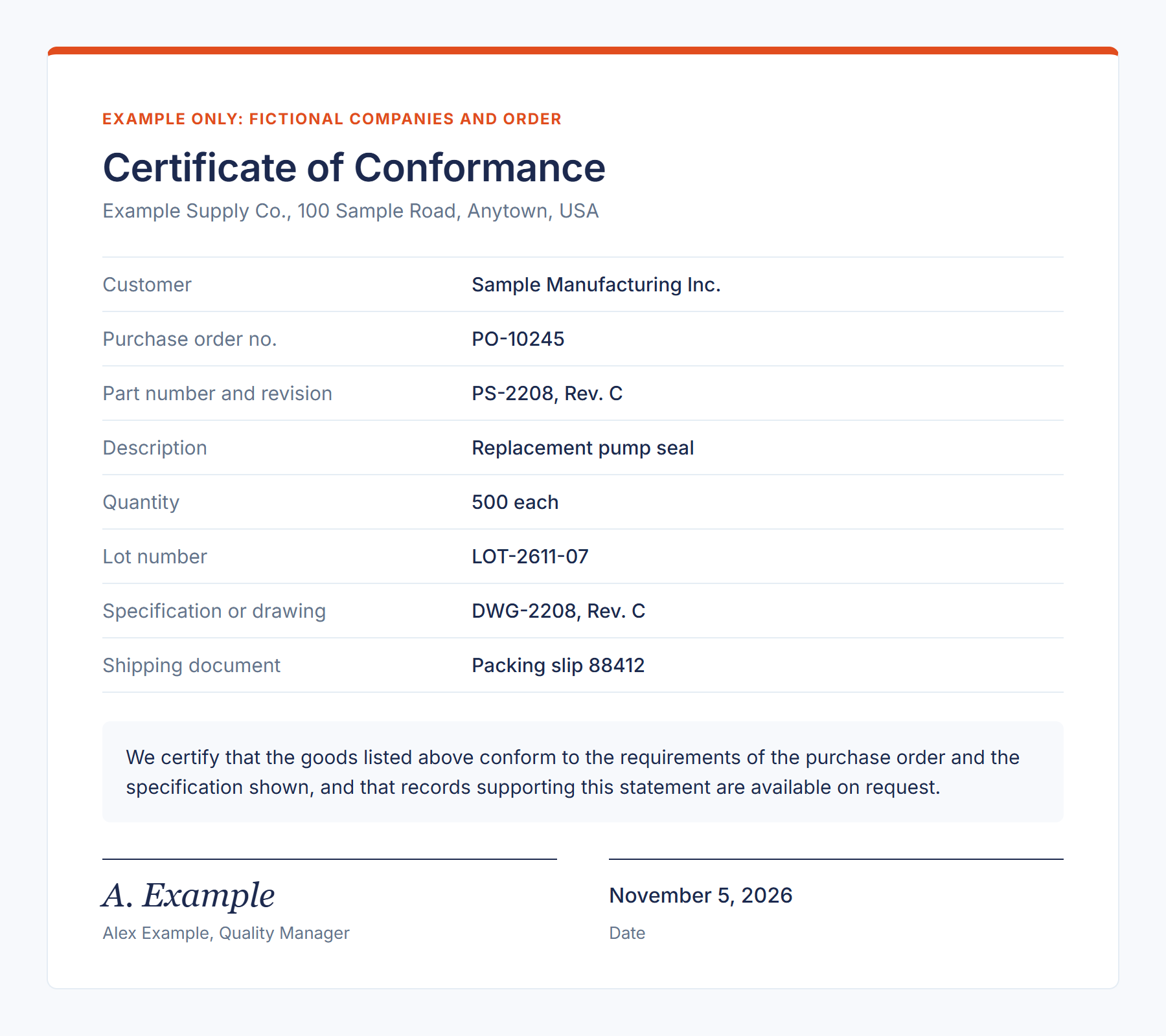
Here is what a completed certificate can look like. The companies and order details are fictional.
Certificate of conformance vs certificate of compliance vs certificate of analysis
These documents get mixed up because their names are similar and their use is not standardized. As a working guide:
| Document | What it generally says | Contains test data? |
|---|---|---|
| Certificate of conformance | The goods meet the order, contract or specification. | Usually not |
| Certificate of compliance | Often means the product meets a regulation or standard, though many companies use the term interchangeably with conformance. | Sometimes |
| Certificate of analysis | Reports measured test results for a specific lot or batch. | Yes |
Regulated products can have their own rules. For example, the U.S. Consumer Product Safety Commission requires manufacturers and importers of many general-use consumer products to issue a General Certificate of Conformity with seven specific elements, based on testing or a reasonable testing program. A generic supplier CoC does not automatically satisfy a rule like that.
Certificates of conformance on federal contracts
The Federal Acquisition Regulation (FAR) has its own version. Under FAR 46.504, a contracting officer may use a certificate of conformance in certain cases instead of source inspection. It has to be in the government’s interest, and either a defect would mean only small losses or the contractor’s reputation or past performance makes acceptable work likely.
The clause itself, FAR 52.246-15, adds some practical points:
- The contractor ships with a certificate only when the Contract Administration Office has authorized it in writing.
- The clause prescribes the wording of the certificate, including identifying the items by part number and quantity.
- A signed copy goes with the inspection or receiving report that accompanies the shipment.
- The government keeps its right to inspect, and it can reject defective supplies within a reasonable time after delivery. The contractor then corrects or replaces them at its own expense.
The FAR is being rewritten, and agencies can add their own requirements, so always work from the clause in your actual contract. If you are new to this kind of work, our guide to the government contract bidding process covers the wider picture.
Who signs a certificate of conformance?
Someone authorized by the supplier, who can stand behind the statement. That is often a quality manager, but the right person depends on the company and the contract. A reseller or distributor should be careful here: it can pass along the manufacturer’s certificate, but it should only certify what it can support itself.
Take the signature seriously. A CoC is a formal statement that the buyer relies on, and a false one can bring real consequences. On federal work, knowingly making a false statement on a matter within the government’s jurisdiction can be a crime under 18 U.S.C. 1001.
Does a certificate of conformance need to be notarized?
Usually not. The signature block in FAR 52.246-15 asks for a date, a signature and a title, with no notary. Many commercial purchase orders simply ask for a signed certificate too.
A buyer can still require notarization in its purchase order or quality terms, so check your order. Notarization tells the buyer who signed the document. It does not prove that the goods conform. If you are asked for one, confirm what the buyer needs and whether it will accept an electronic notarization. If it will, online notarization for businesses lets your signer complete it by video instead of finding a notary in person, which helps when a shipment is waiting on the paperwork.
How buyers can get more from a CoC
A certificate is only useful if someone asks for the right one and reads it when it arrives.
- Ask early. State the document, the wording and any traceability you need in the RFQ and on the purchase order, not after the goods ship.
- Match it to the delivery. Compare the part number, revision, quantity and lot numbers with the order and the packing slip.
- Match the inspection to the risk. For critical items, use a CoC alongside inspection or test data, not in place of them.
- Keep it findable. File each certificate with the purchase order so you can produce it during an audit or a quality problem.
- Build it into onboarding. Make your document requirements part of your vendor onboarding checklist and your supplier selection criteria.
Buying parts that need paperwork?
Chasing certificates across several suppliers takes time. With Hubzone Depot’s Spotbuy, you send us a part number, a photo or a rough description. We search more than 2,500 suppliers and return one clear quote for you to approve. If your order needs a certificate of conformance, say so in your request. Hubzone Depot is an SBA-certified HUBZone and Women-Owned Small Business (WOSB), and public-sector buyers can learn more about our government procurement solutions.
Frequently asked questions
What does CoC mean on a shipment?
CoC usually stands for certificate of conformance, though some companies use it for certificate of compliance or certificate of conformity. It is the supplier’s signed statement that the shipped goods meet the stated requirements. If the term is unclear on your order, ask the buyer which document it wants.
How do I get a certificate of conformance?
Ask the supplier or manufacturer for one, ideally in your RFQ and purchase order. Tell them the requirement it should reference and any wording or traceability you need. If you are the supplier, you issue it yourself on your own letterhead, using the buyer’s form if there is one.
Who is responsible for a certificate of conformance?
The company that issues it is responsible for the statement, through the person authorized to sign. The buyer is still responsible for asking for the right document and checking that it matches the delivery.
Is a certificate of conformance the same as a certification?
Not usually. A CoC is a supplier’s own statement about a specific shipment. A certification such as a management system or product certification generally comes from an outside body and covers more than one delivery. Read the document to see who is making the claim.
Is a certificate of conformance required by law?
It depends on the product and the contract. Many CoCs are required by the purchase order or contract rather than a statute, but some regulated products have certificate rules of their own. Check your contract and the rules for your product.